Pearson Edexcel · A-Level · History
Course version: 9HI0 · Version from Sept 2015
Attitudes towards women, 1918–89; the role and status of women, 1918–1932;…
Full specification wording
Aspects of life in Germany and West Germany, 1918–89: Attitudes towards women, 1918–89; the role and status of women, 1918–1932; the impact of the Kinder, Küche, Kirche policies and the Second World War on women’s lives, 1933–45; the role and status of women in the FRG.
This topic examines changing attitudes towards women and their role and status in Germany from 1918 to 1989.
Checked against the Pearson Edexcel 9HI0 specification (opens in a new tab) on .
- Point 1 of 3
- 4 key terms
Study notes
From the checked teaching notes for this specification point.
The idea
This topic examines changing attitudes towards women and their role and status in Germany from 1918 to 1989. In the Weimar Republic (1918–1932), women gained suffrage and increased employment, though traditional attitudes persisted. Under the Nazis (1933–45), the Kinder, Küche, Kirche (children, kitchen, church) ideology promoted domesticity, but the Second World War forced many women into work, creating tension between ideology and reality. In the FRG (1949–89), women's roles evolved with the Basic Law's equality clause, rising employment, and feminist movements, yet traditional expectations and unequal pay remained.
What earns the marks
- Explains changing attitudes towards women across the period, including shifts in public opinion and government policy.
- Analyses the role and status of women in the Weimar Republic, noting advances such as suffrage and education.
- Assesses the impact of Nazi Kinder, Küche, Kirche policies and the Second World War on women's lives, including contradictions.
- Evaluates the role and status of women in the FRG, considering legal equality, employment patterns and social attitudes.
- Compares and contrasts the experiences of women in different periods to identify continuity and change.
Common mistakes and how to put them right
Assuming Nazi policies were uniformly enforced.
Put it right: Recognise regional and wartime variations, with women increasingly in work.
Overstating women's liberation in the FRG.
Put it right: Acknowledge persistent gender pay gaps and traditional expectations.
Ignoring the impact of the Second World War on women's employment.
Put it right: Note that wartime labour demands challenged Nazi domestic ideals.
Exam tips
- Use specific examples, such as the 1919 suffrage or the 1957 Equal Rights Act, to illustrate points.
- Consider both ideological aims and practical realities when discussing women's lives.
- Compare different periods to show how attitudes and status changed over time.
Try the lesson
The start of the Aspects of life in Germany and West Germany, 1918–89: Attitudes towards women, 1918–89; the role and status of women, 1918–1932; the impact of the Kinder, Küche, Kirche policies and the Second World War on women’s lives, 1933–45; the role and status of women in the FRG. lesson, made from checked teaching notes for this specification point.
Have a go first
What did the Nazi slogan ‘Kinder, Küche, Kirche’ expect women to focus on?
Listen
This topic examines changing attitudes towards women and their role and status in Germany from 1918 to 1989. In the Weimar Republic (1918–1932), women gained suffrage and increased employment, though traditional attitudes persisted. Under the Nazis (1933–45), the Kinder, Küche, Kirche (children, kitchen, church) ideology promoted domesticity, but the Second World War forced many women into work, creating tension between ideology and reality. In the FRG (1949–89), women's roles evolved with the Basic Law's equality clause, rising employment, and feminist movements, yet traditional expectations and unequal pay remained. A strong answer earns marks for these points. Explains changing attitudes towards women across the period, including shifts in public opinion and government policy. Analyses the role and status of women in the Weimar Republic, noting advances such as suffrage and education. Assesses the impact of Nazi Kinder, Küche, Kirche policies and the Second World War on women's lives, including contradictions. Evaluates the role and status of women in the FRG, considering legal equality, employment patterns and social attitudes. A common slip: assuming Nazi policies were uniformly enforced. Instead, recognise regional and wartime variations, with women increasingly in work. Exam tip: Use specific examples, such as the 1919 suffrage or the 1957 Equal Rights Act, to illustrate points.
See it
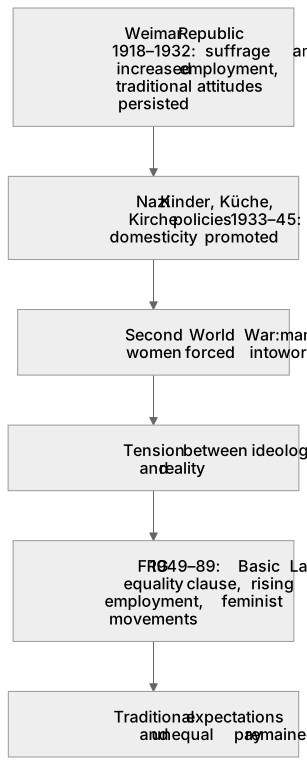
Put it in order
Put these steps in the order they happen.
- 1. Second World War: many women forced into work
- 2. Nazi Kinder, Küche, Kirche policies 1933–45: domesticity promoted
- 3. Weimar Republic 1918–1932: suffrage and increased employment, traditional attitudes persisted
- 4. Traditional expectations and unequal pay remained
- 5. FRG 1949–89: Basic Law equality clause, rising employment, feminist movements
- 6. Tension between ideology and reality
Key words
Say what each word means before you turn the card.
Changing attitudes towards women
Try answering aloud or in your head before turning the card.
Women's role and status in Weimar Germany
Try answering aloud or in your head before turning the card.
Nazi policies and the Second World War
Try answering aloud or in your head before turning the card.
Women in the FRG
Try answering aloud or in your head before turning the card.
See every definition
- Changing attitudes towards women
- Shifts in public opinion and government policy towards women across the period from 1918 to 1989.
- Women's role and status in Weimar Germany
- Women gained suffrage and increased employment in 1918–1932, though traditional attitudes persisted.
- Nazi policies and the Second World War
- Kinder, Küche, Kirche ideology promoted domesticity, but wartime labour demands forced many women into work, creating tension between ideology and reality.
- Women in the FRG
- Roles evolved with the Basic Law's equality clause, rising employment and feminist movements, yet traditional expectations and unequal pay remained.
Label the diagram
Some boxes have lost their names. Pick the right name for each number.
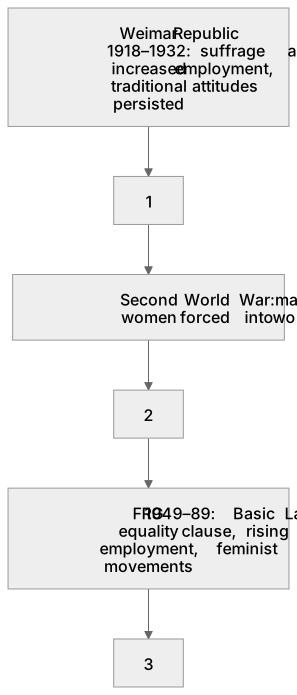
1Box 1
2Box 2
3Box 3
There is more to this lesson
The full lesson goes on to check your understanding and help you earn the marks. Create a free account to carry on, with your progress saved.
A week of Premium from your first lesson · Then the free plan continues · No card, no charge
Test your understanding of Aspects of life in Germany and West Germany, 1918–89: Attitudes towards women, 1918–89; the role and status of women, 1918–1932; the impact of the Kinder, Küche, Kirche policies and the Second World War on women’s lives, 1933–45; the role and status of women in the FRG.
Active recall beats re-reading. Take an instant quiz now to test what you’ve learned and lock it into long-term memory.
A week of Premium from your first lesson · Then the free plan continues · No card, no charge