Pearson Edexcel · A-Level · History
Course version: 9HI0 · Version from Sept 2015
Gandhi and civil disobedience, 1920–22: Gandhi’s aims and beliefs; his…
Full specification wording
Changing political relationships, 1920–30: Gandhi and civil disobedience, 1920–22: Gandhi’s aims and beliefs; his becoming leader of Congress 1920; the non- cooperation campaign; significance of his imprisonment.
Gandhi’s aims and beliefs fused swaraj, Hindu-Muslim unity, and satyagraha (truth-force) with non-violence and self-reliance.
Checked against the Pearson Edexcel 9HI0 specification (opens in a new tab) on .
- Point 1 of 4
- 4 key terms
Study notes
From the checked teaching notes for this specification point.
The idea
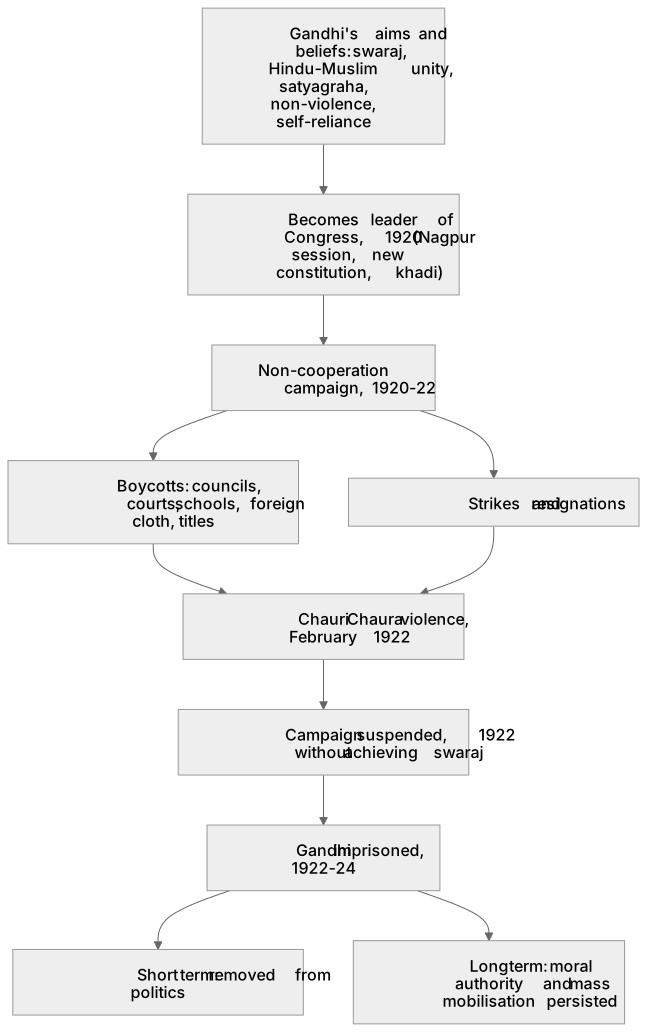
Gandhi’s aims and beliefs fused swaraj, Hindu-Muslim unity, and satyagraha (truth-force) with non-violence and self-reliance. In 1920 he became Congress leader, reshaping it into a mass movement with a new constitution and khadi. The non-cooperation campaign (1920–22) involved boycotts of councils, courts, schools, and foreign cloth, with strikes and resignations. It ended after Chauri Chaura violence in February 1922. Gandhi’s imprisonment (1922–24) removed him from politics, but his moral authority and mass mobilisation persisted, influencing later campaigns.
What earns the marks
- Explains Gandhi’s aims: swaraj, Hindu-Muslim unity, non-violence, self-reliance, and satyagraha.
- Describes how Gandhi became leader of Congress in 1920, including the Nagpur session and constitutional changes.
- Outlines the methods of non-cooperation: boycotts of councils, courts, schools, foreign cloth, and titles.
- Assesses the significance of Gandhi’s imprisonment: short-term withdrawal, long-term inspiration, and impact on Congress leadership.
Common mistakes and how to put them right
Stating that Gandhi became Congress leader in 1919.
Put it right: He became leader in 1920 at the Nagpur session.
Claiming the non-cooperation campaign achieved immediate swaraj.
Put it right: It was suspended in 1922 without achieving swaraj.
Saying Gandhi’s imprisonment ended his influence.
Put it right: It enhanced his moral stature and he remained a key figure.
Exam tips
- Use specific examples like the Nagpur session, Chauri Chaura, and the suspension of the campaign.
- Link Gandhi’s beliefs to his actions to show understanding of causation.
- Evaluate the significance of imprisonment by considering both short-term and long-term effects.
Try the lesson
The start of the Changing political relationships, 1920–30: Gandhi and civil disobedience, 1920–22: Gandhi’s aims and beliefs; his becoming leader of Congress 1920; the non- cooperation campaign; significance of his imprisonment. lesson, made from checked teaching notes for this specification point.
Have a go first
What was the central premise of Gandhi's non-cooperation campaign launched in 1920?
Listen
Gandhi’s aims and beliefs fused swaraj, Hindu-Muslim unity, and satyagraha (truth-force) with non-violence and self-reliance. In 1920 he became Congress leader, reshaping it into a mass movement with a new constitution and khadi. The non-cooperation campaign (1920–22) involved boycotts of councils, courts, schools, and foreign cloth, with strikes and resignations. It ended after Chauri Chaura violence in February 1922. Gandhi’s imprisonment (1922–24) removed him from politics, but his moral authority and mass mobilisation persisted, influencing later campaigns. A strong answer earns marks for these points. Explains Gandhi’s aims: swaraj, Hindu-Muslim unity, non-violence, self-reliance, and satyagraha. Describes how Gandhi became leader of Congress in 1920, including the Nagpur session and constitutional changes. Outlines the methods of non-cooperation: boycotts of councils, courts, schools, foreign cloth, and titles. Assesses the significance of Gandhi’s imprisonment: short-term withdrawal, long-term inspiration, and impact on Congress leadership. A common slip: stating that Gandhi became Congress leader in 1919. Instead, he became leader in 1920 at the Nagpur session. Exam tip: Use specific examples like the Nagpur session, Chauri Chaura, and the suspension of the campaign.
See it
Key words
Say what each word means before you turn the card.
Leadership and ideology
Try answering aloud or in your head before turning the card.
Mass mobilisation and protest
Try answering aloud or in your head before turning the card.
Repression and resistance
Try answering aloud or in your head before turning the card.
Continuity and change in nationalism
Try answering aloud or in your head before turning the card.
See every definition
- Leadership and ideology
- Gandhi became leader of Congress in 1920, and his aims and beliefs fused swaraj, Hindu-Muslim unity and satyagraha with non-violence and self-reliance.
- Mass mobilisation and protest
- Gandhi reshaped Congress into a mass movement, and the non-cooperation campaign involved boycotts of councils, courts, schools and foreign cloth, with strikes and resignations.
- Repression and resistance
- The campaign ended after Chauri Chaura violence in February 1922, and Gandhi's imprisonment from 1922 to 1924 removed him from politics.
- Continuity and change in nationalism
- Although imprisonment removed him from politics, his moral authority and mass mobilisation persisted and influenced later campaigns.
Label the diagram
Some boxes have lost their names. Pick the right name for each number.
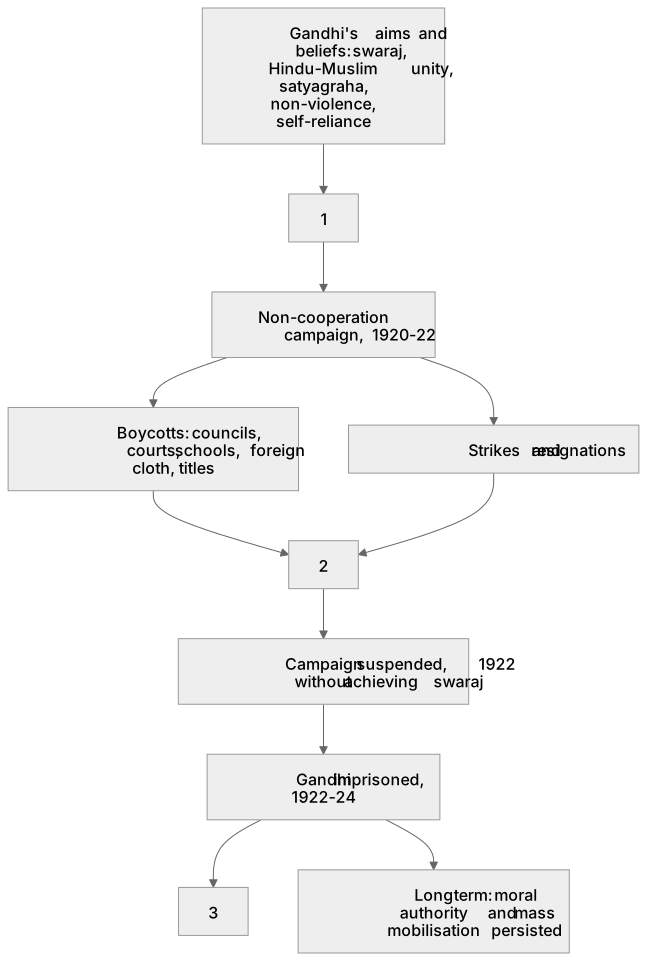
1Box 1
2Box 2
3Box 3
There is more to this lesson
The full lesson goes on to check your understanding and help you earn the marks. Create a free account to carry on, with your progress saved.
A week of Premium from your first lesson · Then the free plan continues · No card, no charge
Test your understanding of Changing political relationships, 1920–30: Gandhi and civil disobedience, 1920–22: Gandhi’s aims and beliefs; his becoming leader of Congress 1920; the non- cooperation campaign; significance of his imprisonment.
Active recall beats re-reading. Take an instant quiz now to test what you’ve learned and lock it into long-term memory.
A week of Premium from your first lesson · Then the free plan continues · No card, no charge