Pearson Edexcel · A-Level · History
Course version: 9HI0 · Version from Sept 2015
The Muslim League: the Khilafat movement; re-emergence of Muslim values;…
Full specification wording
Changing political relationships, 1920–30: The Muslim League: the Khilafat movement; re-emergence of Muslim values; the concept of separateness; breakdown of relations with Congress; Jinnah’s beliefs and aims; the significance of failed attempts to reunite with Congress.
The Khilafat movement (1919–24) saw Muslims and Congress campaign together to defend the Ottoman Caliph, but its collapse after Turkish abolition of the Caliphate left many Muslims feeling…
Checked against the Pearson Edexcel 9HI0 specification (opens in a new tab) on .
- Point 3 of 4
- 4 key terms
Study notes
From the checked teaching notes for this specification point.
The idea
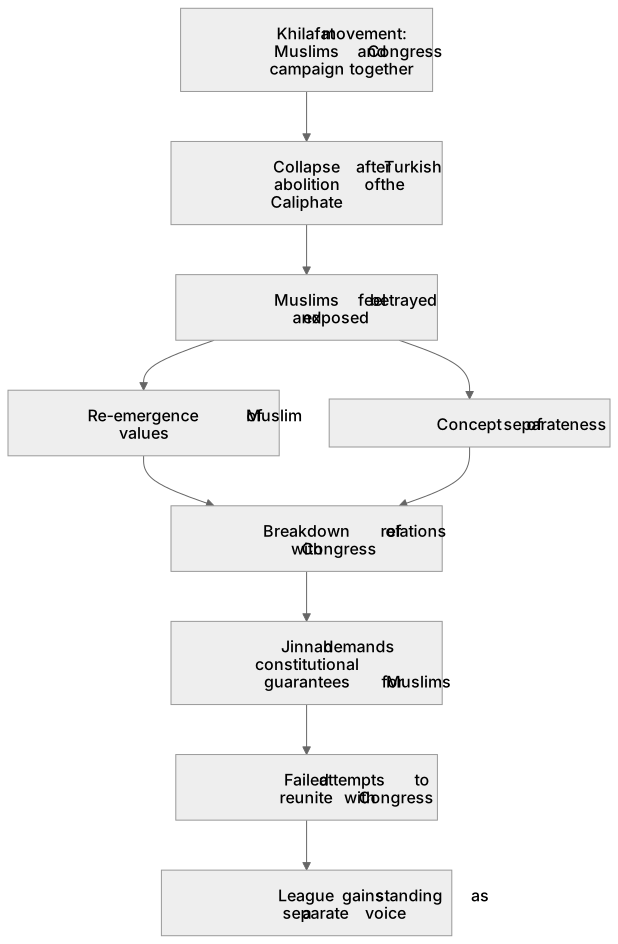
The Khilafat movement (1919–24) saw Muslims and Congress campaign together to defend the Ottoman Caliph, but its collapse after Turkish abolition of the Caliphate left many Muslims feeling betrayed and exposed. Muslim values re-emerged through defence of Urdu, Islamic education and personal law, while the concept of separateness held that Muslims formed a distinct community needing its own safeguards. Relations with Congress broke down over Nehru Report proposals and the 1928–29 split, and Jinnah, once a Congress ally, now demanded constitutional guarantees for Muslims. His aim was parity, not partition. Failed reunification attempts, such as the 1928 All Parties Convention, showed that shared anti-colonial protest could not settle communal representation, so the League gained standing as a separate voice.
What earns the marks
- Explains the Khilafat movement’s origins, methods and collapse, and links that collapse to Muslim disillusion with joint action.
- Analyses how re-emergence of Muslim values and the concept of separateness shaped Muslim political identity in the 1920s.
- Traces the breakdown of relations with Congress through the Nehru Report, Jinnah’s Fourteen Points and the failure of the All Parties Convention.
- Assesses Jinnah’s beliefs and aims, including constitutional safeguards and Muslim parity, and weighs the significance of failed reunification attempts.
Common mistakes and how to put them right
Treating the Khilafat movement as purely religious.
Put it right by explaining its political anti-British purpose and its alliance with the Non-Cooperation movement.
Assuming Jinnah always sought Pakistan.
Put it right by showing that in the 1920s he pursued safeguards within a united India.
Describing the breakdown with Congress as sudden.
Put it right by tracing it through the Nehru Report, Jinnah’s Fourteen Points and failed conventions.
Exam tips
- Link each factor to the changing relationship between the League and Congress rather than narrating events in isolation.
- Use precise dates and terms such as Khilafat, Fourteen Points and All Parties Convention to anchor analysis.
- Reach a judgement on which factor most weakened unity, supporting it with evidence from the period.
Try the lesson
The start of the Changing political relationships, 1920–30: The Muslim League: the Khilafat movement; re-emergence of Muslim values; the concept of separateness; breakdown of relations with Congress; Jinnah’s beliefs and aims; the significance of failed attempts to reunite with Congress. lesson, made from checked teaching notes for this specification point.
Have a go first
Which movement did the Muslim League support alongside Congress in 1919–22 in defence of the Ottoman Caliph?
Listen
The Khilafat movement (1919–24) saw Muslims and Congress campaign together to defend the Ottoman Caliph, but its collapse after Turkish abolition of the Caliphate left many Muslims feeling betrayed and exposed. Muslim values re-emerged through defence of Urdu, Islamic education and personal law, while the concept of separateness held that Muslims formed a distinct community needing its own safeguards. Relations with Congress broke down over Nehru Report proposals and the 1928–29 split, and Jinnah, once a Congress ally, now demanded constitutional guarantees for Muslims. His aim was parity, not partition. Failed reunification attempts, such as the 1928 All Parties Convention, showed that shared anti-colonial protest could not settle communal representation, so the League gained standing as a separate voice. A strong answer earns marks for these points. Explains the Khilafat movement’s origins, methods and collapse, and links that collapse to Muslim disillusion with joint action. Analyses how re-emergence of Muslim values and the concept of separateness shaped Muslim political identity in the 1920s. Traces the breakdown of relations with Congress through the Nehru Report, Jinnah’s Fourteen Points and the failure of the All Parties Convention. Assesses Jinnah’s beliefs and aims, including constitutional safeguards and Muslim parity, and weighs the significance of failed reunification attempts. A common slip: Treating the Khilafat movement as purely religious. Instead, explaining its political anti-British purpose and its alliance with the Non-Cooperation movement. Exam tip: Link each factor to the changing relationship between the League and Congress rather than narrating events in isolation.
See it
Key words
Say what each word means before you turn the card.
Khilafat movement
Try answering aloud or in your head before turning the card.
Concept of separateness
Try answering aloud or in your head before turning the card.
Jinnah’s aims
Try answering aloud or in your head before turning the card.
Failed reunification attempts
Try answering aloud or in your head before turning the card.
See every definition
- Khilafat movement
- A campaign in which Muslims and Congress worked together to defend the Ottoman Caliph, collapsing after Turkish abolition of the Caliphate.
- Concept of separateness
- The idea that Muslims formed a distinct community needing its own safeguards.
- Jinnah’s aims
- Constitutional guarantees for Muslims, seeking parity rather than partition.
- Failed reunification attempts
- Efforts such as the 1928 All Parties Convention, which showed shared anti-colonial protest could not settle communal representation.
Label the diagram
Some boxes have lost their names. Pick the right name for each number.
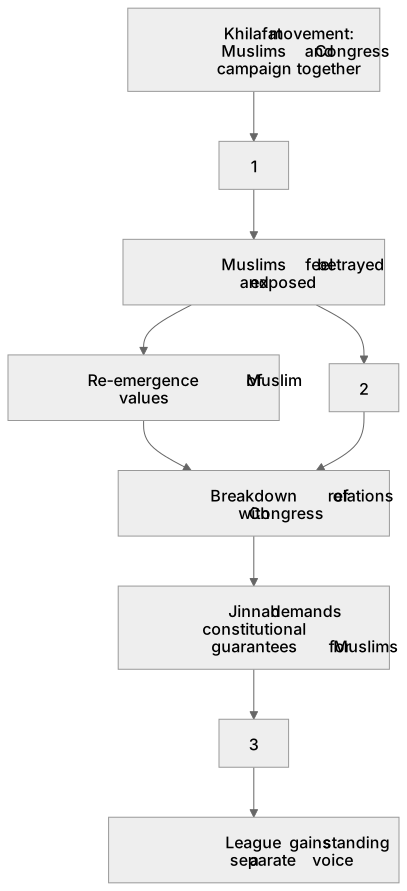
1Box 1
2Box 2
3Box 3
There is more to this lesson
The full lesson goes on to check your understanding and help you earn the marks. Create a free account to carry on, with your progress saved.
A week of Premium from your first lesson · Then the free plan continues · No card, no charge
Test your understanding of Changing political relationships, 1920–30: The Muslim League: the Khilafat movement; re-emergence of Muslim values; the concept of separateness; breakdown of relations with Congress; Jinnah’s beliefs and aims; the significance of failed attempts to reunite with Congress.
Active recall beats re-reading. Take an instant quiz now to test what you’ve learned and lock it into long-term memory.
A week of Premium from your first lesson · Then the free plan continues · No card, no charge