Pearson Edexcel · A-Level · History
Course version: 9HI0 · Version from Sept 2015
The secret police: attacks on opponents of the government; the roles of…
Full specification wording
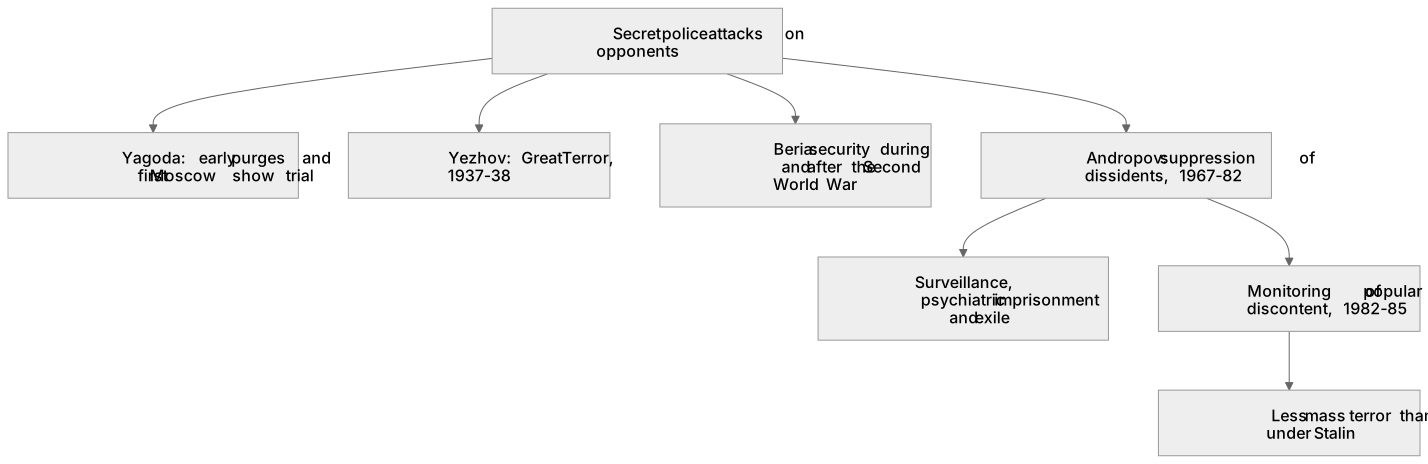
Control of the people, 1917–85: The secret police: attacks on opponents of the government; the roles of Yagoda, Yezhov and Beria; Andropov’s suppression of dissidents, 1967–82; the continued monitoring of popular discontent, 1982–85.
This topic examines the secret police as an instrument of control, focusing on attacks on opponents, key leaders, Andropov’s suppression of dissidents, and continued monitoring after 1982.
Checked against the Pearson Edexcel 9HI0 specification (opens in a new tab) on .
- Point 2 of 3
- 4 key terms
Study notes
From the checked teaching notes for this specification point.
The idea
This topic examines the secret police as an instrument of control, focusing on attacks on opponents, key leaders, Andropov’s suppression of dissidents, and continued monitoring after 1982. The secret police, known by names such as OGPU, NKVD and KGB, arrested, imprisoned and executed perceived enemies. Yagoda oversaw the early purges and the first Moscow show trial; Yezhov directed the Great Terror of 1937–38; Beria controlled the security apparatus during and after the Second World War. Andropov, KGB chairman from 1967 to 1982, targeted dissidents through surveillance, psychiatric imprisonment and exile. After Andropov became General Secretary, and continuing under Chernenko until 1985, the KGB monitored popular discontent, though with less mass terror than under Stalin.
What earns the marks
- Explains that the secret police attacked opponents through arrest, execution, labour camps and show trials, aiming to eliminate dissent.
- Describes Yagoda’s role in the early 1930s, including supervision of the NKVD and involvement in the first show trial.
- Analyses Yezhov’s direction of the Great Terror, with mass arrests and executions of Party members, military officers and ordinary citizens.
- Assesses Beria’s role in managing security during and after the war, including deportations and control of the Soviet atomic project.
- Evaluates Andropov’s suppression of dissidents from 1967 to 1982, using surveillance, psychiatric hospitals and exile, and the continued monitoring of discontent from 1982 to 1985.
Common mistakes and how to put them right
Confusing the roles of Yagoda, Yezhov and Beria.
Put it right: Associate Yagoda with the early purges, Yezhov with the Great Terror, and Beria with wartime and post-war security.
Assuming Andropov ended repression.
Put it right: Recognise that he intensified targeting of dissidents through less visible methods such as surveillance and psychiatric detention.
Believing that monitoring stopped after 1982.
Put it right: Note that the KGB continued to monitor popular discontent until 1985, even if mass terror declined.
Exam tips
- Use precise dates and names, such as the 1936–38 show trials or Andropov’s KGB chairmanship from 1967, to show detailed knowledge.
- When discussing change over time, contrast Stalin-era mass terror with later selective repression under Andropov.
- Link secret police actions to the broader theme of control, explaining how they suppressed opposition and enforced conformity.
Try the lesson
The start of the Control of the people, 1917–85: The secret police: attacks on opponents of the government; the roles of Yagoda, Yezhov and Beria; Andropov’s suppression of dissidents, 1967–82; the continued monitoring of popular discontent, 1982–85. lesson, made from checked teaching notes for this specification point.
Have a go first
Which secret police chief was appointed to head the NKVD in September 1936 and oversaw the most intense phase of the Great Terror?
Listen
This topic examines the secret police as an instrument of control, focusing on attacks on opponents, key leaders, Andropov’s suppression of dissidents, and continued monitoring after 1982. The secret police, known by names such as OGPU, NKVD and KGB, arrested, imprisoned and executed perceived enemies. Yagoda oversaw the early purges and the first Moscow show trial; Yezhov directed the Great Terror of 1937–38; Beria controlled the security apparatus during and after the Second World War. Andropov, KGB chairman from 1967 to 1982, targeted dissidents through surveillance, psychiatric imprisonment and exile. After Andropov became General Secretary, and continuing under Chernenko until 1985, the KGB monitored popular discontent, though with less mass terror than under Stalin. A strong answer earns marks for these points. Explains that the secret police attacked opponents through arrest, execution, labour camps and show trials, aiming to eliminate dissent. Describes Yagoda’s role in the early 1930s, including supervision of the NKVD and involvement in the first show trial. Analyses Yezhov’s direction of the Great Terror, with mass arrests and executions of Party members, military officers and ordinary citizens. Assesses Beria’s role in managing security during and after the war, including deportations and control of the Soviet atomic project. A common slip: Confusing the roles of Yagoda, Yezhov and Beria. Instead, associate Yagoda with the early purges, Yezhov with the Great Terror, and Beria with wartime and post-war security. Exam tip: Use precise dates and names, such as the 1936–38 show trials or Andropov’s KGB chairmanship from 1967, to show detailed knowledge.
See it
Put the events in order
Put these events in the order they happened, earliest first.
- 1. Yezhov directed the Great Terror
- 2. KGB continued monitoring popular discontent after Andropov became General Secretary
- 3. Andropov became KGB chairman and targeted dissidents
Key words
Say what each word means before you turn the card.
Repression and terror
Try answering aloud or in your head before turning the card.
Surveillance and monitoring
Try answering aloud or in your head before turning the card.
Leadership of the secret police
Try answering aloud or in your head before turning the card.
Continuity and change in control methods
Try answering aloud or in your head before turning the card.
See every definition
- Repression and terror
- Attacks on opponents of the government through arrest, imprisonment and execution, with mass terror under Stalin and less mass terror later.
- Surveillance and monitoring
- Watching over dissidents and popular discontent, used by Andropov and continued by the KGB until 1985.
- Leadership of the secret police
- The roles of Yagoda in the early purges, Yezhov in the Great Terror and Beria in wartime and post-war security.
- Continuity and change in control methods
- Assessing how methods and scale of secret police control persisted or altered, contrasting Stalin-era mass terror with later selective repression.
Label the diagram
Some boxes have lost their names. Pick the right name for each number.
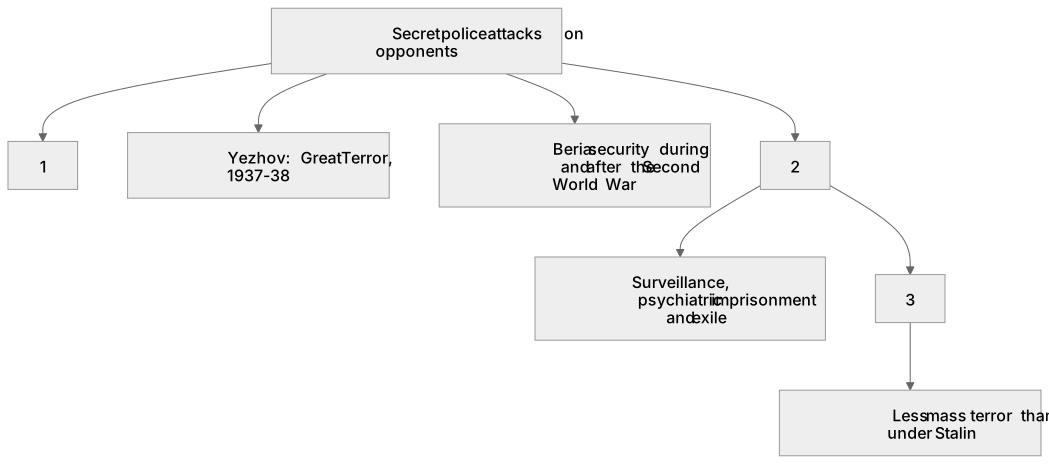
1Box 1
2Box 2
3Box 3
There is more to this lesson
The full lesson goes on to check your understanding and help you earn the marks. Create a free account to carry on, with your progress saved.
A week of Premium from your first lesson · Then the free plan continues · No card, no charge
Test your understanding of Control of the people, 1917–85: The secret police: attacks on opponents of the government; the roles of Yagoda, Yezhov and Beria; Andropov’s suppression of dissidents, 1967–82; the continued monitoring of popular discontent, 1982–85.
Active recall beats re-reading. Take an instant quiz now to test what you’ve learned and lock it into long-term memory.
A week of Premium from your first lesson · Then the free plan continues · No card, no charge