Pearson Edexcel · A-Level · History
Course version: 9HI0 · Version from Sept 2015
Providing social welfare: the extent, and nature of, social welfare…
Full specification wording
Creating a welfare state, 1918–79: Providing social welfare: the extent, and nature of, social welfare provision, 1918–39; the impact of the Second World War, the Labour government and consensus, 1939–64; the reasons for increasing challenges to state welfare provision, 1964–79.
This topic examines how far the state provided welfare and how that changed.
Checked against the Pearson Edexcel 9HI0 specification (opens in a new tab) on .
- Point 1 of 3
- 3 key terms
Study notes
From the checked teaching notes for this specification point.
The idea
This topic examines how far the state provided welfare and how that changed. For 1918–39, assess the extent and nature of provision: limited national insurance and pensions, the Poor Law legacy, means testing and voluntary or charitable help. For 1939–64, explain the impact of the Second World War — evacuation, rationing and the Beveridge Report — then the Labour government's reforms, including the NHS and expanded insurance, and the post-war consensus that followed. For 1964–79, analyse why state welfare faced growing challenges: rising costs, economic downturn, criticisms of universalism and dependency, and debates over funding and reform.
What earns the marks
- Assesses the extent and nature of social welfare provision 1918–39, including insurance, pensions, means testing and voluntary provision.
- Explains the impact of the Second World War on attitudes to welfare, including evacuation, rationing and the Beveridge Report.
- Analyses the Labour government's welfare reforms and the emergence of a post-war consensus, 1939–64.
- Explains reasons for increasing challenges to state welfare provision 1964–79, such as cost, economic decline and political criticism.
- Reaches a supported judgement on how far provision changed and why challenges grew.
- Uses accurate evidence, such as legislation, reports and statistics, to support each point.
Common mistakes and how to put them right
Treating 1918–39 as no welfare at all.
Put it right: Recognise existing insurance, pensions and local provision while noting their limits.
Crediting the Second World War with creating the NHS directly.
Put it right: Explain how war shaped attitudes and the Beveridge Report, with reform following under Labour.
Assuming consensus meant no disagreement.
Put it right: Show continuing debate over scope, cost and universality.
Exam tips
- Structure answers around the three periods in the statement to cover every clause.
- Use named reports, acts and figures as evidence rather than vague references to reform.
- For challenge questions, distinguish economic, political and social reasons and weigh them.
Try the lesson
The start of the Creating a welfare state, 1918–79: Providing social welfare: the extent, and nature of, social welfare provision, 1918–39; the impact of the Second World War, the Labour government and consensus, 1939–64; the reasons for increasing challenges to state welfare provision, 1964–79. lesson, made from checked teaching notes for this specification point.
Have a go first
Which interwar legislation significantly extended the contributory scheme providing unemployment benefit to a wider range of insured workers?
Listen
This topic examines how far the state provided welfare and how that changed. For 1918–39, assess the extent and nature of provision: limited national insurance and pensions, the Poor Law legacy, means testing and voluntary or charitable help. For 1939–64, explain the impact of the Second World War — evacuation, rationing and the Beveridge Report — then the Labour government's reforms, including the NHS and expanded insurance, and the post-war consensus that followed. For 1964–79, analyse why state welfare faced growing challenges: rising costs, economic downturn, criticisms of universalism and dependency, and debates over funding and reform. A strong answer earns marks for these points. Assesses the extent and nature of social welfare provision 1918–39, including insurance, pensions, means testing and voluntary provision. Explains the impact of the Second World War on attitudes to welfare, including evacuation, rationing and the Beveridge Report. Analyses the Labour government's welfare reforms and the emergence of a post-war consensus, 1939–64. Explains reasons for increasing challenges to state welfare provision 1964–79, such as cost, economic decline and political criticism. A common slip: Treating 1918–39 as no welfare at all. Instead, recognise existing insurance, pensions and local provision while noting their limits. Exam tip: Structure answers around the three periods in the statement to cover every clause.
See it
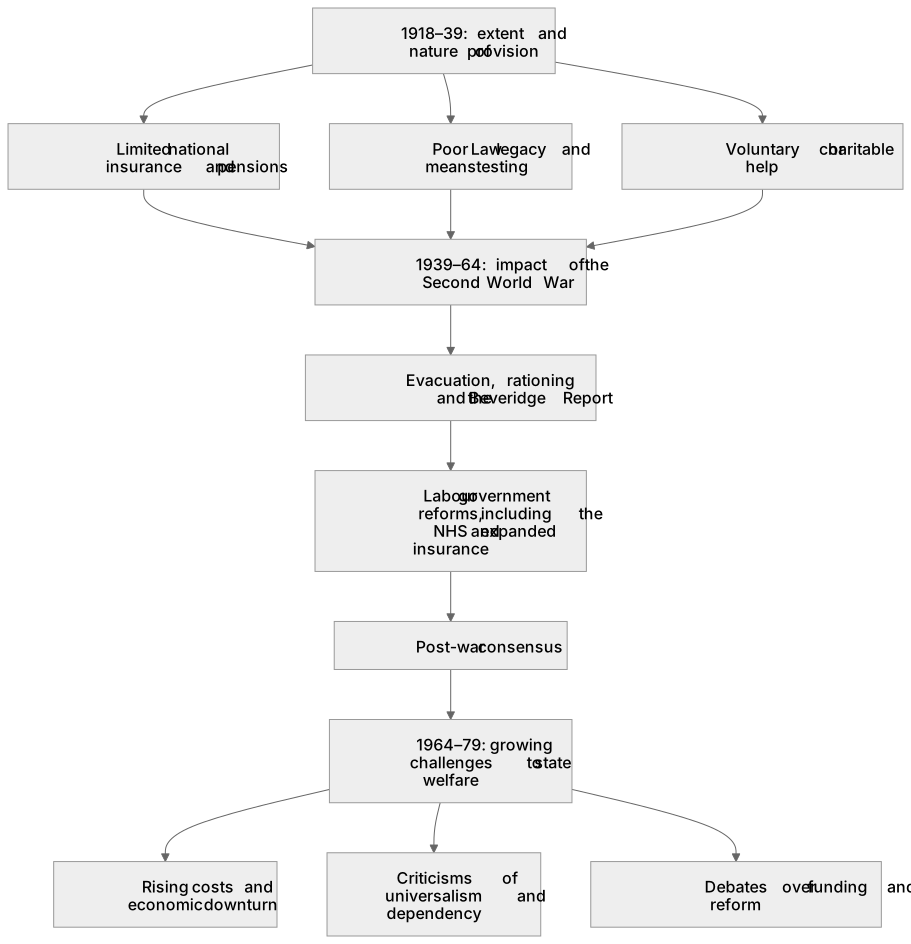
Key words
Say what each word means before you turn the card.
War as a catalyst for social reform
Try answering aloud or in your head before turning the card.
Consensus and its limits in post-war Britain
Try answering aloud or in your head before turning the card.
Economic pressure and the politics of welfare
Try answering aloud or in your head before turning the card.
See every definition
- War as a catalyst for social reform
- The way the Second World War shaped attitudes to welfare, through evacuation, rationing and the Beveridge Report, with reform following under Labour.
- Consensus and its limits in post-war Britain
- The post-war agreement that followed the Labour government's reforms, which still involved continuing debate over scope, cost and universality.
- Economic pressure and the politics of welfare
- The rising costs, economic downturn and political criticism, including of universalism and dependency, that brought growing challenges to state welfare provision.
Label the diagram
Some boxes have lost their names. Pick the right name for each number.
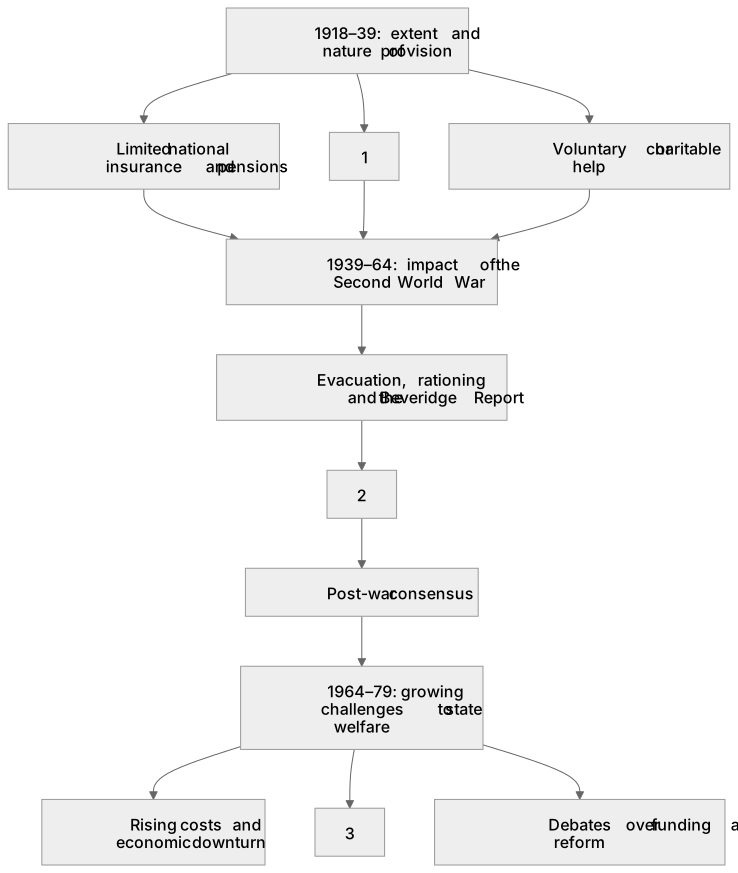
1Box 1
2Box 2
3Box 3
There is more to this lesson
The full lesson goes on to check your understanding and help you earn the marks. Create a free account to carry on, with your progress saved.
A week of Premium from your first lesson · Then the free plan continues · No card, no charge
Test your understanding of Creating a welfare state, 1918–79: Providing social welfare: the extent, and nature of, social welfare provision, 1918–39; the impact of the Second World War, the Labour government and consensus, 1939–64; the reasons for increasing challenges to state welfare provision, 1964–79.
Active recall beats re-reading. Take an instant quiz now to test what you’ve learned and lock it into long-term memory.
A week of Premium from your first lesson · Then the free plan continues · No card, no charge