Pearson Edexcel · A-Level · History
Course version: 9HI0 · Version from Sept 2015
Spain, 1930–31: impact of political events, 1930–31 and the creation of…
Full specification wording
Creation and destabilisation of the Second Republic, 1930–36: Spain, 1930–31: impact of political events, 1930–31 and the creation of the Second Republic; forces of conservatism, including landowners, church, army; political unrest; economic and social problems.
The collapse of Primo de Rivera's regime in January 1930 left a monarchy isolated.
Checked against the Pearson Edexcel 9HI0 specification (opens in a new tab) on .
- Point 1 of 4
- 4 key terms
Study notes
From the checked teaching notes for this specification point.
The idea
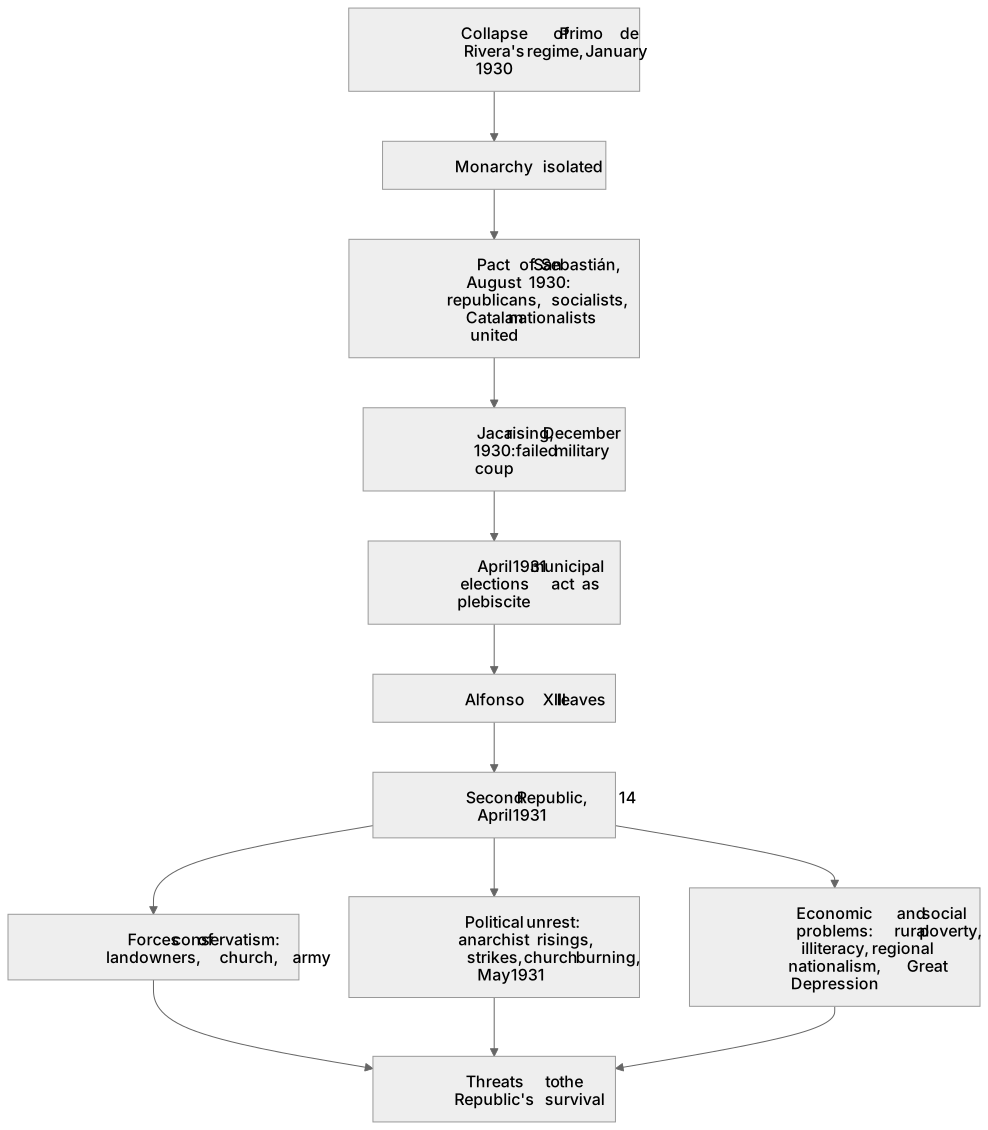
The collapse of Primo de Rivera's regime in January 1930 left a monarchy isolated. The Pact of San Sebastián (August 1930) united republicans, socialists and Catalan nationalists; the December 1930 Jaca rising failed, but April 1931 municipal elections became a plebiscite and Alfonso XIII left, producing the Second Republic on 14 April. Its survival was threatened by conservative forces: landowners held latifundios in the south and resisted land reform; the Catholic Church controlled education and was hostile to secularisation; the army, over-officered and monarchist, resented reform. Unrest included anarchist risings, strikes and church burning in May 1931. Economic and social problems — rural poverty, illiteracy, regional nationalism and the Great Depression — deepened instability.
What earns the marks
- Explains how the Pact of San Sebastián (August 1930) allied republicans, socialists and Catalan nationalists against the monarchy.
- Analyses the December 1930 Jaca rising as a failed military coup that nevertheless discredited the monarchy.
- Assesses the April 1931 municipal elections as a decisive political event leading to Alfonso XIII's departure and the Second Republic.
- Explains the power of landowners, including latifundios and control of rural labour, as a force of conservatism.
- Analyses the Catholic Church's influence over education and its opposition to secular reform.
- Assesses the army's over-officered, monarchist character and its resistance to reform.
- Explains political unrest such as anarchist risings, strikes and church burning in May 1931.
- Analyses economic and social problems: rural poverty, illiteracy, regional nationalism and the Great Depression.
Common mistakes and how to put them right
Treating the April 1931 elections as a general election rather than municipal elections that acted as a plebiscite.
Put it right by specifying their municipal character and plebiscitary effect.
Assuming the Second Republic was created by a violent revolution.
Put it right by explaining the peaceful departure of Alfonso XIII after republican electoral success.
Describing the church, army and landowners as a single undifferentiated bloc.
Put it right by distinguishing their separate interests and methods of resistance.
Exam tips
- Link each political event to the creation of the Second Republic, showing cause and consequence rather than listing dates.
- Use precise terms such as latifundios, caciquismo and plebiscite to demonstrate secure knowledge.
- When discussing conservative forces, explain how each group could obstruct reform, not merely that it existed.
Try the lesson
The start of the Creation and destabilisation of the Second Republic, 1930–36: Spain, 1930–31: impact of political events, 1930–31 and the creation of the Second Republic; forces of conservatism, including landowners, church, army; political unrest; economic and social problems. lesson, made from checked teaching notes for this specification point.
Have a go first
Which king left Spain in April 1931 as the Second Republic was proclaimed?
Listen
The collapse of Primo de Rivera's regime in January 1930 left a monarchy isolated. The Pact of San Sebastián (August 1930) united republicans, socialists and Catalan nationalists; the December 1930 Jaca rising failed, but April 1931 municipal elections became a plebiscite and Alfonso XIII left, producing the Second Republic on 14 April. Its survival was threatened by conservative forces: landowners held latifundios in the south and resisted land reform; the Catholic Church controlled education and was hostile to secularisation; the army, over-officered and monarchist, resented reform. Unrest included anarchist risings, strikes and church burning in May 1931. Economic and social problems — rural poverty, illiteracy, regional nationalism and the Great Depression — deepened instability. A strong answer earns marks for these points. Explains how the Pact of San Sebastián (August 1930) allied republicans, socialists and Catalan nationalists against the monarchy. Analyses the December 1930 Jaca rising as a failed military coup that nevertheless discredited the monarchy. Assesses the April 1931 municipal elections as a decisive political event leading to Alfonso XIII's departure and the Second Republic. Explains the power of landowners, including latifundios and control of rural labour, as a force of conservatism. A common slip: Treating the April 1931 elections as a general election rather than municipal elections that acted as a plebiscite. Instead, specifying their municipal character and plebiscitary effect. Exam tip: Link each political event to the creation of the Second Republic, showing cause and consequence rather than listing dates.
See it
Key words
Say what each word means before you turn the card.
Pact of San Sebastián
Try answering aloud or in your head before turning the card.
Second Republic
Try answering aloud or in your head before turning the card.
Latifundios
Try answering aloud or in your head before turning the card.
Great Depression
Try answering aloud or in your head before turning the card.
See every definition
- Pact of San Sebastián
- Agreement of August 1930 that united republicans, socialists and Catalan nationalists against the monarchy.
- Second Republic
- Regime produced on 14 April 1931 after Alfonso XIII left following the April 1931 municipal elections.
- Latifundios
- Large estates held by landowners in the south, who resisted land reform.
- Great Depression
- Economic and social problem that, alongside rural poverty, illiteracy and regional nationalism, deepened instability.
Label the diagram
Some boxes have lost their names. Pick the right name for each number.
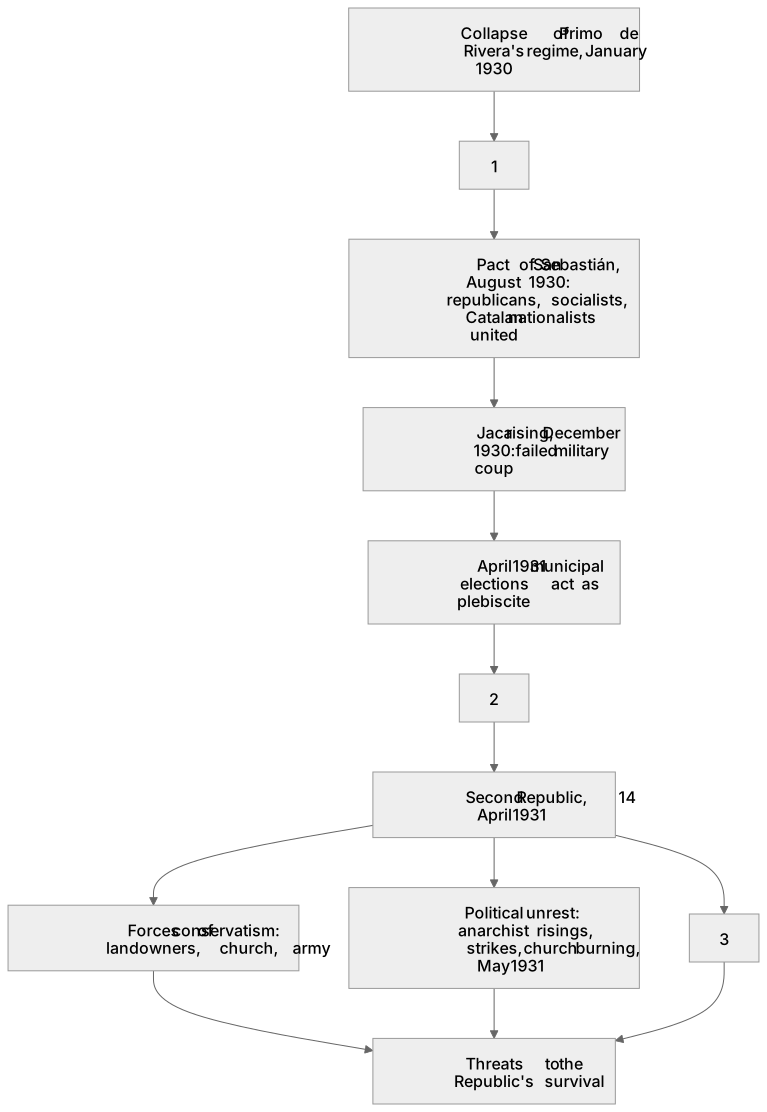
1Box 1
2Box 2
3Box 3
There is more to this lesson
The full lesson goes on to check your understanding and help you earn the marks. Create a free account to carry on, with your progress saved.
A week of Premium from your first lesson · Then the free plan continues · No card, no charge
Test your understanding of Creation and destabilisation of the Second Republic, 1930–36: Spain, 1930–31: impact of political events, 1930–31 and the creation of the Second Republic; forces of conservatism, including landowners, church, army; political unrest; economic and social problems.
Active recall beats re-reading. Take an instant quiz now to test what you’ve learned and lock it into long-term memory.
A week of Premium from your first lesson · Then the free plan continues · No card, no charge