Pearson Edexcel · A-Level · History
Course version: 9HI0 · Version from Sept 2015
Transition to democracy: the role of Juan Carlos; immediate steps towards…
Full specification wording
Dictatorship remodelled and the transition to democracy, 1956–78: Transition to democracy: the role of Juan Carlos; immediate steps towards democracy; conservative obstacles; agreeing a democratic constitution in 1978.
After Franco's death in 1975, Juan Carlos became king and used his constitutional powers to steer Spain towards democracy.
Checked against the Pearson Edexcel 9HI0 specification (opens in a new tab) on .
- Point 4 of 4
- 4 key terms
Study notes
From the checked teaching notes for this specification point.
The idea
After Franco's death in 1975, Juan Carlos became king and used his constitutional powers to steer Spain towards democracy. He appointed Adolfo Suárez as prime minister in 1976, who pushed the Political Reform Act through the Francoist Cortes in 1976, paving the way for free elections in 1977. Conservative obstacles included the Francoist Cortes, the military, and the far-right, who resisted change. The 1977 elections produced a parliament that drafted a new constitution, approved by referendum in 1978, establishing a constitutional monarchy with civil liberties and regional autonomy. Juan Carlos's role was crucial in legitimising the process and restraining the army.
What earns the marks
- Explains Juan Carlos's role in appointing reformist leaders such as Adolfo Suárez and using his authority to support democratic change while maintaining stability.
- Identifies immediate steps: the Political Reform Act of 1976, legalisation of political parties, and the June 1977 general election.
- Analyses conservative obstacles: the Francoist Cortes had to approve reform, the military opposed legalising the Communist Party, and far-right violence threatened the process.
- Assesses the negotiation and agreement of the 1978 Constitution, including consensus between political parties on monarchy, civil liberties, and regional autonomy.
- Evaluates the significance of the 1978 referendum in legitimising the transition and establishing a democratic framework.
Common mistakes and how to put them right
Saying Juan Carlos imposed democracy by decree.
Put it right: He worked within existing laws and with appointed reformers, and the 1976 Political Reform Act was passed by the Francoist Cortes.
Claiming there was no conservative opposition.
Put it right: The military, Falangists, and parts of the Cortes resisted, and the 1978 Constitution was a compromise.
Confusing the 1977 elections with the 1978 referendum.
Put it right: The 1977 elections chose a parliament that then drafted the constitution, which was approved by referendum in 1978.
Stating the constitution was agreed without debate.
Put it right: It involved lengthy negotiations among parties, including the Communist Party, to balance monarchy, rights, and regional powers.
Exam tips
- When discussing Juan Carlos, focus on his actions as king: appointing Suárez, supporting the Political Reform Act, and defending the process against military pressure.
- For immediate steps, use precise dates and measures: the 1976 Political Reform Act, the 1977 election, and the 1978 Constitution.
- When analysing obstacles, distinguish between institutional resistance (Cortes, military) and extra-parliamentary violence, and explain how each was overcome.
- For the 1978 Constitution, explain the key compromises: constitutional monarchy, devolution, and a bill of rights, and why consensus was necessary.
Try the lesson
The start of the Dictatorship remodelled and the transition to democracy, 1956–78: Transition to democracy: the role of Juan Carlos; immediate steps towards democracy; conservative obstacles; agreeing a democratic constitution in 1978. lesson, made from checked teaching notes for this specification point.
Have a go first
After Franco's death in November 1975, which figure became King of Spain and played the central role in the transition to democracy?
Listen
After Franco's death in 1975, Juan Carlos became king and used his constitutional powers to steer Spain towards democracy. He appointed Adolfo Suárez as prime minister in 1976, who pushed the Political Reform Act through the Francoist Cortes in 1976, paving the way for free elections in 1977. Conservative obstacles included the Francoist Cortes, the military, and the far-right, who resisted change. The 1977 elections produced a parliament that drafted a new constitution, approved by referendum in 1978, establishing a constitutional monarchy with civil liberties and regional autonomy. Juan Carlos's role was crucial in legitimising the process and restraining the army. A strong answer earns marks for these points. Explains Juan Carlos's role in appointing reformist leaders such as Adolfo Suárez and using his authority to support democratic change while maintaining stability. Identifies immediate steps: the Political Reform Act of 1976, legalisation of political parties, and the June 1977 general election. Analyses conservative obstacles: the Francoist Cortes had to approve reform, the military opposed legalising the Communist Party, and far-right violence threatened the process. Assesses the negotiation and agreement of the 1978 Constitution, including consensus between political parties on monarchy, civil liberties, and regional autonomy. A common slip: saying Juan Carlos imposed democracy by decree. Instead, he worked within existing laws and with appointed reformers, and the 1976 Political Reform Act was passed by the Francoist Cortes. Exam tip: When discussing Juan Carlos, focus on his actions as king: appointing Suárez, supporting the Political Reform Act, and defending the process against military pressure.
See it
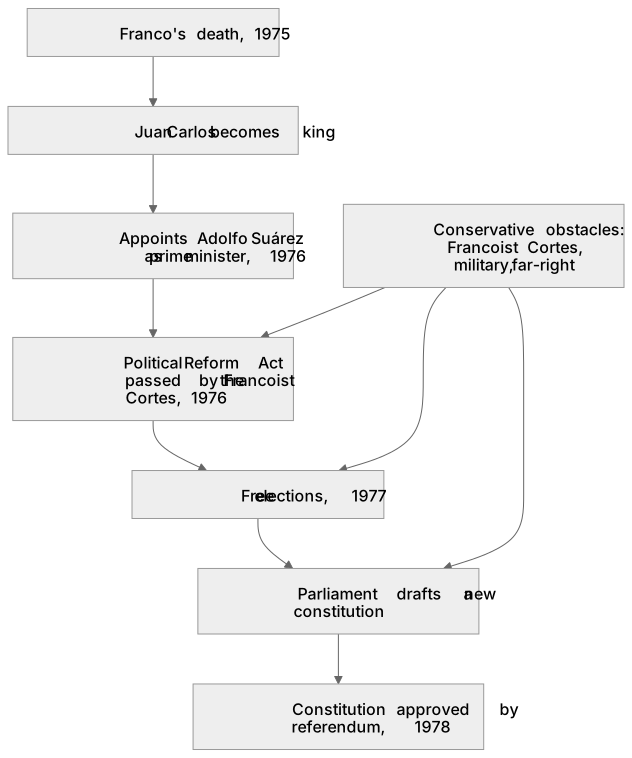
Put the events in order
Put these events in the order they happened, earliest first.
- 1. New constitution approved by referendum
- 2. Juan Carlos became king after Franco's death
- 3. Free general election produced a parliament that drafted a new constitution
- 4. Adolfo Suárez appointed prime minister and pushed through the Political Reform Act
Key words
Say what each word means before you turn the card.
Democratic transition and consolidation
Try answering aloud or in your head before turning the card.
The monarchy as an agent of change
Try answering aloud or in your head before turning the card.
Negotiation and compromise in constitution-making
Try answering aloud or in your head before turning the card.
Resistance from authoritarian institutions
Try answering aloud or in your head before turning the card.
See every definition
- Democratic transition and consolidation
- The process by which Spain moved towards democracy after Franco's death in 1975, steered by Juan Carlos using his constitutional powers.
- The monarchy as an agent of change
- Juan Carlos's role in legitimising the process and restraining the army, and in appointing reformist leaders such as Adolfo Suárez.
- Negotiation and compromise in constitution-making
- Lengthy negotiations among parties, including the Communist Party, to balance monarchy, rights and regional powers in the 1978 Constitution.
- Resistance from authoritarian institutions
- Conservative obstacles including the Francoist Cortes, which had to approve reform, the military, and the far-right, who resisted change.
Label the diagram
Some boxes have lost their names. Pick the right name for each number.
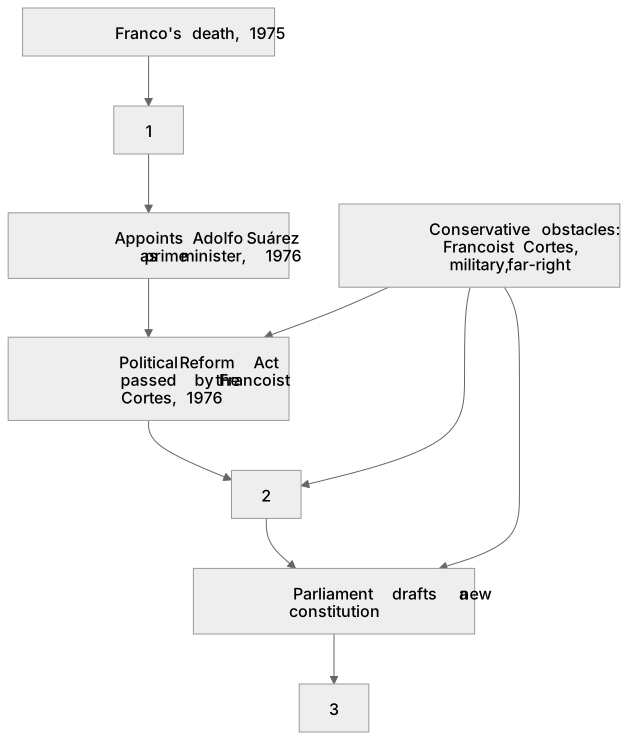
1Box 1
2Box 2
3Box 3
There is more to this lesson
The full lesson goes on to check your understanding and help you earn the marks. Create a free account to carry on, with your progress saved.
A week of Premium from your first lesson · Then the free plan continues · No card, no charge
Test your understanding of Dictatorship remodelled and the transition to democracy, 1956–78: Transition to democracy: the role of Juan Carlos; immediate steps towards democracy; conservative obstacles; agreeing a democratic constitution in 1978.
Active recall beats re-reading. Take an instant quiz now to test what you’ve learned and lock it into long-term memory.
A week of Premium from your first lesson · Then the free plan continues · No card, no charge