Pearson Edexcel · A-Level · History
Course version: 9HI0 · Version from Sept 2015
Agriculture: changes in agricultural techniques; the development of…
Full specification wording
Economy, trade and empire, 1625–88: Agriculture: changes in agricultural techniques; the development of specialised farming and the growth of employment; capital investment in agriculture; the development of national markets.
Seventeenth-century English agriculture underwent a revolution that transformed the economy.
Checked against the Pearson Edexcel 9HI0 specification (opens in a new tab) on .
- Point 1 of 3
- 4 key terms
Study notes
From the checked teaching notes for this specification point.
The idea
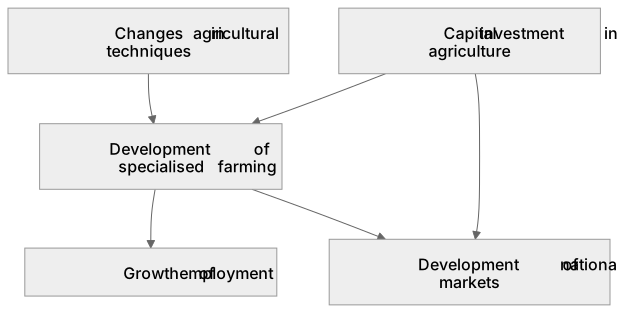
Seventeenth-century English agriculture underwent a revolution that transformed the economy. Changes in agricultural techniques, such as crop rotation, water meadows, and the introduction of new crops like clover and turnips, dramatically increased yields. This facilitated the development of specialised farming, where regions focused on specific pastoral or arable produce, subsequently driving the growth of rural employment. Wealthy landowners provided crucial capital investment in agriculture, funding enclosure and infrastructure improvements. These advancements, combined with improved transport links, enabled the development of national markets, replacing localised trading and feeding the rapidly expanding population of London.
What earns the marks
- Identify specific changes in agricultural techniques, such as the use of nitrogen-fixing crops (clover) and cleaning/fodder crops (turnips), alongside the creation of water meadows.
- Explain how regional geography dictated the development of specialised farming, separating pastoral and arable dominance.
- Analyse the relationship between agricultural innovation, the enclosure movement, and the resulting growth of wage-dependent rural employment.
- Evaluate the role of the gentry and aristocracy in providing capital investment for large-scale agricultural improvements.
- Assess how improved infrastructure and the demands of London stimulated the transition from local economies to integrated national markets.
Common mistakes and how to put them right
Claiming that agricultural changes benefited all rural workers equally.
Put it right: Note that while employment grew, enclosure often displaced poorer peasants and created a class of landless labourers.
Ignoring the role of London in economic development.
Put it right: Explicitly link the development of national markets to the insatiable demand for food from London's booming population.
Confusing subsistence farming with specialised farming.
Put it right: Define specialised farming as producing specific goods for market sale rather than growing a variety of crops for personal survival.
Exam tips
- Use specific examples of techniques, like the floating of water meadows, to demonstrate precise knowledge of agricultural changes.
- Link capital investment directly to the enclosure movement to show how financial resources drove physical changes to the landscape.
- Discuss the development of national markets as a key turning point in England's transition to a modern capitalist economy.
Try the lesson
The start of the Economy, trade and empire, 1625–88: Agriculture: changes in agricultural techniques; the development of specialised farming and the growth of employment; capital investment in agriculture; the development of national markets. lesson, made from checked teaching notes for this specification point.
Have a go first
Which agricultural development in the period 1625–88 allowed farmers to maintain soil fertility without needing to leave land fallow?
Listen
Seventeenth-century English agriculture underwent a revolution that transformed the economy. Changes in agricultural techniques, such as crop rotation, water meadows, and the introduction of new crops like clover and turnips, dramatically increased yields. This facilitated the development of specialised farming, where regions focused on specific pastoral or arable produce, subsequently driving the growth of rural employment. Wealthy landowners provided crucial capital investment in agriculture, funding enclosure and infrastructure improvements. These advancements, combined with improved transport links, enabled the development of national markets, replacing localised trading and feeding the rapidly expanding population of London. A strong answer earns marks for these points. Identify specific changes in agricultural techniques, such as the use of nitrogen-fixing crops (clover) and cleaning/fodder crops (turnips), alongside the creation of water meadows. Explain how regional geography dictated the development of specialised farming, separating pastoral and arable dominance. Analyse the relationship between agricultural innovation, the enclosure movement, and the resulting growth of wage-dependent rural employment. Evaluate the role of the gentry and aristocracy in providing capital investment for large-scale agricultural improvements. A common slip: Claiming that agricultural changes benefited all rural workers equally. Instead, note that while employment grew, enclosure often displaced poorer peasants and created a class of landless labourers. Exam tip: Use specific examples of techniques, like the floating of water meadows, to demonstrate precise knowledge of agricultural changes.
See it
Watch it explained
What is the one idea the video explains? Say it in a sentence.
Read the described scene instead
Seventeenth-century English agriculture changed the economy. New techniques, specialised farming and capital investment linked rural production to growing markets. This lesson traces those connections without assuming that every rural worker gained equally. The source identifies specific changes in agricultural techniques. Crop rotation, water meadows, clover and turnips increased yields. Clover is a nitrogen-fixing crop; turnips served as cleaning and fodder crops. These were not merely new plants: they altered how land could be used and how livestock could be fed. Regional geography helped dictate specialised farming. Some areas became predominantly pastoral; others specialised in arable produce. Because specialised farming produced for market sale rather than personal survival, it supported growth in rural employment. But that employment was often wage-dependent, and enclosure could displace poorer peasants, creating landless labourers. Consider how capital investment could change the landscape. A wealthy landowner, often from the gentry or aristocracy, supplied funds. Those funds could finance enclosure and infrastructure improvements. Pause to trace the link: investment finances physical change; enclosure supports large-scale improvement; improved agriculture can supply wider markets. Capital investment is therefore directly connected to the enclosure movement, not separate from it. Three corrections matter. First, agricultural changes did not benefit all rural workers equally: employment grew, but enclosure often displaced poorer peasants and created landless labourers. Second, do not ignore London: its booming population created demand that helped national markets develop. Third, distinguish subsistence farming from specialised farming. Specialised farming produced specific goods for market sale, not a variety of crops for personal survival. The lesson's chain runs from technique to market. Crop rotation, water meadows, clover and turnips raised yields. Specialised farming and rural employment grew, while enclosure created landless labourers. Gentry and aristocracy supplied capital for enclosure and infrastructure. Improved transport and London's demand helped replace localised trading with integrated national markets. That transition is central to England's move toward a modern capitalist economy.
Key words
Say what each word means before you turn the card.
Specialised farming
Try answering aloud or in your head before turning the card.
Capital investment in agriculture
Try answering aloud or in your head before turning the card.
National markets
Try answering aloud or in your head before turning the card.
Enclosure
Try answering aloud or in your head before turning the card.
See every definition
- Specialised farming
- Regions focused on specific pastoral or arable produce rather than growing a variety of crops for personal survival.
- Capital investment in agriculture
- Crucial funding provided by wealthy landowners for enclosure and infrastructure improvements.
- National markets
- Integrated trading that replaced localised trading, enabled by advancements combined with improved transport links and fed by the demand of London's expanding population.
- Enclosure
- A movement funded by capital investment that often displaced poorer peasants and created a class of landless labourers.
Label the diagram
Some boxes have lost their names. Pick the right name for each number.
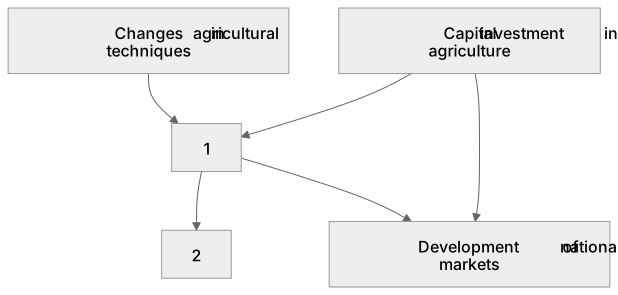
1Box 1
2Box 2
There is more to this lesson
The full lesson goes on to check your understanding and help you earn the marks. Create a free account to carry on, with your progress saved.
A week of Premium from your first lesson · Then the free plan continues · No card, no charge
Test your understanding of Economy, trade and empire, 1625–88: Agriculture: changes in agricultural techniques; the development of specialised farming and the growth of employment; capital investment in agriculture; the development of national markets.
Active recall beats re-reading. Take an instant quiz now to test what you’ve learned and lock it into long-term memory.
A week of Premium from your first lesson · Then the free plan continues · No card, no charge