Pearson Edexcel · A-Level · History
Course version: 9HI0 · Version from Sept 2015
China in 1949: the aftermath of the civil war of 1946–49; the state of…
Full specification wording
Establishing communist rule: China in 1949: the aftermath of the civil war of 1946–49; the state of China’s industry, agriculture and national infrastructure.
By 1949 the civil war between the GMD and CCP had devastated China.
Checked against the Pearson Edexcel 9HI0 specification (opens in a new tab) on .
- Point 1 of 4
- 4 key terms
Study notes
From the checked teaching notes for this specification point.
The idea
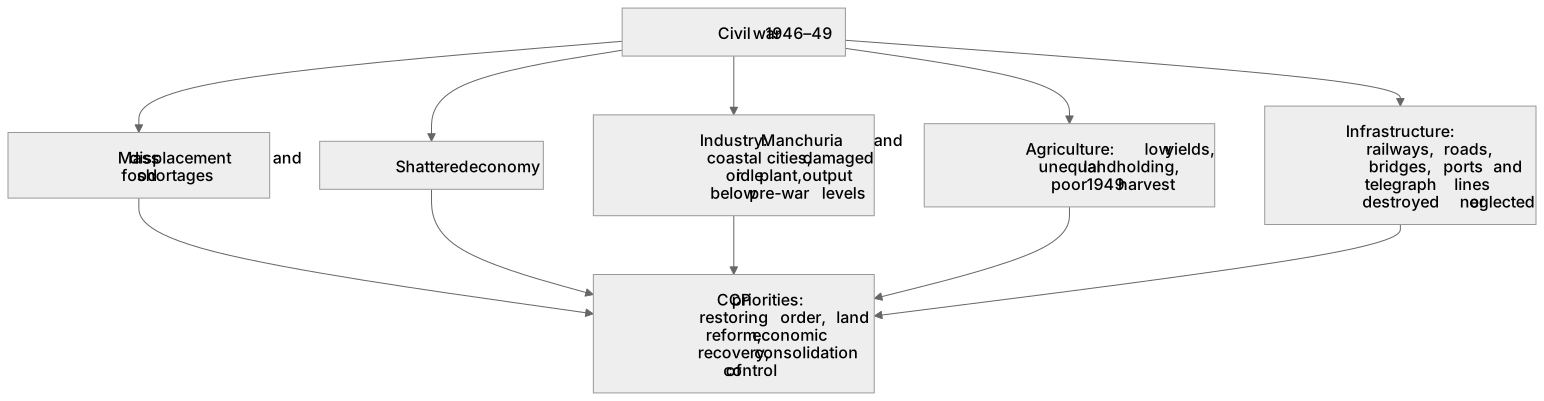
By 1949 the civil war between the GMD and CCP had devastated China. The CCP won because it retained rural support, while GMD morale, inflation and military losses mounted. The aftermath brought mass displacement, food shortages and a shattered economy. Industry was concentrated in Manchuria and coastal cities such as Shanghai; many plants were damaged or idle, and output had fallen far below pre-war levels. Agriculture remained the main employer, but yields were low, landholding was unequal and the 1949 harvest was poor. Infrastructure was severely disrupted: railways, roads, bridges, ports and telegraph lines had been destroyed or neglected. This legacy shaped the CCP’s priorities: restoring order, land reform, economic recovery and consolidation of control.
What earns the marks
- Explains the human and economic aftermath of 1946–49: casualties, refugees, food shortages and inflation.
- Describes the state of industry: concentration in Manchuria and coastal cities, damaged plant, low output and disrupted trade.
- Describes agriculture: low yields, unequal landownership, subsistence farming and a poor 1949 harvest.
- Describes infrastructure: damaged railways, roads, bridges, ports and communications.
- Links these conditions to the CCP’s early priorities, such as recovery, land reform and consolidation.
Common mistakes and how to put them right
Treating 1949 as a clean starting point.
Put it right by noting the cumulative wartime damage and dislocation.
Assuming industry was evenly spread.
Put it right by locating it in Manchuria and coastal cities.
Confusing the civil war with the anti-Japanese war.
Put it right by dating the civil war to 1946–49.
Exam tips
- Use specific sectors and regions to show precise knowledge.
- Connect conditions to CCP policies rather than listing facts.
- Keep a clear chronological frame from 1946 to 1949.
Try the lesson
The start of the Establishing communist rule: China in 1949: the aftermath of the civil war of 1946–49; the state of China’s industry, agriculture and national infrastructure. lesson, made from checked teaching notes for this specification point.
Have a go first
Which description best matches the state of China's industry in 1949, immediately after the civil war of 1946–49?
Listen
By 1949 the civil war between the GMD and CCP had devastated China. The CCP won because it retained rural support, while GMD morale, inflation and military losses mounted. The aftermath brought mass displacement, food shortages and a shattered economy. Industry was concentrated in Manchuria and coastal cities such as Shanghai; many plants were damaged or idle, and output had fallen far below pre-war levels. Agriculture remained the main employer, but yields were low, landholding was unequal and the 1949 harvest was poor. Infrastructure was severely disrupted: railways, roads, bridges, ports and telegraph lines had been destroyed or neglected. This legacy shaped the CCP’s priorities: restoring order, land reform, economic recovery and consolidation of control. A strong answer earns marks for these points. Explains the human and economic aftermath of 1946–49: casualties, refugees, food shortages and inflation. Describes the state of industry: concentration in Manchuria and coastal cities, damaged plant, low output and disrupted trade. Describes agriculture: low yields, unequal landownership, subsistence farming and a poor 1949 harvest. Describes infrastructure: damaged railways, roads, bridges, ports and communications. A common slip: Treating 1949 as a clean starting point. Instead, noting the cumulative wartime damage and dislocation. Exam tip: Use specific sectors and regions to show precise knowledge.
See it
Watch it explained
What is the one idea the video explains? Say it in a sentence.
Read the described scene instead
By 1949, the civil war between the Guomindang and the Chinese Communist Party had devastated China. The conflict ran from 1946 to 1949, so 1949 was not a clean starting point. Its aftermath included mass displacement, food shortages and a shattered economy. This lesson examines industry, agriculture and infrastructure, and links these conditions to the Communist Party’s early priorities. The war left connected problems. Human dislocation included casualties, refugees and food shortages. Inflation and military losses weakened the Guomindang, while the Communist Party retained rural support. The economy was shattered, with industry, farming and transport all affected. Together, these conditions shaped the Communist Party’s early priorities. Industry was not evenly spread. It was concentrated in Manchuria and coastal cities such as Shanghai. Many plants were damaged or idle, and output had fallen far below pre-war levels. Disrupted trade made recovery harder. So the Communist Party faced a damaged industrial base in specific regions. Agriculture remained the main employer, but yields were low. Landholding was unequal, and many peasants farmed for subsistence. The 1949 harvest was poor, worsening food shortages. These rural conditions help explain why land reform became a Communist priority after 1949. They also show that rural poverty was part of the legacy. Infrastructure was severely disrupted. Railways, roads, bridges, ports and telegraph lines had been destroyed or neglected. This damaged transport and communications, making economic recovery harder. Before I explain how these conditions shaped policy, pause briefly and think: which problems would the Communist Party need to tackle first? The source links recovery, land reform and consolidation of control to this legacy. The legacy shaped the Communist Party’s priorities: restoring order, land reform, economic recovery and consolidation of control. Two mistakes to avoid are treating 1949 as a clean starting point and assuming industry was evenly spread. Also keep the civil war separate from the anti-Japanese war: date it to 1946 to 1949. Use sectors and regions—industry in Manchuria and coastal cities, agriculture, infrastructure—to connect conditions to policy. In summary, the civil war of 1946 to 1949 left China with mass displacement, food shortages and a shattered economy. Industry was concentrated in Manchuria and coastal cities, often damaged or idle. Agriculture had low yields, unequal landholding and a poor 1949 harvest. Railways, roads, bridges, ports and communications were disrupted. These conditions framed the Communist Party’s early tasks of recovery, land reform and consolidation.
Key words
Say what each word means before you turn the card.
Civil war devastation
Try answering aloud or in your head before turning the card.
Economic weakness
Try answering aloud or in your head before turning the card.
Rural poverty
Try answering aloud or in your head before turning the card.
Infrastructure collapse
Try answering aloud or in your head before turning the card.
See every definition
- Civil war devastation
- The civil war between the GMD and CCP had devastated China by 1949, bringing mass displacement, food shortages and a shattered economy.
- Economic weakness
- Industry was concentrated in Manchuria and coastal cities such as Shanghai, many plants were damaged or idle, and output had fallen far below pre-war levels.
- Rural poverty
- Agriculture remained the main employer, but yields were low, landholding was unequal and the 1949 harvest was poor.
- Infrastructure collapse
- Railways, roads, bridges, ports and telegraph lines had been destroyed or neglected, leaving infrastructure severely disrupted.
Label the diagram
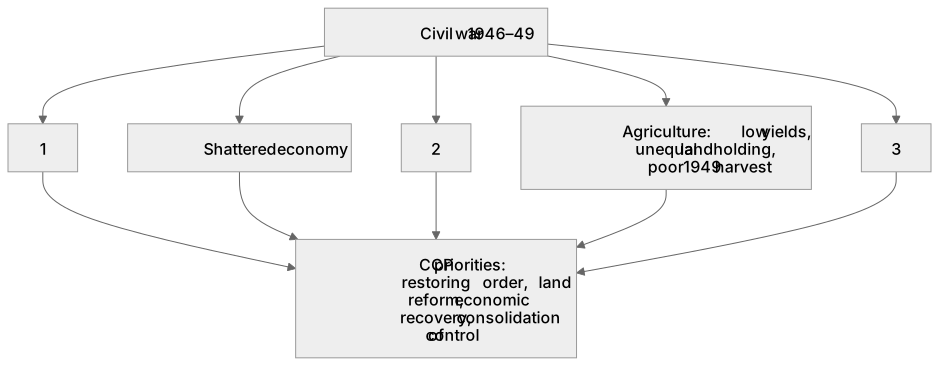
Some boxes have lost their names. Pick the right name for each number.
1Box 1
2Box 2
3Box 3
There is more to this lesson
The full lesson goes on to check your understanding and help you earn the marks. Create a free account to carry on, with your progress saved.
A week of Premium from your first lesson · Then the free plan continues · No card, no charge
Test your understanding of Establishing communist rule: China in 1949: the aftermath of the civil war of 1946–49; the state of China’s industry, agriculture and national infrastructure.
Active recall beats re-reading. Take an instant quiz now to test what you’ve learned and lock it into long-term memory.
A week of Premium from your first lesson · Then the free plan continues · No card, no charge