Pearson Edexcel · A-Level · History
Course version: 9HI0 · Version from Sept 2015
Economic development: economic problems and the impact of the civil war;…
Full specification wording
Establishing Franco’s dictatorship, 1938–56: Economic development: economic problems and the impact of the civil war; the development of corporatism; the implementation of autarky; successes and failures.
After 1939, Spain faced ruin: war had destroyed infrastructure, killed workers and disrupted agriculture, while the 1940s drought and Allied blockade worsened shortages.
Checked against the Pearson Edexcel 9HI0 specification (opens in a new tab) on .
- Point 3 of 4
- 4 key terms
Study notes
From the checked teaching notes for this specification point.
The idea
After 1939, Spain faced ruin: war had destroyed infrastructure, killed workers and disrupted agriculture, while the 1940s drought and Allied blockade worsened shortages. Franco’s regime responded with corporatism, organising employers and workers into vertical syndicates under state control, which suppressed independent unions and fixed wages. From 1939, autarky aimed at self-sufficiency through import substitution and state direction of industry, notably in the INI. Early results were poor: rationing, black markets and stagnant output. From the 1950s, US aid and trade gradually eased shortages, but autarky’s failures contributed to later liberalisation. Assess successes and failures by comparing aims with outcomes.
What earns the marks
- Explains how the civil war and its aftermath created economic problems: physical destruction, loss of labour, disrupted trade and reduced agricultural output.
- Describes corporatism as state-controlled vertical syndicates that regulated labour and production, limiting independent unions and collective bargaining.
- Explains autarky as a policy of self-sufficiency using import substitution, tariffs and state investment through the INI to reduce dependence on foreign goods.
- Evaluates successes and failures of autarky, for example early industrial growth in some sectors against persistent shortages, inflation and low living standards.
- Uses specific evidence such as rationing, the black market, the 1940s drought or US aid from 1951 to support judgements about economic development.
Common mistakes and how to put them right
Treating autarky as simply a trade policy, rather than a broad programme of state-directed industrialisation and import substitution.
Put it right by linking it to the INI and domestic production targets.
Assuming corporatism gave workers real representation.
Put it right by explaining that syndicates were controlled by the regime and independent unions were banned.
Claiming the civil war had little economic impact because Spain industrialised later.
Put it right by showing immediate wartime destruction and post-war shortages that shaped policy.
Exam tips
- Plan answers around the four clauses: problems, corporatism, autarky, and successes versus failures, so every part of the statement is addressed.
- Use precise examples, such as the INI or rationing, to illustrate economic problems and policy outcomes rather than describing them in general terms.
- When judging success or failure, compare stated aims with actual results and consider different groups, such as workers, landowners and industrialists.
Try the lesson
The start of the Establishing Franco’s dictatorship, 1938–56: Economic development: economic problems and the impact of the civil war; the development of corporatism; the implementation of autarky; successes and failures. lesson, made from checked teaching notes for this specification point.
Have a go first
Which economic policy did Franco's regime adopt after the Civil War, aiming to make Spain self-sufficient and reduce reliance on imports?
Listen
After 1939, Spain faced ruin: war had destroyed infrastructure, killed workers and disrupted agriculture, while the 1940s drought and Allied blockade worsened shortages. Franco’s regime responded with corporatism, organising employers and workers into vertical syndicates under state control, which suppressed independent unions and fixed wages. From 1939, autarky aimed at self-sufficiency through import substitution and state direction of industry, notably in the INI. Early results were poor: rationing, black markets and stagnant output. From the 1950s, US aid and trade gradually eased shortages, but autarky’s failures contributed to later liberalisation. Assess successes and failures by comparing aims with outcomes. A strong answer earns marks for these points. Explains how the civil war and its aftermath created economic problems: physical destruction, loss of labour, disrupted trade and reduced agricultural output. Describes corporatism as state-controlled vertical syndicates that regulated labour and production, limiting independent unions and collective bargaining. Explains autarky as a policy of self-sufficiency using import substitution, tariffs and state investment through the INI to reduce dependence on foreign goods. Evaluates successes and failures of autarky, for example early industrial growth in some sectors against persistent shortages, inflation and low living standards. A common slip: Treating autarky as simply a trade policy, rather than a broad programme of state-directed industrialisation and import substitution. Instead, linking it to the INI and domestic production targets. Exam tip: Plan answers around the four clauses: problems, corporatism, autarky, and successes versus failures, so every part of the statement is addressed.
See it
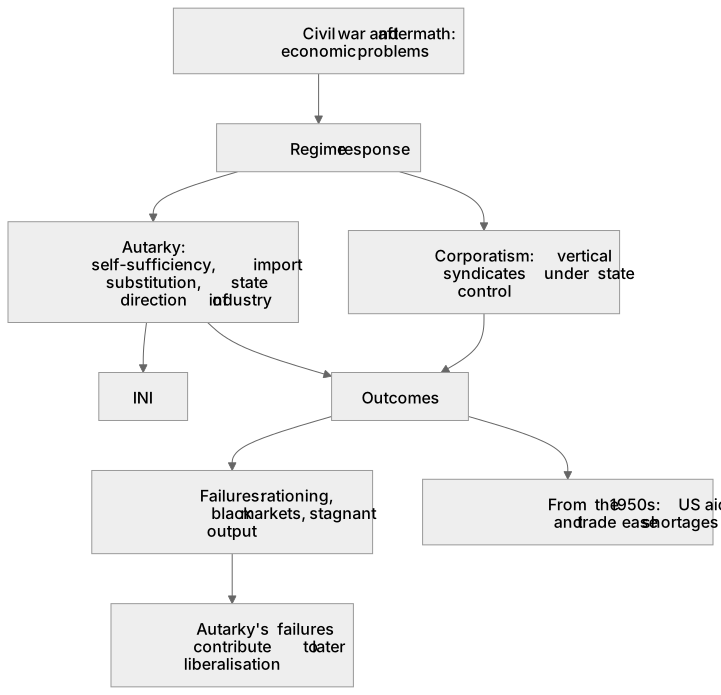
Key words
Say what each word means before you turn the card.
Corporatism
Try answering aloud or in your head before turning the card.
Autarky
Try answering aloud or in your head before turning the card.
Import substitution
Try answering aloud or in your head before turning the card.
INI
Try answering aloud or in your head before turning the card.
See every definition
- Corporatism
- Organising employers and workers into vertical syndicates under state control, which suppressed independent unions and fixed wages.
- Autarky
- A policy of self-sufficiency using import substitution, tariffs and state investment through the INI to reduce dependence on foreign goods.
- Import substitution
- A means of pursuing self-sufficiency by replacing foreign goods with domestic production, supported by tariffs and state investment through the INI.
- INI
- The body through which state direction of industry and state investment under autarky were carried out.
Label the diagram
Some boxes have lost their names. Pick the right name for each number.
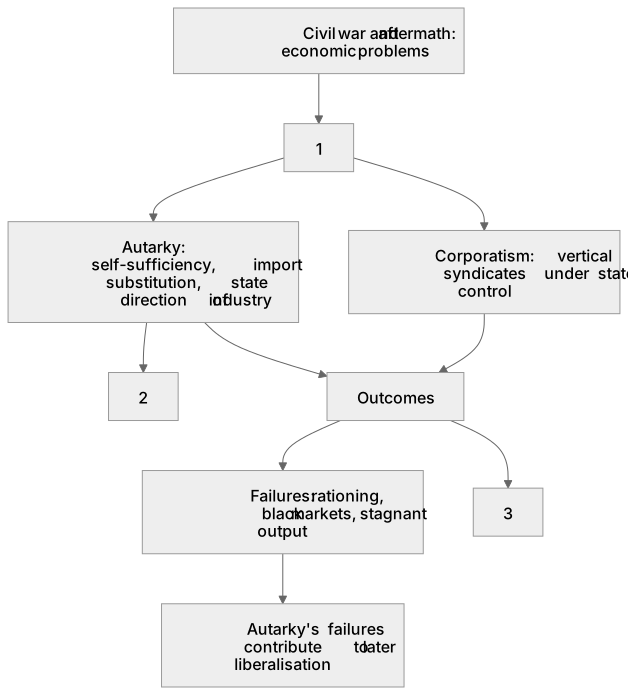
1Box 1
2Box 2
3Box 3
There is more to this lesson
The full lesson goes on to check your understanding and help you earn the marks. Create a free account to carry on, with your progress saved.
A week of Premium from your first lesson · Then the free plan continues · No card, no charge
Test your understanding of Establishing Franco’s dictatorship, 1938–56: Economic development: economic problems and the impact of the civil war; the development of corporatism; the implementation of autarky; successes and failures.
Active recall beats re-reading. Take an instant quiz now to test what you’ve learned and lock it into long-term memory.
A week of Premium from your first lesson · Then the free plan continues · No card, no charge