Pearson Edexcel · A-Level · History
Course version: 9HI0 · Version from Sept 2015
Problems facing the Directory: political violence, including the White…
Full specification wording
From the Directory to Brumaire, 1795–99: Problems facing the Directory: political violence, including the White Terror; political divisions; economic and financial pressures; popular protest.
The Directory, established in November 1795, faced multiple interconnected problems.
Checked against the Pearson Edexcel 9HI0 specification (opens in a new tab) on .
- Point 1 of 4
- 4 key terms
Study notes
From the checked teaching notes for this specification point.
The idea
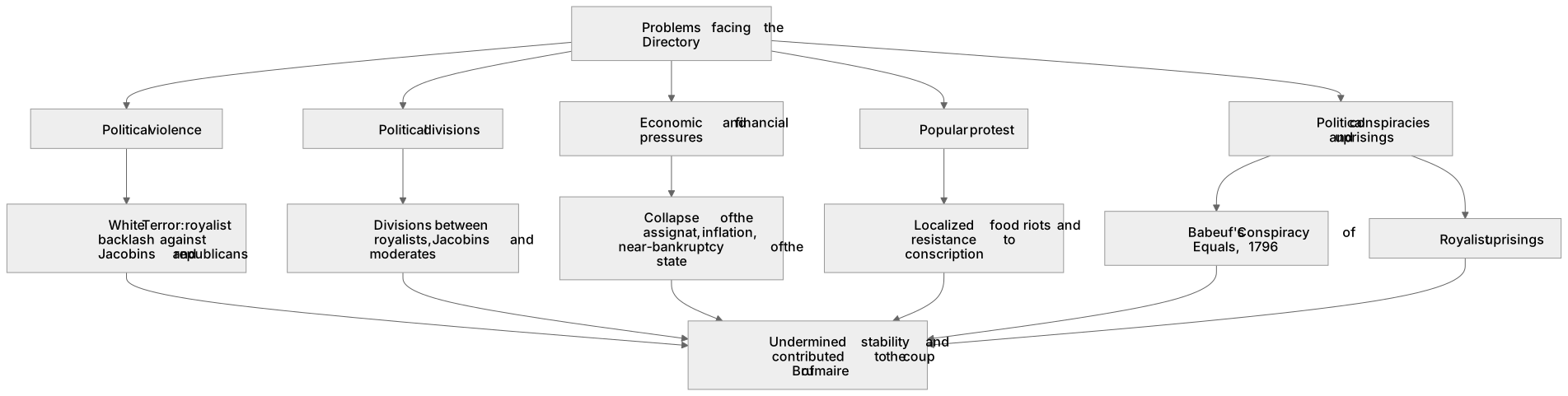
The Directory, established in November 1795, faced multiple interconnected problems. Political violence included the White Terror, a royalist backlash in the south-east where gangs killed Jacobins and republicans. Political divisions split the Directors, the Councils, and the country between royalists, Jacobins, and moderates. Economic and financial pressures included the collapse of the assignat, inflation, and the near-bankruptcy of the state. Popular protest erupted in localized food riots and resistance to conscription, rather than the massive journées of earlier years. Additionally, the Directory faced political conspiracies, notably Babeuf's Conspiracy of Equals in 1796 and royalist uprisings. These problems undermined stability and contributed to the coup of Brumaire.
What earns the marks
- Explains the White Terror as royalist political violence against Jacobins and republicans, especially in the Rhône valley and Marseille.
- Analyses political divisions between royalists, Jacobins, and moderates within the Councils and the Directory itself.
- Assesses economic and financial pressures: assignat collapse, inflation, and the state's inability to pay debts or fund armies.
- Describes popular protest, such as localized riots and resistance to conscription, alongside political uprisings like the Babeuf conspiracy.
Common mistakes and how to put them right
Confusing the White Terror with the earlier Reign of Terror.
Put it right: The White Terror was royalist and targeted Jacobins, while the Reign of Terror was revolutionary.
Attributing the uprising of Prairial to the Directory.
Put it right: Prairial occurred in May 1795 under the Thermidorian Convention, before the Directory was established in November 1795.
Assuming the Directory faced only royalist opposition.
Put it right: It also faced Jacobin and popular challenges from the left.
Exam tips
- Use specific examples such as the White Terror in Lyon and Marseille, and the Babeuf conspiracy, to support your arguments.
- Balance your answer by covering all four types of problems: political violence, political divisions, economic pressures, and popular protest.
Try the lesson
The start of the From the Directory to Brumaire, 1795–99: Problems facing the Directory: political violence, including the White Terror; political divisions; economic and financial pressures; popular protest. lesson, made from checked teaching notes for this specification point.
Have a go first
Which group carried out the White Terror that troubled the Directory in 1795?
Listen
The Directory, established in November 1795, faced multiple interconnected problems. Political violence included the White Terror, a royalist backlash in the south-east where gangs killed Jacobins and republicans. Political divisions split the Directors, the Councils, and the country between royalists, Jacobins, and moderates. Economic and financial pressures included the collapse of the assignat, inflation, and the near-bankruptcy of the state. Popular protest erupted in localized food riots and resistance to conscription, rather than the massive journées of earlier years. Additionally, the Directory faced political conspiracies, notably Babeuf's Conspiracy of Equals in 1796 and royalist uprisings. These problems undermined stability and contributed to the coup of Brumaire. A strong answer earns marks for these points. Explains the White Terror as royalist political violence against Jacobins and republicans, especially in the Rhône valley and Marseille. Analyses political divisions between royalists, Jacobins, and moderates within the Councils and the Directory itself. Assesses economic and financial pressures: assignat collapse, inflation, and the state's inability to pay debts or fund armies. Describes popular protest, such as localized riots and resistance to conscription, alongside political uprisings like the Babeuf conspiracy. A common slip: Attributing the uprising of Prairial to the Directory. Instead, Prairial occurred in May 1795 under the Thermidorian Convention, before the Directory was established in November 1795. Exam tip: Use specific examples such as the White Terror in Lyon and Marseille, and the Babeuf conspiracy, to support your arguments.
See it
Key words
Say what each word means before you turn the card.
White Terror
Try answering aloud or in your head before turning the card.
Political divisions
Try answering aloud or in your head before turning the card.
Economic and financial pressures
Try answering aloud or in your head before turning the card.
Popular protest
Try answering aloud or in your head before turning the card.
See every definition
- White Terror
- A royalist backlash in the south-east where gangs killed Jacobins and republicans.
- Political divisions
- Splits between the Directors, the Councils, and the country among royalists, Jacobins, and moderates.
- Economic and financial pressures
- The collapse of the assignat, inflation, and the near-bankruptcy of the state.
- Popular protest
- Localized food riots and resistance to conscription, rather than the massive journées of earlier years.
Label the diagram
Some boxes have lost their names. Pick the right name for each number.
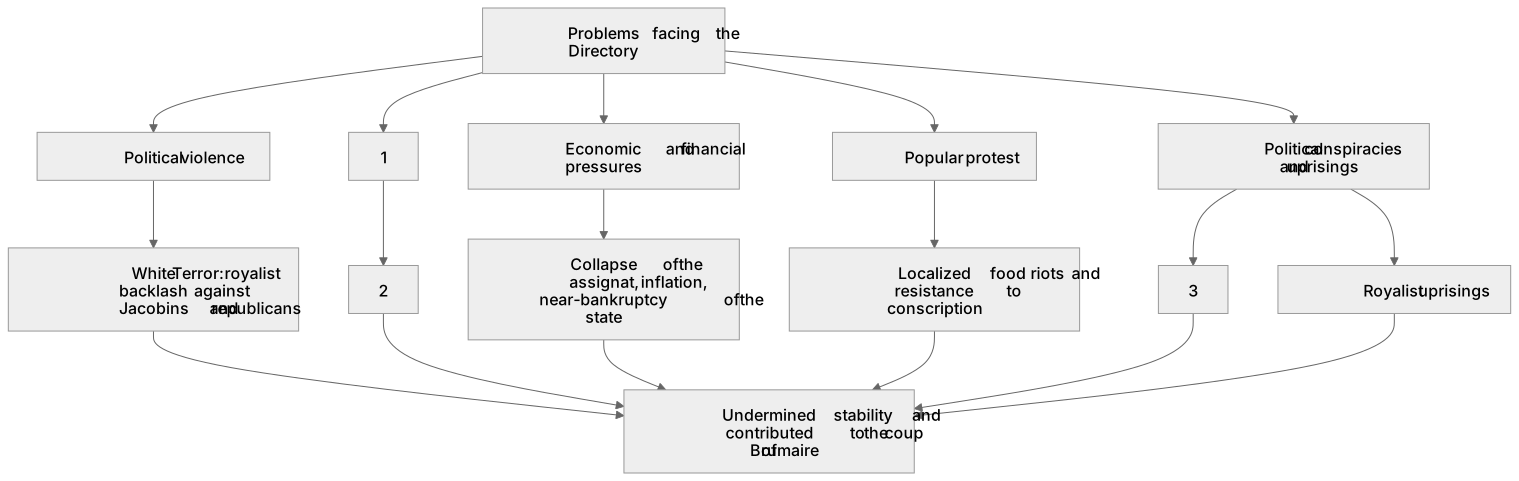
1Box 1
2Box 2
3Box 3
There is more to this lesson
The full lesson goes on to check your understanding and help you earn the marks. Create a free account to carry on, with your progress saved.
A week of Premium from your first lesson · Then the free plan continues · No card, no charge
Test your understanding of From the Directory to Brumaire, 1795–99: Problems facing the Directory: political violence, including the White Terror; political divisions; economic and financial pressures; popular protest.
Active recall beats re-reading. Take an instant quiz now to test what you’ve learned and lock it into long-term memory.
A week of Premium from your first lesson · Then the free plan continues · No card, no charge