Pearson Edexcel · A-Level · History
Course version: 9HI0 · Version from Sept 2015
The coup de Brumaire 1799: the Directory under threat; the role of Sieyés;…
Full specification wording
From the Directory to Brumaire, 1795–99: The coup de Brumaire 1799: the Directory under threat; the role of Sieyés; the significance of the return of Bonaparte; the coup of November and establishment of the Consulship.
By 1799 the Directory faced military defeats, financial crisis and renewed Jacobin and royalist threats.
Checked against the Pearson Edexcel 9HI0 specification (opens in a new tab) on .
- Point 4 of 4
- 4 key terms
Study notes
From the checked teaching notes for this specification point.
The idea
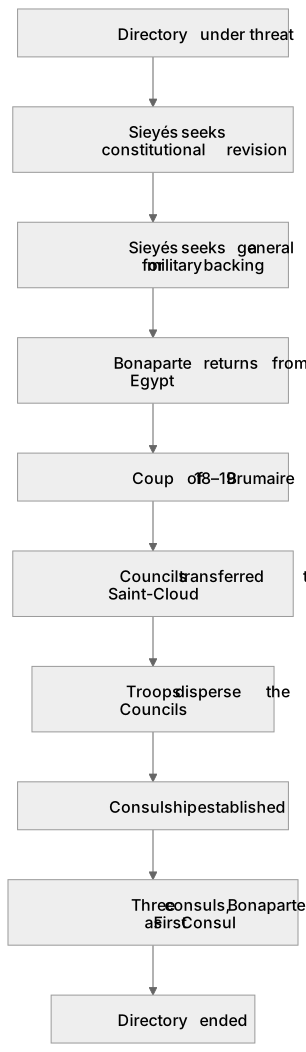
By 1799 the Directory faced military defeats, financial crisis and renewed Jacobin and royalist threats. Sieyés, a director, sought a strong military figure to support a constitutional revision. Bonaparte's return from Egypt in October 1799 provided the necessary prestige and force. The coup of 18–19 Brumaire (9–10 November 1799) involved manipulating the Councils, using troops to disperse opposition, and establishing a Consulate. The Consulship, initially with three consuls, concentrated executive power, effectively ending the Directory and paving the way for Napoleon's dominance.
What earns the marks
- Explains the threats to the Directory in 1799: military setbacks, financial difficulties, and the resurgence of Jacobin and royalist opposition.
- Analyses Sieyés's role: as a director, he plotted a constitutional revision and sought a general to provide military backing, initially considering Joubert but turning to Bonaparte.
- Assesses the significance of Bonaparte's return: his popularity and control of the army were crucial for the coup's success, providing the force to intimidate the Councils.
- Describes the coup of November: the transfer of the Councils to Saint-Cloud, the use of troops to disperse them, and the establishment of the Consulate.
- Evaluates the establishment of the Consulship: the new constitution concentrated power in three consuls, with Bonaparte as First Consul, effectively ending the Directory and revolutionary government.
Common mistakes and how to put them right
Claiming Sieyés alone executed the coup.
Put it right: Sieyés orchestrated the political groundwork, but Bonaparte's military support was essential for the coup's success.
Stating the coup occurred without violence.
Put it right: Troops were used to disperse the Councils at Saint-Cloud, and opposition was suppressed by force.
Confusing the Consulate with the Directory.
Put it right: The Consulate replaced the Directory, with a new constitution and a three-man executive, marking a new regime.
Exam tips
- Explain the interplay between political plotting (Sieyés) and military force (Bonaparte) in the coup's success.
- Use precise dates (18–19 Brumaire) and terms (Consulate, First Consul) to demonstrate accurate knowledge.
- Assess the significance of Brumaire as a turning point: did it preserve or betray revolutionary principles?
Try the lesson
The start of the From the Directory to Brumaire, 1795–99: The coup de Brumaire 1799: the Directory under threat; the role of Sieyés; the significance of the return of Bonaparte; the coup of November and establishment of the Consulship. lesson, made from checked teaching notes for this specification point.
Have a go first
Which figure, a former abbé and Director, helped plan the coup of Brumaire in 1799 by seeking a general to support a change of regime?
Listen
By 1799 the Directory faced military defeats, financial crisis and renewed Jacobin and royalist threats. Sieyés, a director, sought a strong military figure to support a constitutional revision. Bonaparte's return from Egypt in October 1799 provided the necessary prestige and force. The coup of 18–19 Brumaire (9–10 November 1799) involved manipulating the Councils, using troops to disperse opposition, and establishing a Consulate. The Consulship, initially with three consuls, concentrated executive power, effectively ending the Directory and paving the way for Napoleon's dominance. A strong answer earns marks for these points. Explains the threats to the Directory in 1799: military setbacks, financial difficulties, and the resurgence of Jacobin and royalist opposition. Analyses Sieyés's role: as a director, he plotted a constitutional revision and sought a general to provide military backing, initially considering Joubert but turning to Bonaparte. Assesses the significance of Bonaparte's return: his popularity and control of the army were crucial for the coup's success, providing the force to intimidate the Councils. Describes the coup of November: the transfer of the Councils to Saint-Cloud, the use of troops to disperse them, and the establishment of the Consulate. A common slip: claiming Sieyés alone executed the coup. Instead, Sieyés orchestrated the political groundwork, but Bonaparte's military support was essential for the coup's success. Exam tip: Explain the interplay between political plotting (Sieyés) and military force (Bonaparte) in the coup's success.
See it
Key words
Say what each word means before you turn the card.
The weakness of the Directory
Try answering aloud or in your head before turning the card.
The role of key individuals (Sieyés, Bonaparte)
Try answering aloud or in your head before turning the card.
The mechanics of the coup
Try answering aloud or in your head before turning the card.
The establishment of the Consulate and its significance
Try answering aloud or in your head before turning the card.
See every definition
- The weakness of the Directory
- By 1799 it faced military defeats, financial crisis and renewed Jacobin and royalist threats.
- The role of key individuals (Sieyés, Bonaparte)
- Sieyés, a director, sought a strong military figure to support a constitutional revision, and Bonaparte's return provided the necessary prestige and force.
- The mechanics of the coup
- The coup of 18–19 Brumaire involved manipulating the Councils, using troops to disperse opposition, and establishing a Consulate.
- The establishment of the Consulate and its significance
- The Consulship, initially with three consuls, concentrated executive power, effectively ending the Directory and paving the way for Napoleon's dominance.
Label the diagram
Some boxes have lost their names. Pick the right name for each number.
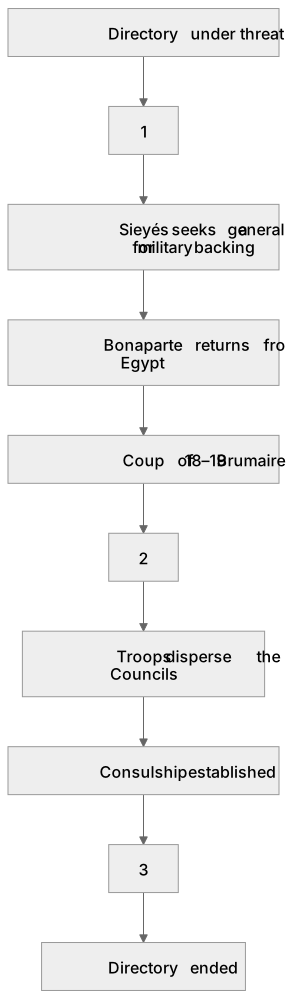
1Box 1
2Box 2
3Box 3
There is more to this lesson
The full lesson goes on to check your understanding and help you earn the marks. Create a free account to carry on, with your progress saved.
A week of Premium from your first lesson · Then the free plan continues · No card, no charge
Test your understanding of From the Directory to Brumaire, 1795–99: The coup de Brumaire 1799: the Directory under threat; the role of Sieyés; the significance of the return of Bonaparte; the coup of November and establishment of the Consulship.
Active recall beats re-reading. Take an instant quiz now to test what you’ve learned and lock it into long-term memory.
A week of Premium from your first lesson · Then the free plan continues · No card, no charge