Pearson Edexcel · A-Level · History
Course version: 9HI0 · Version from Sept 2015
Economic situation in the 1980s: the growing national debt; high spending…
Full specification wording
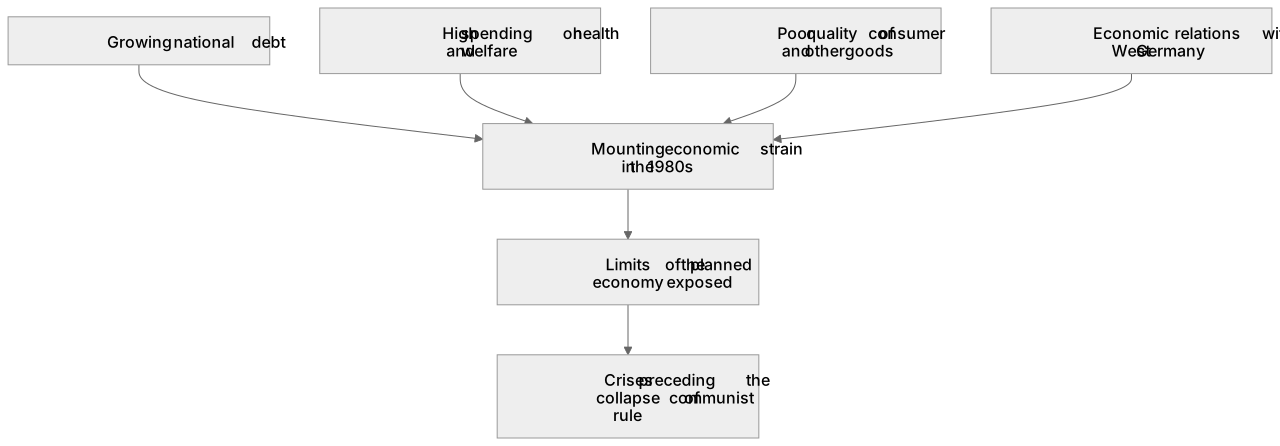
Growing crises and the collapse of communist rule in the GDR: Economic situation in the 1980s: the growing national debt; high spending on health and welfare; the poor quality of consumer and other goods; economic relations with West Germany.
By the 1980s the GDR faced mounting economic strain.
Checked against the Pearson Edexcel 9HI0 specification (opens in a new tab) on .
- Point 1 of 4
- 4 key terms
Study notes
From the checked teaching notes for this specification point.
The idea
By the 1980s the GDR faced mounting economic strain. National debt to Western banks and governments grew as imports of technology and raw materials were financed by borrowing rather than export earnings. High spending on health and welfare maintained social stability but consumed a large share of the budget, limiting investment. Consumer and other goods were often of poor quality, with shortages and long waiting times for cars and housing, which eroded public satisfaction. Economic relations with West Germany were vital: loans, intra-German trade and hard-currency payments helped sustain the GDR, but also increased dependence on the Federal Republic. Together these pressures exposed the limits of the planned economy and contributed to the crises that preceded the collapse of communist rule.
What earns the marks
- Explains that national debt rose in the 1980s because the GDR borrowed from Western banks and governments to fund imports and investment, increasing hard-currency obligations.
- Shows that high spending on health and welfare was maintained to secure social peace, but it absorbed resources and reduced funds available for modernising industry.
- Describes the poor quality of consumer and other goods, including shortages, long waiting lists for cars and housing, and inferior products that fuelled public discontent.
- Analyses economic relations with West Germany, including loans, intra-German trade and hard-currency transfers, and explains how these both propped up and made the GDR dependent on the Federal Republic.
- Links these economic problems to the wider crisis of the SED state, showing how they undermined legitimacy and limited the government's room for manoeuvre.
Common mistakes and how to put them right
Treating the GDR economy as uniformly successful in the 1980s.
Put it right: Recognise that hidden debt and welfare costs masked underlying stagnation.
Assuming that West German economic relations were purely hostile.
Put it right: Explain that they included loans, trade and payments that stabilised the GDR in the short term.
Confusing poor quality of goods with absolute scarcity.
Put it right: Distinguish between goods being available but unreliable or inferior and goods being unavailable altogether.
Exam tips
- Use specific examples such as the scale of hard-currency debt, the cost of subsidised basic goods, or waiting times for a Trabant to support your analysis.
- Connect each economic problem to political consequences, for example how welfare spending bought loyalty but limited reform.
- When discussing West Germany, distinguish between different forms of economic relationship and explain their significance for GDR sovereignty.
Try the lesson
The start of the Growing crises and the collapse of communist rule in the GDR: Economic situation in the 1980s: the growing national debt; high spending on health and welfare; the poor quality of consumer and other goods; economic relations with West Germany. lesson, made from checked teaching notes for this specification point.
Have a go first
During the 1980s, the GDR experienced a rapidly growing national debt. Which of the following significantly contributed to this economic situation?
Listen
By the 1980s the GDR faced mounting economic strain. National debt to Western banks and governments grew as imports of technology and raw materials were financed by borrowing rather than export earnings. High spending on health and welfare maintained social stability but consumed a large share of the budget, limiting investment. Consumer and other goods were often of poor quality, with shortages and long waiting times for cars and housing, which eroded public satisfaction. Economic relations with West Germany were vital: loans, intra-German trade and hard-currency payments helped sustain the GDR, but also increased dependence on the Federal Republic. Together these pressures exposed the limits of the planned economy and contributed to the crises that preceded the collapse of communist rule. A strong answer earns marks for these points. Explains that national debt rose in the 1980s because the GDR borrowed from Western banks and governments to fund imports and investment, increasing hard-currency obligations. Shows that high spending on health and welfare was maintained to secure social peace, but it absorbed resources and reduced funds available for modernising industry. Describes the poor quality of consumer and other goods, including shortages, long waiting lists for cars and housing, and inferior products that fuelled public discontent. Analyses economic relations with West Germany, including loans, intra-German trade and hard-currency transfers, and explains how these both propped up and made the GDR dependent on the Federal Republic. A common slip: Treating the GDR economy as uniformly successful in the 1980s. Instead, recognise that hidden debt and welfare costs masked underlying stagnation. Exam tip: Use specific examples such as the scale of hard-currency debt, the cost of subsidised basic goods, or waiting times for a Trabant to support your analysis.
See it
Key words
Say what each word means before you turn the card.
Economic decline and debt in the planned economy
Try answering aloud or in your head before turning the card.
Welfare spending and social stability
Try answering aloud or in your head before turning the card.
Consumer dissatisfaction and quality of goods
Try answering aloud or in your head before turning the card.
Dependence on West Germany and intra-German relations
Try answering aloud or in your head before turning the card.
See every definition
- Economic decline and debt in the planned economy
- National debt to Western banks and governments grew in the 1980s as imports were financed by borrowing rather than export earnings, exposing the limits of the planned economy.
- Welfare spending and social stability
- High spending on health and welfare maintained social stability but consumed a large share of the budget, limiting investment.
- Consumer dissatisfaction and quality of goods
- Consumer and other goods were often of poor quality, with shortages and long waiting times for cars and housing, which eroded public satisfaction.
- Dependence on West Germany and intra-German relations
- Loans, intra-German trade and hard-currency payments from West Germany helped sustain the GDR but also increased dependence on the Federal Republic.
Label the diagram
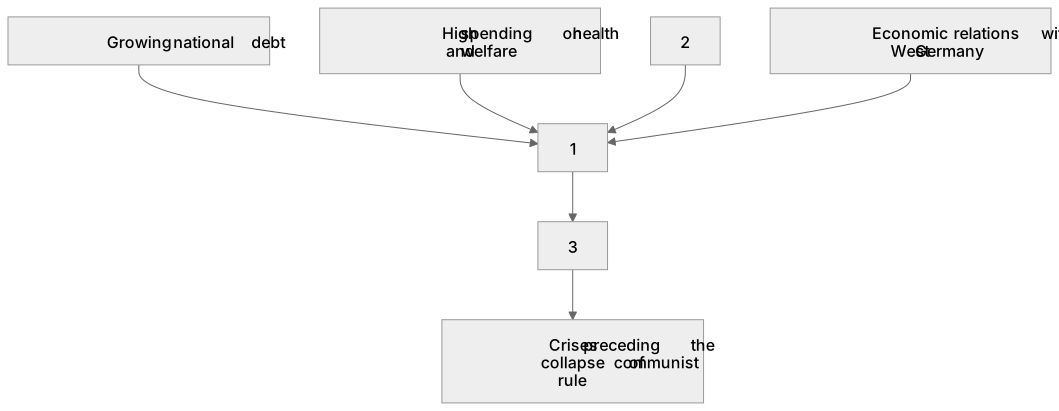
Some boxes have lost their names. Pick the right name for each number.
1Box 1
2Box 2
3Box 3
There is more to this lesson
The full lesson goes on to check your understanding and help you earn the marks. Create a free account to carry on, with your progress saved.
A week of Premium from your first lesson · Then the free plan continues · No card, no charge
Test your understanding of Growing crises and the collapse of communist rule in the GDR: Economic situation in the 1980s: the growing national debt; high spending on health and welfare; the poor quality of consumer and other goods; economic relations with West Germany.
Active recall beats re-reading. Take an instant quiz now to test what you’ve learned and lock it into long-term memory.
A week of Premium from your first lesson · Then the free plan continues · No card, no charge