Pearson Edexcel · A-Level · History
Course version: 9HI0 · Version from Sept 2015
The influence of German history on Nazi foreign policy.
Full specification wording
How far was Hitler’s foreign policy responsible for the Second World War?: The influence of German history on Nazi foreign policy.
Nazi foreign policy drew on deep currents in German history: the Treaty of Versailles (1919) created grievance over territory, disarmament and the 'war guilt' clause; nineteenth-century…
Checked against the Pearson Edexcel 9HI0 specification (opens in a new tab) on .
- Point 1 of 4
- 4 key terms
Study notes
From the checked teaching notes for this specification point.
The idea
Nazi foreign policy drew on deep currents in German history: the Treaty of Versailles (1919) created grievance over territory, disarmament and the 'war guilt' clause; nineteenth-century nationalism and the 'Drang nach Osten' supplied ideas of eastward expansion; Bismarck's Realpolitik showed pragmatic alliances; and Weimar's revisionism under Stresemann pursued peaceful treaty change. Hitler rejected Weimar diplomacy, blending racial ideology with historical ambition. Use specific examples: the 1933 withdrawal from the League, 1935 rearmament, 1936 Rhineland remilitarisation, 1938 Anschluss and Munich, and the 1939 Nazi–Soviet Pact.
What earns the marks
- Explains how the Treaty of Versailles generated revisionist aims: loss of territory, disarmament, reparations and the war-guilt clause.
- Links nineteenth-century nationalism and Pan-German ideas, including eastward expansion, to later Nazi Lebensraum aims.
- Contrasts Bismarck's pragmatic Realpolitik with Hitler's ideologically driven expansionism.
- Assesses Weimar revisionism under Stresemann as a peaceful alternative that Hitler rejected.
- Uses specific events to show continuity and change: withdrawal from the League (1933), rearmament (1935), Rhineland (1936), Anschluss and Munich (1938), Nazi–Soviet Pact (1939).
- Evaluates whether Nazi foreign policy was a radical break from or an extreme continuation of earlier German history.
Common mistakes and how to put them right
Treating Versailles as the sole cause of Nazi foreign policy.
Put it right: Also consider nineteenth-century nationalism, Bismarckian diplomacy and Weimar revisionism.
Assuming all German history pointed inevitably to Hitler.
Put it right: Show alternative paths such as Stresemann's peaceful revisionism.
Listing events without linking them to historical influences.
Put it right: Explain how each event reflects or departs from earlier traditions.
Exam tips
- Plan an argument that weighs continuity against change, using named examples from 1919–39.
- Define key terms such as Lebensraum and Realpolitik precisely in your introduction.
- Embed historians' interpretations or contemporary views to support your evaluation.
Try the lesson
The start of the How far was Hitler’s foreign policy responsible for the Second World War?: The influence of German history on Nazi foreign policy. lesson, made from checked teaching notes for this specification point.
Have a go first
How did the 'stab-in-the-back' myth (Dolchstoßlegende) emerging from the end of the First World War influence Nazi foreign policy?
Listen
Nazi foreign policy drew on deep currents in German history: the Treaty of Versailles (1919) created grievance over territory, disarmament and the 'war guilt' clause; nineteenth-century nationalism and the 'Drang nach Osten' supplied ideas of eastward expansion; Bismarck's Realpolitik showed pragmatic alliances; and Weimar's revisionism under Stresemann pursued peaceful treaty change. Hitler rejected Weimar diplomacy, blending racial ideology with historical ambition. Use specific examples: the 1933 withdrawal from the League, 1935 rearmament, 1936 Rhineland remilitarisation, 1938 Anschluss and Munich, and the 1939 Nazi–Soviet Pact. A strong answer earns marks for these points. Explains how the Treaty of Versailles generated revisionist aims: loss of territory, disarmament, reparations and the war-guilt clause. Links nineteenth-century nationalism and Pan-German ideas, including eastward expansion, to later Nazi Lebensraum aims. Contrasts Bismarck's pragmatic Realpolitik with Hitler's ideologically driven expansionism. Assesses Weimar revisionism under Stresemann as a peaceful alternative that Hitler rejected. A common slip: Treating Versailles as the sole cause of Nazi foreign policy. Instead, also consider nineteenth-century nationalism, Bismarckian diplomacy and Weimar revisionism. Exam tip: Plan an argument that weighs continuity against change, using named examples from 1919–39.
See it
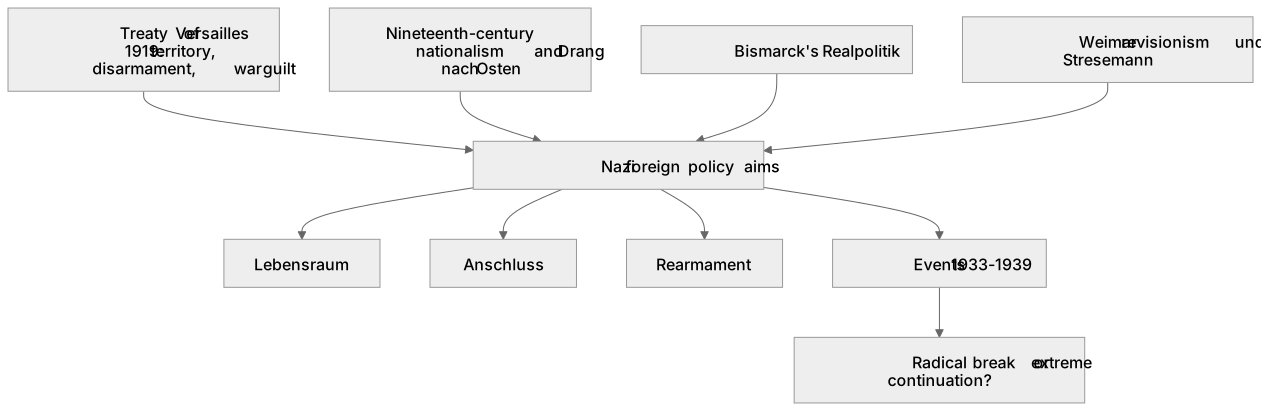
Key words
Say what each word means before you turn the card.
Treaty of Versailles and revisionism
Try answering aloud or in your head before turning the card.
Nationalism and eastward expansion
Try answering aloud or in your head before turning the card.
Bismarckian Realpolitik versus Hitler's ideology
Try answering aloud or in your head before turning the card.
Weimar diplomacy and its rejection
Try answering aloud or in your head before turning the card.
See every definition
- Treaty of Versailles and revisionism
- The 1919 settlement created grievance over territory, disarmament and the 'war guilt' clause, generating revisionist aims.
- Nationalism and eastward expansion
- Nineteenth-century nationalism and the 'Drang nach Osten' supplied ideas of eastward expansion later linked to Nazi Lebensraum aims.
- Bismarckian Realpolitik versus Hitler's ideology
- Bismarck's pragmatic alliances are contrasted with Hitler's ideologically driven expansionism.
- Weimar diplomacy and its rejection
- Weimar's revisionism under Stresemann pursued peaceful treaty change, a peaceful alternative that Hitler rejected.
Label the diagram
Some boxes have lost their names. Pick the right name for each number.
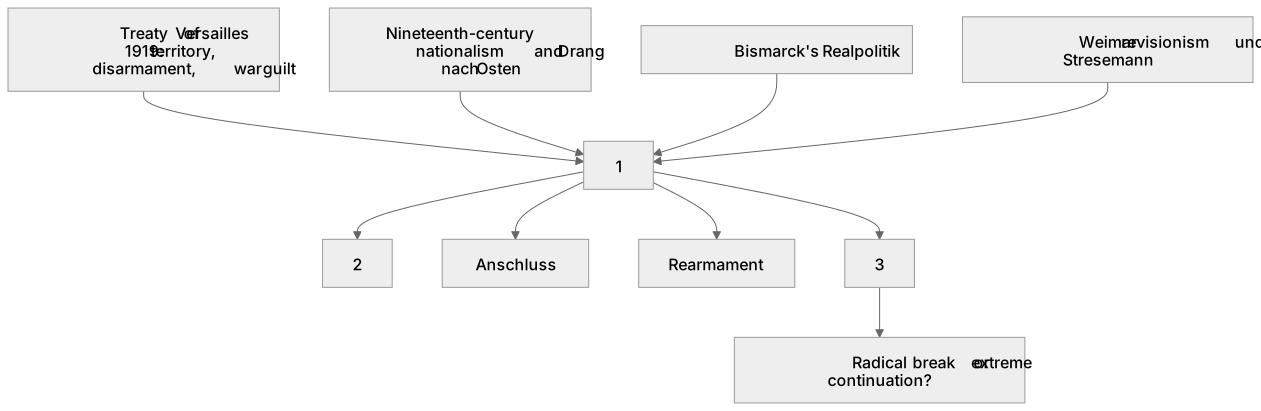
1Box 1
2Box 2
3Box 3
There is more to this lesson
The full lesson goes on to check your understanding and help you earn the marks. Create a free account to carry on, with your progress saved.
A week of Premium from your first lesson · Then the free plan continues · No card, no charge
Test your understanding of How far was Hitler’s foreign policy responsible for the Second World War?: The influence of German history on Nazi foreign policy.
Active recall beats re-reading. Take an instant quiz now to test what you’ve learned and lock it into long-term memory.
A week of Premium from your first lesson · Then the free plan continues · No card, no charge