Pearson Edexcel · A-Level · History
Course version: 9HI0 · Version from Sept 2015
Monarchy and government: the power of the English monarchy; the earldoms…
Full specification wording
Late Anglo- Saxon England, c1053–66: Monarchy and government: the power of the English monarchy; the earldoms and shires; local government; the legal system.
In late Anglo-Saxon England, the power of the English monarchy rested on land, lordship and law.
Checked against the Pearson Edexcel 9HI0 specification (opens in a new tab) on .
- Point 1 of 4
- 4 key terms
Study notes
From the checked teaching notes for this specification point.
The idea
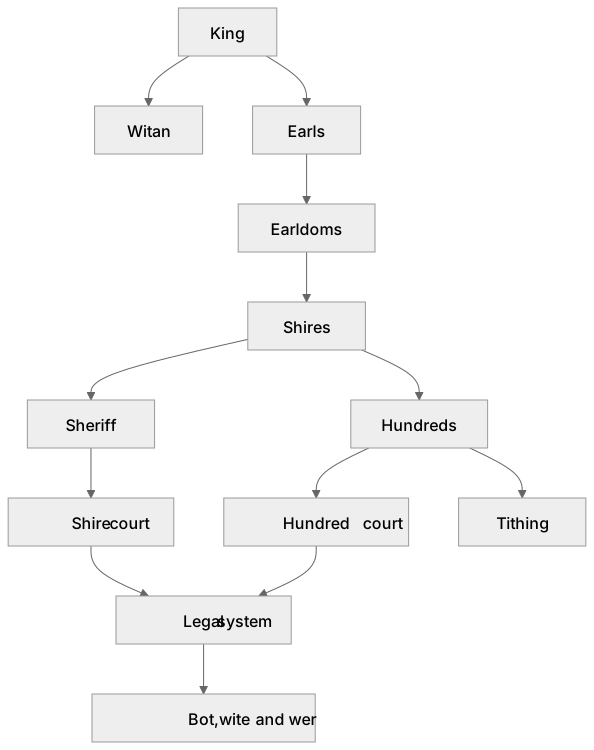
In late Anglo-Saxon England, the power of the English monarchy rested on land, lordship and law. The king ruled with the witan, but relied on earls who governed large earldoms. Below them, shires were administered by sheriffs who presided over shire courts, while hundreds handled local order. The legal system combined royal, shire and hundred courts, with financial penalties classified as bot, wite and wer. For example, a thief caught in a tithing could be tried in a hundred court, while the sheriff ensured royal justice in the shire court. This system allowed effective local government without a standing army.
What earns the marks
- Explains that the power of the English monarchy derived from lordship, landholding, the witan, control of coinage and the ability to raise taxes and military service.
- Describes the role of earls as regional magnates who governed earldoms, commanded local forces and often acted as the king's representatives.
- Outlines the shires as the principal unit of local government, administered by the sheriff and the shire court, with the hundred and tithing below it.
- Explains the legal system: royal, shire and hundred courts; the use of oath-helpers and ordeal; and the financial penalties of bot, wite and wer.
- Analyses how these institutions balanced royal authority with local autonomy, and how local government depended on cooperation between king, earls and communities.
Common mistakes and how to put them right
Assuming the king ruled as an absolute monarch.
Put it right: The power of the English monarchy was limited by the need to consult the witan and secure the cooperation of earls.
Confusing earldoms with shires.
Put it right: Earldoms were large regional territories held by earls, while shires were smaller administrative districts within them, managed by a sheriff.
Misunderstanding bot, wite and wer as crimes.
Put it right: These were financial penalties and compensations within the legal system, not the offences themselves.
Exam tips
- When analysing the power of the English monarchy, use specific examples such as the king's control of coinage or the role of the witan to support your argument.
- For questions on local government, explain the functions of the sheriff and the shire court, and show how they connected royal authority to local communities.
- In essays on the legal system, distinguish between different types of courts and financial penalties, and assess how far justice was royal or local in practice.
Try the lesson
The start of the Late Anglo- Saxon England, c1053–66: Monarchy and government: the power of the English monarchy; the earldoms and shires; local government; the legal system. lesson, made from checked teaching notes for this specification point.
Have a go first
In late Anglo-Saxon England, which royal official was responsible for the day-to-day administration of a shire on the king's behalf?
Listen
In late Anglo-Saxon England, the power of the English monarchy rested on land, lordship and law. The king ruled with the witan, but relied on earls who governed large earldoms. Below them, shires were administered by sheriffs who presided over shire courts, while hundreds handled local order. The legal system combined royal, shire and hundred courts, with financial penalties classified as bot, wite and wer. For example, a thief caught in a tithing could be tried in a hundred court, while the sheriff ensured royal justice in the shire court. This system allowed effective local government without a standing army. A strong answer earns marks for these points. Explains that the power of the English monarchy derived from lordship, landholding, the witan, control of coinage and the ability to raise taxes and military service. Describes the role of earls as regional magnates who governed earldoms, commanded local forces and often acted as the king's representatives. Outlines the shires as the principal unit of local government, administered by the sheriff and the shire court, with the hundred and tithing below it. Explains the legal system: royal, shire and hundred courts; the use of oath-helpers and ordeal; and the financial penalties of bot, wite and wer. A common slip: Assuming the king ruled as an absolute monarch. Instead, The power of the English monarchy was limited by the need to consult the witan and secure the cooperation of earls. Exam tip: When analysing the power of the English monarchy, use specific examples such as the king's control of coinage or the role of the witan to support your argument.
See it
Key words
Say what each word means before you turn the card.
Royal authority and its limits
Try answering aloud or in your head before turning the card.
Earldoms and regional governance
Try answering aloud or in your head before turning the card.
Shires, hundreds and tithings
Try answering aloud or in your head before turning the card.
Legal procedures and penalties
Try answering aloud or in your head before turning the card.
See every definition
- Royal authority and its limits
- The power of the English monarchy rested on land, lordship and law, but was limited by the need to consult the witan and secure the cooperation of earls.
- Earldoms and regional governance
- Large regional territories held by earls, who governed them, commanded local forces and often acted as the king's representatives.
- Shires, hundreds and tithings
- The shires were the principal unit of local government, administered by the sheriff and the shire court, with the hundred and tithing below it.
- Legal procedures and penalties
- The legal system combined royal, shire and hundred courts, with financial penalties classified as bot, wite and wer.
Label the diagram
Some boxes have lost their names. Pick the right name for each number.
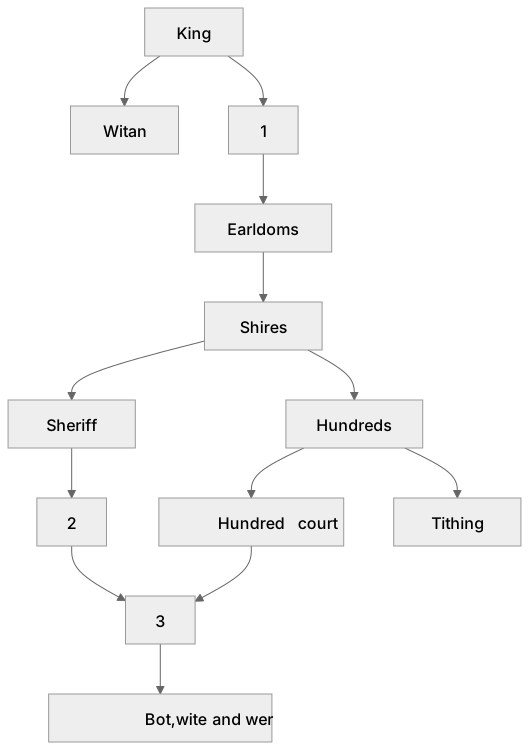
1Box 1
2Box 2
3Box 3
There is more to this lesson
The full lesson goes on to check your understanding and help you earn the marks. Create a free account to carry on, with your progress saved.
A week of Premium from your first lesson · Then the free plan continues · No card, no charge
Test your understanding of Late Anglo- Saxon England, c1053–66: Monarchy and government: the power of the English monarchy; the earldoms and shires; local government; the legal system.
Active recall beats re-reading. Take an instant quiz now to test what you’ve learned and lock it into long-term memory.
A week of Premium from your first lesson · Then the free plan continues · No card, no charge