Pearson Edexcel · A-Level · History
Course version: 9HI0 · Version from Sept 2015
The principal servants of the crown: the powers exercised by leading…
Full specification wording
Monarchy and government, 1509–88: The principal servants of the crown: the powers exercised by leading ministers; the influence of Wolsey, Cromwell and Burghley. Changes to the structure of government.
Leading ministers served the crown but their power depended on royal favour.
Checked against the Pearson Edexcel 9HI0 specification (opens in a new tab) on .
- Point 3 of 3
- 4 key terms
Study notes
From the checked teaching notes for this specification point.
The idea
Leading ministers served the crown but their power depended on royal favour. Wolsey, as Lord Chancellor and papal legate, controlled the legal system, foreign policy and the Church, yet fell when he failed to secure Henry VIII's annulment. Cromwell, as Vicegerent in Spirituals, drove the dissolution of the monasteries and reorganised finance, but was executed in 1540. Burghley, Elizabeth's Lord Treasurer, managed patronage, intelligence and Parliament for four decades. Structural change included the growth of the Privy Council, the decline of the Chamber, new revenue courts such as the Court of Augmentations, and the rise of the Secretary of State. Assess how far ministers shaped policy rather than merely executing the king's will.
What earns the marks
- Evaluates Burghley's long tenure as Lord Treasurer and principal secretary, including his management of patronage, intelligence networks and parliamentary business, and how this sustained Elizabethan stability.
- Judges the extent to which ministers exercised independent power or acted as agents of royal will, using specific examples such as Wolsey's foreign policy or Cromwell's religious legislation.
Common mistakes and how to put them right
Treating Wolsey, Cromwell and Burghley as equally powerful without distinguishing the source of their authority.
Put it right by explaining that each depended on royal favour and that their influence varied with the monarch's needs.
Assuming structural change was sudden and complete.
Put it right by showing that medieval institutions such as the Chamber persisted alongside new bodies like the Privy Council and Court of Augmentations.
Confusing the roles of different offices, for example describing Cromwell as Lord Chancellor.
Put it right by specifying Cromwell's position as Vicegerent in Spirituals and principal secretary under Henry VIII.
Exam tips
- Anchor each minister to at least one concrete policy or institutional change so that claims about power are evidenced rather than asserted.
- When discussing structural change, compare before and after to show what actually altered in the machinery of government.
- Address the wording of the question directly, especially any instruction to assess influence or extent, and keep the judgement running through the essay.
Try the lesson
The start of the Monarchy and government, 1509–88: The principal servants of the crown: the powers exercised by leading ministers; the influence of Wolsey, Cromwell and Burghley. Changes to the structure of government. lesson, made from checked teaching notes for this specification point.
Have a go first
Which leading minister of Henry VIII is most closely associated with the dissolution of the monasteries and the administrative reforms of the 1530s?
Listen
Leading ministers served the crown but their power depended on royal favour. Wolsey, as Lord Chancellor and papal legate, controlled the legal system, foreign policy and the Church, yet fell when he failed to secure Henry VIII's annulment. Cromwell, as Vicegerent in Spirituals, drove the dissolution of the monasteries and reorganised finance, but was executed in 1540. Burghley, Elizabeth's Lord Treasurer, managed patronage, intelligence and Parliament for four decades. Structural change included the growth of the Privy Council, the decline of the Chamber, new revenue courts such as the Court of Augmentations, and the rise of the Secretary of State. Assess how far ministers shaped policy rather than merely executing the king's will. A strong answer earns marks for these points. Explains that Wolsey's power rested on his dual role as Lord Chancellor and papal legate, giving him control of equity courts, foreign diplomacy and the Church, but that this depended entirely on Henry VIII's continued favour. Analyses Cromwell's institutional legacy: the Vicegerency, the dissolution of the monasteries, the Court of Augmentations and the reorganisation of the royal household finance, showing how administrative reform outlasted his execution in 1540. Evaluates Burghley's long tenure as Lord Treasurer and principal secretary, including his management of patronage, intelligence networks and parliamentary business, and how this sustained Elizabethan stability. Assesses changes to government structure: the shift from the medieval Chamber to the Privy Council, the emergence of the Secretary of State, and the creation of revenue courts, weighing continuity against genuine innovation. A common slip: Treating Wolsey, Cromwell and Burghley as equally powerful without distinguishing the source of their authority. Instead, explaining that each depended on royal favour and that their influence varied with the monarch's needs. Exam tip: Anchor each minister to at least one concrete policy or institutional change so that claims about power are evidenced rather than asserted.
See it
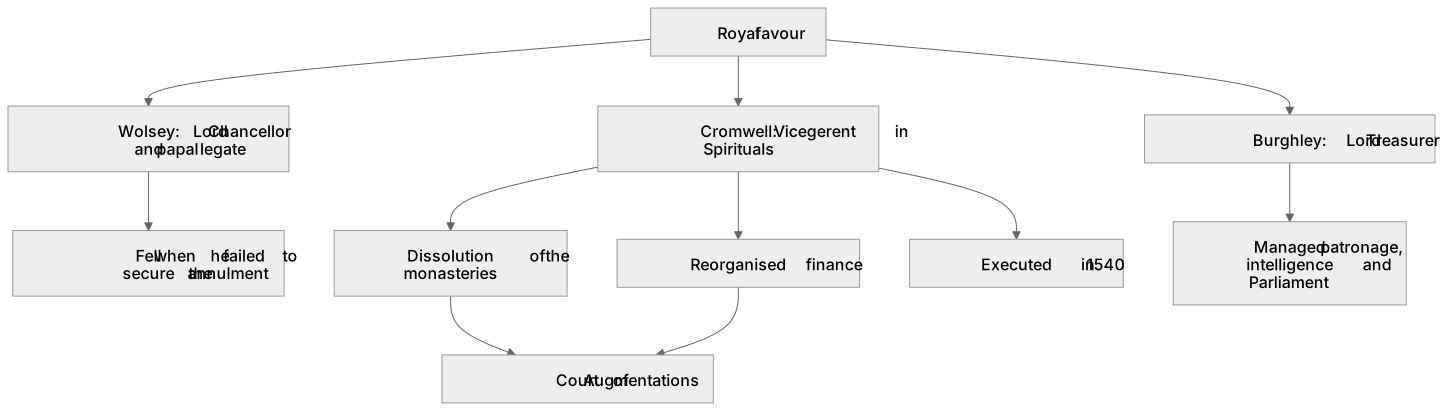
Key words
Say what each word means before you turn the card.
Royal favour and ministerial power
Try answering aloud or in your head before turning the card.
Administrative and financial reform
Try answering aloud or in your head before turning the card.
The role of the Secretary of State
Try answering aloud or in your head before turning the card.
Continuity and change in Tudor government
Try answering aloud or in your head before turning the card.
See every definition
- Royal favour and ministerial power
- Leading ministers served the crown, but their power depended on royal favour, so their influence varied with the monarch's needs.
- Administrative and financial reform
- Cromwell drove the dissolution of the monasteries and reorganised finance, and this administrative reform outlasted his execution in 1540.
- The role of the Secretary of State
- Structural change included the rise of the Secretary of State, and Burghley managed patronage, intelligence and Parliament as principal secretary.
- Continuity and change in Tudor government
- Structural change included the growth of the Privy Council, the decline of the Chamber and new revenue courts, while medieval institutions persisted alongside new bodies.
Label the diagram
Some boxes have lost their names. Pick the right name for each number.
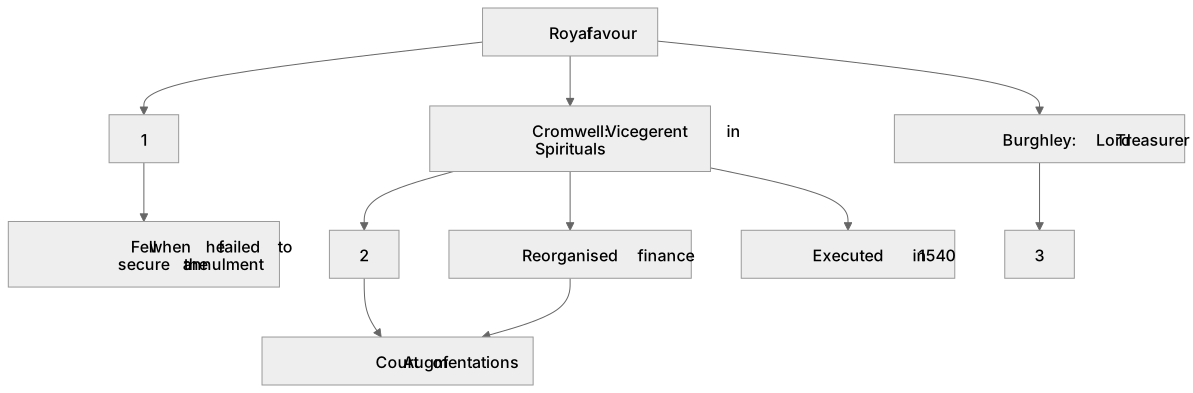
1Box 1
2Box 2
3Box 3
There is more to this lesson
The full lesson goes on to check your understanding and help you earn the marks. Create a free account to carry on, with your progress saved.
A week of Premium from your first lesson · Then the free plan continues · No card, no charge
Test your understanding of Monarchy and government, 1509–88: The principal servants of the crown: the powers exercised by leading ministers; the influence of Wolsey, Cromwell and Burghley. Changes to the structure of government.
Active recall beats re-reading. Take an instant quiz now to test what you’ve learned and lock it into long-term memory.
A week of Premium from your first lesson · Then the free plan continues · No card, no charge