Pearson Edexcel · A-Level · History
Course version: 9HI0 · Version from Sept 2015
Opposition to government, 1918–89: the impact of Versailles, political…
Full specification wording
Opposition, control and consent, 1918–89: Opposition to government, 1918–89: the impact of Versailles, political extremism and crises, 1918–33; opposition and dissent in Nazi Germany, 1933–45; political dissent and active challenge, 1949–89.
Opposition to German governments took varied forms.
Checked against the Pearson Edexcel 9HI0 specification (opens in a new tab) on .
- Point 1 of 3
- 4 key terms
Study notes
From the checked teaching notes for this specification point.
The idea
Opposition to German governments took varied forms. After 1918, the impact of Versailles fuelled resentment and political extremism and crises from left and right during the Weimar Republic, 1918–33. Under Nazi rule, opposition and dissent in Nazi Germany, 1933–45, ranged from underground resistance to non-conformity, met by terror and propaganda. In the FRG, political dissent and active challenge, 1949–89, included parliamentary opposition, extra-parliamentary movements (APO), and terrorism (RAF), while the state used legal measures to defend democracy. The nature and effectiveness of opposition depended on the regime's willingness to tolerate or suppress it.
What earns the marks
- Explains how the impact of Versailles contributed to political extremism and crises in the Weimar Republic, 1918–33, including the 'stab-in-the-back' myth and uprisings.
- Analyses the forms of opposition and dissent in Nazi Germany, 1933–45, such as political resistance, youth groups, and the church, and the regime's responses.
- Evaluates political dissent and active challenge in the FRG, 1949–89, including student protests, the Green movement, and the Red Army Faction.
- Compares the effectiveness of opposition across different regimes, considering factors like repression, popular support, and organisation.
- Uses specific examples, such as the Kapp Putsch (1920), the White Rose (1942–43), and the 1968 student movement.
Common mistakes and how to put them right
Equating all opposition with violent resistance.
Put it right: Opposition included peaceful protest, non-conformity, and parliamentary dissent.
Assuming opposition in Nazi Germany was widespread and effective.
Put it right: It was diverse but often isolated and brutally suppressed.
Ignoring the legal channels of dissent in the FRG.
Put it right: Opposition parties and the Constitutional Court provided legitimate means of challenge.
Exam tips
- Categorise opposition by type (political, religious, youth, etc.) and assess its impact on government policy or stability.
- Use precise examples to illustrate the scale and limits of opposition, such as the 1962 Spiegel Affair or the 1968 protests in the FRG.
- When discussing 'active challenge', distinguish between dissent within the system and attempts to overthrow it.
Try the lesson
The start of the Opposition, control and consent, 1918–89: Opposition to government, 1918–89: the impact of Versailles, political extremism and crises, 1918–33; opposition and dissent in Nazi Germany, 1933–45; political dissent and active challenge, 1949–89. lesson, made from checked teaching notes for this specification point.
Have a go first
Which 1919 treaty imposed territorial losses, military restrictions and reparations on Germany, fuelling extremist opposition to the Weimar Republic?
Listen
Opposition to German governments took varied forms. After 1918, the impact of Versailles fuelled resentment and political extremism and crises from left and right during the Weimar Republic, 1918–33. Under Nazi rule, opposition and dissent in Nazi Germany, 1933–45, ranged from underground resistance to non-conformity, met by terror and propaganda. In the FRG, political dissent and active challenge, 1949–89, included parliamentary opposition, extra-parliamentary movements (APO), and terrorism (RAF), while the state used legal measures to defend democracy. The nature and effectiveness of opposition depended on the regime's willingness to tolerate or suppress it. A strong answer earns marks for these points. Explains how the impact of Versailles contributed to political extremism and crises in the Weimar Republic, 1918–33, including the 'stab-in-the-back' myth and uprisings. Analyses the forms of opposition and dissent in Nazi Germany, 1933–45, such as political resistance, youth groups, and the church, and the regime's responses. Evaluates political dissent and active challenge in the FRG, 1949–89, including student protests, the Green movement, and the Red Army Faction. Compares the effectiveness of opposition across different regimes, considering factors like repression, popular support, and organisation. A common slip: Equating all opposition with violent resistance. Instead, opposition included peaceful protest, non-conformity, and parliamentary dissent. Exam tip: Categorise opposition by type (political, religious, youth, etc.) and assess its impact on government policy or stability.
See it

Put the events in order
Put these events in the order they happened, earliest first.
- 1. Student protests in the FRG
- 2. The Kapp Putsch
- 3. The Spiegel Affair
- 4. The White Rose
Key words
Say what each word means before you turn the card.
Impact of Versailles
Try answering aloud or in your head before turning the card.
Political extremism and crises
Try answering aloud or in your head before turning the card.
Resistance and dissent under dictatorship
Try answering aloud or in your head before turning the card.
Democratic dissent and state responses
Try answering aloud or in your head before turning the card.
See every definition
- Impact of Versailles
- Fuelled resentment and political extremism and crises from left and right during the Weimar Republic, 1918–33.
- Political extremism and crises
- Extremism and crises from left and right during the Weimar Republic, 1918–33, fuelled by the impact of Versailles.
- Resistance and dissent under dictatorship
- Under Nazi rule, 1933–45, ranged from underground resistance to non-conformity, met by terror and propaganda.
- Democratic dissent and state responses
- In the FRG, 1949–89, included parliamentary opposition, extra-parliamentary movements and terrorism, while the state used legal measures to defend democracy.
Label the diagram
Some boxes have lost their names. Pick the right name for each number.
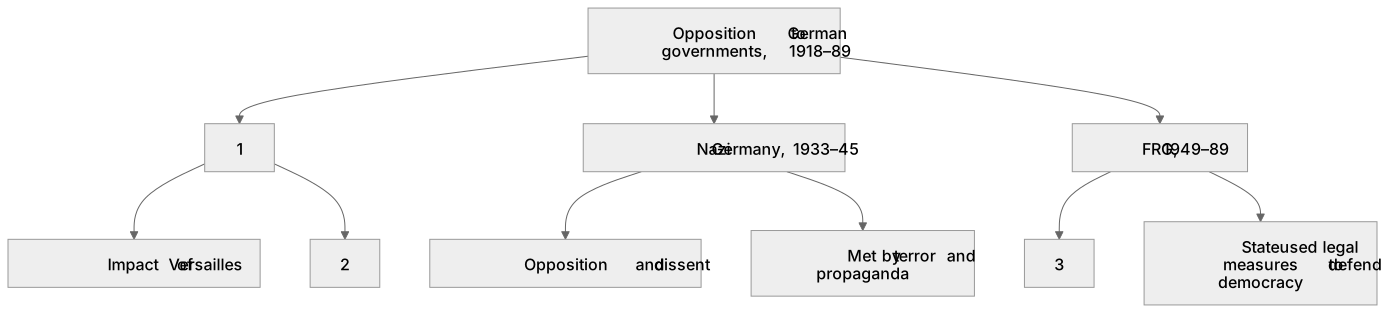
1Box 1
2Box 2
3Box 3
There is more to this lesson
The full lesson goes on to check your understanding and help you earn the marks. Create a free account to carry on, with your progress saved.
A week of Premium from your first lesson · Then the free plan continues · No card, no charge
Test your understanding of Opposition, control and consent, 1918–89: Opposition to government, 1918–89: the impact of Versailles, political extremism and crises, 1918–33; opposition and dissent in Nazi Germany, 1933–45; political dissent and active challenge, 1949–89.
Active recall beats re-reading. Take an instant quiz now to test what you’ve learned and lock it into long-term memory.
A week of Premium from your first lesson · Then the free plan continues · No card, no charge