Pearson Edexcel · A-Level · History
Course version: 9HI0 · Version from Sept 2015
Britain, c1785–c1870: democracy, protest and reform - 3 Unionism and…
Full specification wording
Paper 1, Option 1D: Britain, c1785–c1870: democracy, protest and reform - 3 Unionism and cooperation, c1785–c1870: New model unionism 1835–70, including the significance of the Amalgamated Society of Engineers, the founding of the Trades Union Congress 1868, and the government response to new unionism.
New model unionism emerged between 1835 and 1870, characterised by centralised, national unions of skilled workers with high subscriptions, friendly benefits and cautious strike tactics.
Checked against the Pearson Edexcel 9HI0 specification (opens in a new tab) on .
- Point 2 of 3
- 3 key terms
Study notes
From the checked teaching notes for this specification point.
The idea
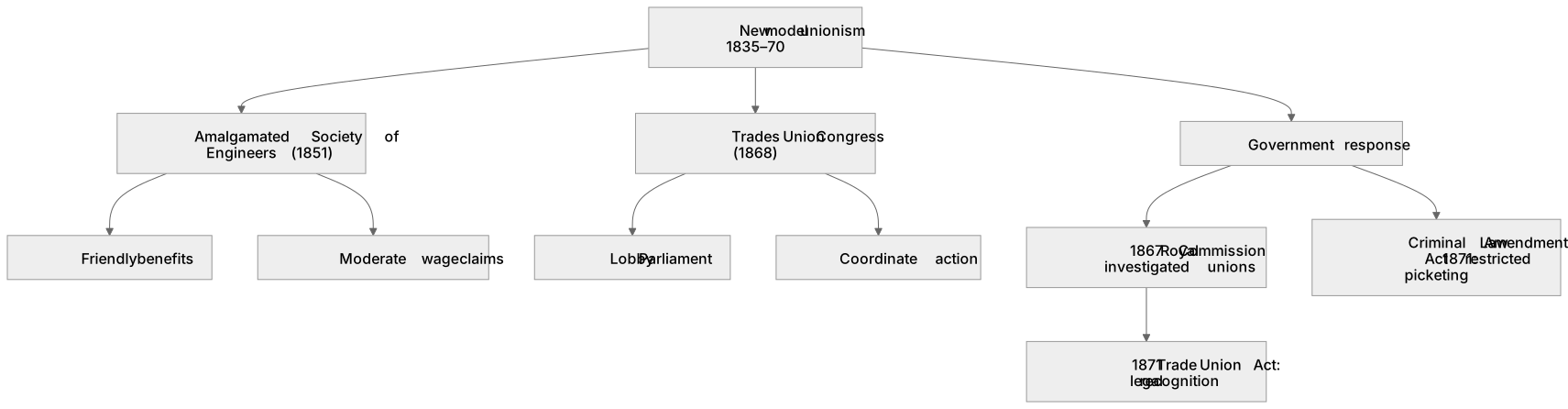
New model unionism emerged between 1835 and 1870, characterised by centralised, national unions of skilled workers with high subscriptions, friendly benefits and cautious strike tactics. The Amalgamated Society of Engineers (1851) exemplified this, offering unemployment, sickness and funeral benefits while pursuing moderate wage claims. The Trades Union Congress (1868) united delegates from various unions to lobby Parliament and coordinate action. The government response evolved: the 1867 Royal Commission investigated unions and found them generally respectable, paving the way for the 1871 Trade Union Act which granted legal recognition, though the Criminal Law Amendment Act restricted picketing.
What earns the marks
- Describes key features of new model unionism 1835–70: national organisation, high subscriptions, friendly benefits, and moderate tactics.
- Explains the significance of the Amalgamated Society of Engineers as a model of stability and respectability for skilled workers.
- Analyses the founding of the Trades Union Congress in 1868 and its role in coordinating union activity and political lobbying.
- Evaluates government responses: the 1867 Royal Commission investigated unions, leading to the Trade Union Act 1871 which granted legal recognition.
- Assesses the impact of the Criminal Law Amendment Act 1871, which restricted picketing despite the legalisation of unions.
Common mistakes and how to put them right
Confusing new model unions with earlier trade societies.
Put it right: New model unions were national, centralised, and offered friendly benefits.
Claiming the TUC was founded to organise strikes.
Put it right: It primarily coordinated political lobbying and representation.
Stating the 1867 Royal Commission granted legal recognition to unions.
Put it right: The Commission only investigated and reported; it was the 1871 Trade Union Act that granted legal recognition.
Exam tips
- Use the Amalgamated Society of Engineers as a concrete example of new model unionism.
- Distinguish between the 1871 Trade Union Act and the Criminal Law Amendment Act in terms of their effects.
- Link the founding of the TUC to the broader movement for political reform and working-class representation.
Try the lesson
The start of the Paper 1, Option 1D: Britain, c1785–c1870: democracy, protest and reform - 3 Unionism and cooperation, c1785–c1870: New model unionism 1835–70, including the significance of the Amalgamated Society of Engineers, the founding of the Trades Union Congress 1868, and the government response to new unionism. lesson, made from checked teaching notes for this specification point.
Have a go first
In which year was the Trades Union Congress founded?
Listen
New model unionism emerged between 1835 and 1870, characterised by centralised, national unions of skilled workers with high subscriptions, friendly benefits and cautious strike tactics. The Amalgamated Society of Engineers (1851) exemplified this, offering unemployment, sickness and funeral benefits while pursuing moderate wage claims. The Trades Union Congress (1868) united delegates from various unions to lobby Parliament and coordinate action. The government response evolved: the 1867 Royal Commission investigated unions and found them generally respectable, paving the way for the 1871 Trade Union Act which granted legal recognition, though the Criminal Law Amendment Act restricted picketing. A strong answer earns marks for these points. Describes key features of new model unionism 1835–70: national organisation, high subscriptions, friendly benefits, and moderate tactics. Explains the significance of the Amalgamated Society of Engineers as a model of stability and respectability for skilled workers. Analyses the founding of the Trades Union Congress in 1868 and its role in coordinating union activity and political lobbying. Evaluates government responses: the 1867 Royal Commission investigated unions, leading to the Trade Union Act 1871 which granted legal recognition. A common slip: confusing new model unions with earlier trade societies. Instead, new model unions were national, centralised, and offered friendly benefits. Exam tip: Use the Amalgamated Society of Engineers as a concrete example of new model unionism.
See it
Put the events in order
Put these events in the order they happened, earliest first.
- 1. Trade Union Act granted legal recognition to unions
- 2. Amalgamated Society of Engineers founded as model of stability
- 3. Trades Union Congress founded to coordinate lobbying
- 4. Royal Commission investigated unions and found them respectable
Key words
Say what each word means before you turn the card.
Respectability and moderation
Try answering aloud or in your head before turning the card.
National organisation and coordination
Try answering aloud or in your head before turning the card.
Legal recognition and political lobbying
Try answering aloud or in your head before turning the card.
See every definition
- Respectability and moderation
- The cautious tactics and friendly benefits of new model unions, which the 1867 Royal Commission found generally respectable.
- National organisation and coordination
- A key feature of new model unionism, being centralised and national, with the Trades Union Congress coordinating action.
- Legal recognition and political lobbying
- Granted by the 1871 Trade Union Act, while the Trades Union Congress lobbied Parliament and coordinated representation.
Label the diagram
Some boxes have lost their names. Pick the right name for each number.
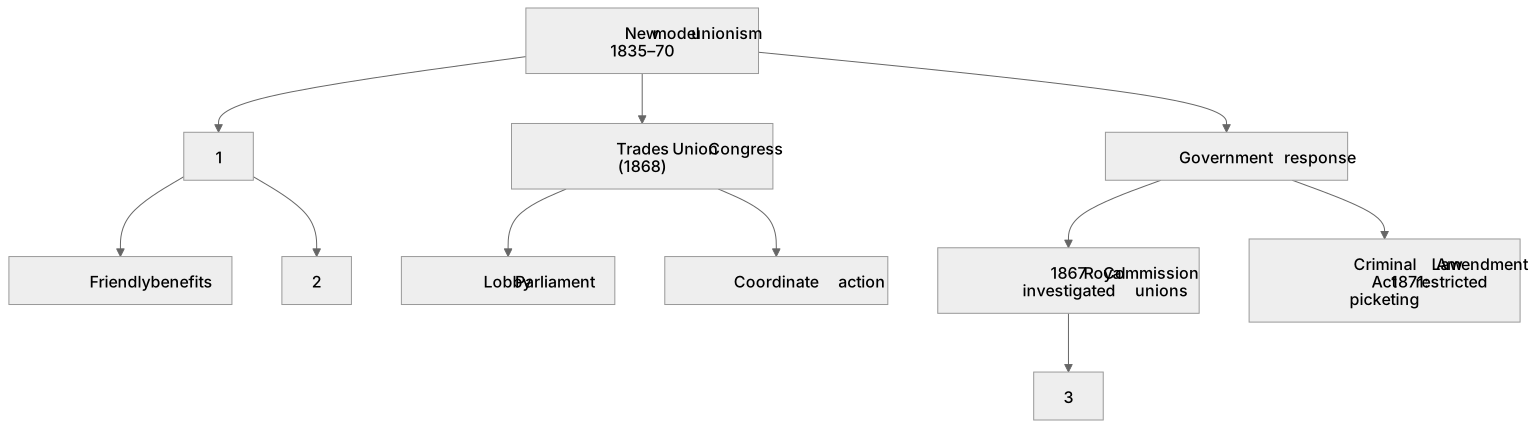
1Box 1
2Box 2
3Box 3
There is more to this lesson
The full lesson goes on to check your understanding and help you earn the marks. Create a free account to carry on, with your progress saved.
A week of Premium from your first lesson · Then the free plan continues · No card, no charge
Test your understanding of Paper 1, Option 1D: Britain, c1785–c1870: democracy, protest and reform - 3 Unionism and cooperation, c1785–c1870: New model unionism 1835–70, including the significance of the Amalgamated Society of Engineers, the founding of the Trades Union Congress 1868, and the government response to new unionism.
Active recall beats re-reading. Take an instant quiz now to test what you’ve learned and lock it into long-term memory.
A week of Premium from your first lesson · Then the free plan continues · No card, no charge