Pearson Edexcel · A-Level · History
Course version: 9HI0 · Version from Sept 2015
Britain, c1785–c1870: democracy, protest and reform - 4 Poverty and…
Full specification wording
Paper 1, Option 1D: Britain, c1785–c1870: democracy, protest and reform - 4 Poverty and pauperism, c1785–c1870: Changing attitudes towards the poor and pauperism, 1834– 70: the impact of the Andover workhouse scandal on national opinion; the growth of charity and self-help; the significance of key individuals, including Dickens and Smiles, in challenging attitudes.
Between 1834 and 1870, attitudes to poverty shifted from harsh deterrence towards greater sympathy and self-help.
Checked against the Pearson Edexcel 9HI0 specification (opens in a new tab) on .
- Point 3 of 3
- 4 key terms
Study notes
From the checked teaching notes for this specification point.
The idea
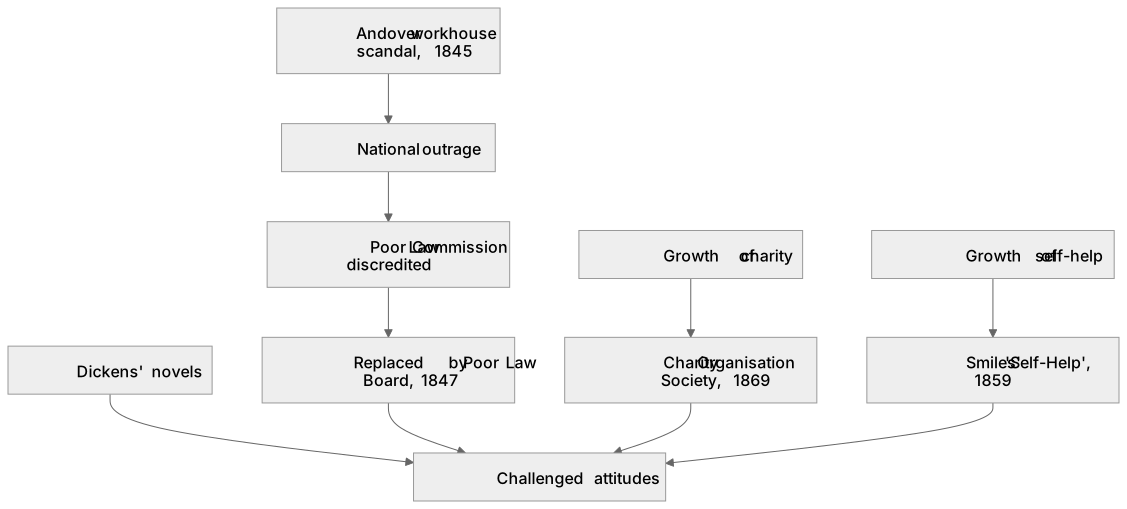
Between 1834 and 1870, attitudes to poverty shifted from harsh deterrence towards greater sympathy and self-help. The Andover workhouse scandal of 1845 exposed cruelty and mismanagement, where inmates were reduced to gnawing bones for marrow, causing national outrage and discrediting the Poor Law Commission. This fuelled criticism and led to reforms. Meanwhile, charity expanded through organisations like the Charity Organisation Society (founded 1869), which stressed careful giving, and self-help was promoted by Samuel Smiles' 'Self-Help' (1859), advocating thrift and independence. Charles Dickens attacked workhouse conditions and utilitarian attitudes in novels such as 'Oliver Twist' (1838) and 'Hard Times' (1854), shaping public opinion.
What earns the marks
- Explains the Andover workhouse scandal: exposure of starvation and bone-gnawing in 1845, leading to public outcry and a parliamentary inquiry.
- Assesses the scandal's impact on national opinion: it undermined confidence in the New Poor Law and contributed to the replacement of the Poor Law Commission with the Poor Law Board in 1847.
- Describes the growth of charity: the rise of charitable organisations, including the Charity Organisation Society, and their role in providing relief and promoting moral improvement.
- Explains the growth of self-help: Samuel Smiles' 'Self-Help' (1859) and its influence in encouraging individual responsibility and thrift among the working classes.
- Analyses Dickens' significance: his novels exposed workhouse cruelty and satirised utilitarian attitudes, influencing middle-class opinion and humanising the poor.
- Evaluates how these factors challenged attitudes: they fostered sympathy, but also reinforced distinctions between deserving and undeserving poor.
Common mistakes and how to put them right
Claiming the Andover scandal immediately ended the workhouse system.
Put it right: It led to reforms and greater oversight, but workhouses continued; the scandal mainly discredited the central commission.
Treating charity and self-help as identical.
Put it right: Charity involved organised giving from the wealthy, while self-help emphasised individual effort and independence among the poor themselves.
Overstating Dickens' direct political influence.
Put it right: His novels shaped public sympathy and attitudes, but change was gradual and driven by multiple factors including scandal and economic shifts.
Exam tips
- Use specific details from the Andover scandal, such as the date (1845) and the bone-gnawing, to show precise knowledge.
- Link Dickens' novels to specific criticisms of the Poor Law, e.g., 'Oliver Twist' and the workhouse, to demonstrate understanding of his role.
- When discussing changing attitudes, distinguish between short-term outrage and long-term shifts, and consider different social classes' perspectives.
Try the lesson
The start of the Paper 1, Option 1D: Britain, c1785–c1870: democracy, protest and reform - 4 Poverty and pauperism, c1785–c1870: Changing attitudes towards the poor and pauperism, 1834– 70: the impact of the Andover workhouse scandal on national opinion; the growth of charity and self-help; the significance of key individuals, including Dickens and Smiles, in challenging attitudes. lesson, made from checked teaching notes for this specification point.
Have a go first
What was the primary impact of the Andover workhouse scandal (1845) on national attitudes towards the poor and pauperism?
Listen
Between 1834 and 1870, attitudes to poverty shifted from harsh deterrence towards greater sympathy and self-help. The Andover workhouse scandal of 1845 exposed cruelty and mismanagement, where inmates were reduced to gnawing bones for marrow, causing national outrage and discrediting the Poor Law Commission. This fuelled criticism and led to reforms. Meanwhile, charity expanded through organisations like the Charity Organisation Society (founded 1869), which stressed careful giving, and self-help was promoted by Samuel Smiles' 'Self-Help' (1859), advocating thrift and independence. Charles Dickens attacked workhouse conditions and utilitarian attitudes in novels such as 'Oliver Twist' (1838) and 'Hard Times' (1854), shaping public opinion. A strong answer earns marks for these points. Explains the Andover workhouse scandal: exposure of starvation and bone-gnawing in 1845, leading to public outcry and a parliamentary inquiry. Assesses the scandal's impact on national opinion: it undermined confidence in the New Poor Law and contributed to the replacement of the Poor Law Commission with the Poor Law Board in 1847. Describes the growth of charity: the rise of charitable organisations, including the Charity Organisation Society, and their role in providing relief and promoting moral improvement. Explains the growth of self-help: Samuel Smiles' 'Self-Help' (1859) and its influence in encouraging individual responsibility and thrift among the working classes. A common slip: claiming the Andover scandal immediately ended the workhouse system. Instead, it led to reforms and greater oversight, but workhouses continued; the scandal mainly discredited the central commission. Exam tip: Use specific details from the Andover scandal, such as the date (1845) and the bone-gnawing, to show precise knowledge.
See it
Put the events in order
Put these events in the order they happened, earliest first.
- 1. Poor Law Commission replaced by the Poor Law Board
- 2. Dickens satirised utilitarian attitudes in 'Hard Times'
- 3. Samuel Smiles' 'Self-Help' promoted thrift and independence
- 4. Andover workhouse scandal exposed starvation and bone-gnawing
- 5. Dickens attacked workhouse conditions in 'Oliver Twist'
- 6. Charity Organisation Society founded, stressing careful giving
Key words
Say what each word means before you turn the card.
Scandal and public opinion
Try answering aloud or in your head before turning the card.
Charity and philanthropy
Try answering aloud or in your head before turning the card.
Self-help and respectability
Try answering aloud or in your head before turning the card.
Literary influence on social reform
Try answering aloud or in your head before turning the card.
See every definition
- Scandal and public opinion
- The Andover workhouse scandal of 1845 exposed cruelty and mismanagement, causing national outrage and discrediting the Poor Law Commission.
- Charity and philanthropy
- Charity expanded through organisations like the Charity Organisation Society, founded 1869, which stressed careful giving and promoted moral improvement.
- Self-help and respectability
- Self-help was promoted by Samuel Smiles' 'Self-Help' (1859), advocating thrift and independence among the working classes.
- Literary influence on social reform
- Charles Dickens attacked workhouse conditions and utilitarian attitudes in novels such as 'Oliver Twist' and 'Hard Times', shaping public opinion.
Label the diagram
Some boxes have lost their names. Pick the right name for each number.
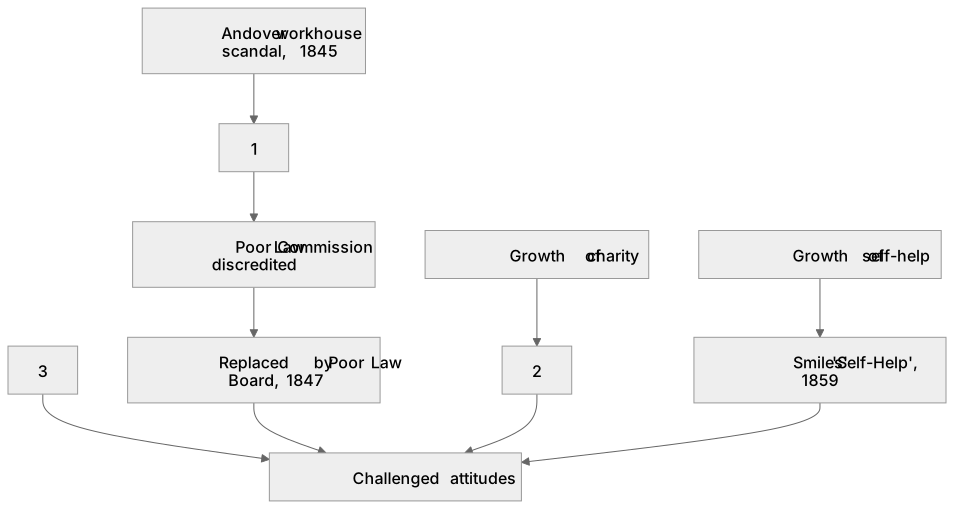
1Box 1
2Box 2
3Box 3
There is more to this lesson
The full lesson goes on to check your understanding and help you earn the marks. Create a free account to carry on, with your progress saved.
A week of Premium from your first lesson · Then the free plan continues · No card, no charge
Test your understanding of Paper 1, Option 1D: Britain, c1785–c1870: democracy, protest and reform - 4 Poverty and pauperism, c1785–c1870: Changing attitudes towards the poor and pauperism, 1834– 70: the impact of the Andover workhouse scandal on national opinion; the growth of charity and self-help; the significance of key individuals, including Dickens and Smiles, in challenging attitudes.
Active recall beats re-reading. Take an instant quiz now to test what you’ve learned and lock it into long-term memory.
A week of Premium from your first lesson · Then the free plan continues · No card, no charge