Pearson Edexcel · A-Level · History
Course version: 9HI0 · Version from Sept 2015
The unification of Italy, c1830–70 - 2 The rise of Piedmont, 1849–56:…
Full specification wording
Paper 2, Option 2D.1: The unification of Italy, c1830–70 - 2 The rise of Piedmont, 1849–56: Developments in diplomacy: relationship with Austria 1849; the significance of the Crimean War and Congress of Paris; relations with Britain and France; the significance of Cavour.
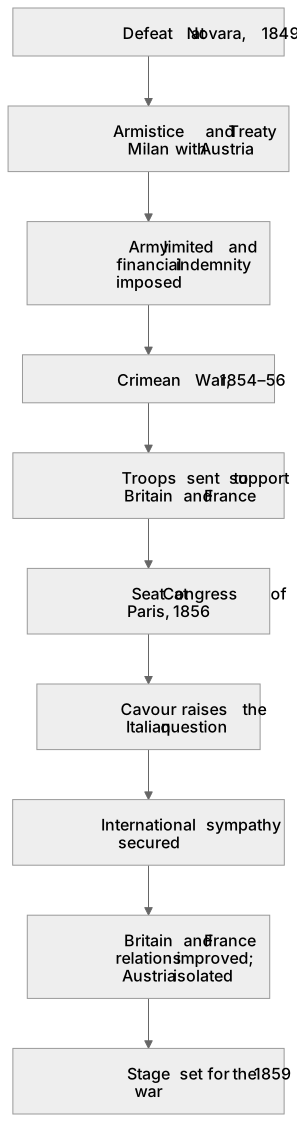
After defeat at Novara in 1849, Piedmont's relationship with Austria was defined by the armistice and the Treaty of Milan, which limited its army and imposed a financial indemnity.
Checked against the Pearson Edexcel 9HI0 specification (opens in a new tab) on .
- Point 4 of 4
- 4 key terms
Study notes
From the checked teaching notes for this specification point.
The idea
After defeat at Novara in 1849, Piedmont's relationship with Austria was defined by the armistice and the Treaty of Milan, which limited its army and imposed a financial indemnity. Cavour used the Crimean War (1854–56) to send troops to support Britain and France, gaining a seat at the Congress of Paris in 1856 where he raised the Italian question. Relations with Britain and France improved through trade treaties and diplomatic support, isolating Austria. Cavour's diplomacy secured international sympathy and set the stage for the 1859 war, making him central to Piedmont's rise.
What earns the marks
- Explains the terms and consequences of the 1849 armistice and Treaty of Milan with Austria, including the military and financial restrictions.
- Assesses the significance of Piedmont's participation in the Crimean War, including the dispatch of troops in 1855 and the resulting diplomatic leverage.
- Evaluates the Congress of Paris in 1856, where Cavour raised the Italian question despite no formal discussion, and its impact on Piedmont's international standing.
- Analyses relations with Britain and France, including trade agreements and diplomatic support, and how these isolated Austria.
- Judges the significance of Cavour's diplomatic strategy in aligning Piedmont with the Western powers and preparing for future conflict with Austria.
Common mistakes and how to put them right
Assuming the Congress of Paris formally resolved the Italian question.
Put it right: Note that Cavour raised it informally and secured sympathy rather than a settlement.
Overstating the immediate military impact of Piedmont's role in the Crimean War.
Put it right: Emphasise its diplomatic rather than military significance.
Treating relations with Britain and France as uniformly supportive.
Put it right: Recognise British caution and French self-interest, especially under Napoleon III.
Exam tips
- Use specific dates and terms, such as the 1849 Treaty of Milan and the 1856 Congress of Paris, to support your arguments.
- Link diplomatic developments to Cavour's broader strategy of isolating Austria and gaining great-power support.
- Compare the relative importance of the Crimean War and the Congress of Paris in improving Piedmont's position.
Try the lesson
The start of the Paper 2, Option 2D.1: The unification of Italy, c1830–70 - 2 The rise of Piedmont, 1849–56: Developments in diplomacy: relationship with Austria 1849; the significance of the Crimean War and Congress of Paris; relations with Britain and France; the significance of Cavour. lesson, made from checked teaching notes for this specification point.
Have a go first
Which major European power defeated Piedmont at the Battle of Novara in 1849, leading to a peace settlement that confirmed its dominance in northern Italy?
Listen
After defeat at Novara in 1849, Piedmont's relationship with Austria was defined by the armistice and the Treaty of Milan, which limited its army and imposed a financial indemnity. Cavour used the Crimean War (1854–56) to send troops to support Britain and France, gaining a seat at the Congress of Paris in 1856 where he raised the Italian question. Relations with Britain and France improved through trade treaties and diplomatic support, isolating Austria. Cavour's diplomacy secured international sympathy and set the stage for the 1859 war, making him central to Piedmont's rise. A strong answer earns marks for these points. Explains the terms and consequences of the 1849 armistice and Treaty of Milan with Austria, including the military and financial restrictions. Assesses the significance of Piedmont's participation in the Crimean War, including the dispatch of troops in 1855 and the resulting diplomatic leverage. Evaluates the Congress of Paris in 1856, where Cavour raised the Italian question despite no formal discussion, and its impact on Piedmont's international standing. Analyses relations with Britain and France, including trade agreements and diplomatic support, and how these isolated Austria. A common slip: Assuming the Congress of Paris formally resolved the Italian question. Instead, note that Cavour raised it informally and secured sympathy rather than a settlement. Exam tip: Use specific dates and terms, such as the 1849 Treaty of Milan and the 1856 Congress of Paris, to support your arguments.
See it
Put the events in order
Put these events in the order they happened, earliest first.
- 1. War with Austria that Cavour's diplomacy helped set stage for
- 2. Armistice and Treaty of Milan restricted Piedmont's army and imposed indemnity
- 3. Congress of Paris where Cavour raised the Italian question
- 4. Piedmont dispatched troops to support Britain and France in Crimean War
Key words
Say what each word means before you turn the card.
Treaty of Milan
Try answering aloud or in your head before turning the card.
Congress of Paris
Try answering aloud or in your head before turning the card.
Crimean War
Try answering aloud or in your head before turning the card.
Cavour
Try answering aloud or in your head before turning the card.
See every definition
- Treaty of Milan
- The 1849 settlement with Austria, following the armistice, which limited Piedmont's army and imposed a financial indemnity.
- Congress of Paris
- The 1856 gathering where Cavour raised the Italian question, securing sympathy rather than a settlement.
- Crimean War
- The 1854–56 conflict in which Cavour sent troops to support Britain and France, gaining diplomatic leverage.
- Cavour
- The figure whose diplomacy aligned Piedmont with the Western powers, isolated Austria and prepared for the 1859 war.
Label the diagram
Some boxes have lost their names. Pick the right name for each number.
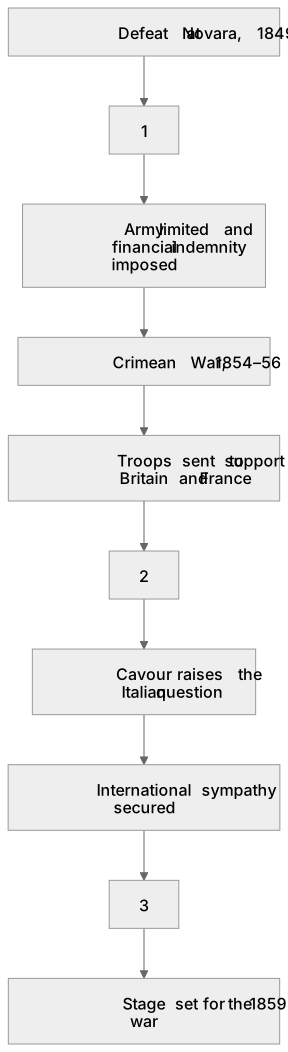
1Box 1
2Box 2
3Box 3
There is more to this lesson
The full lesson goes on to check your understanding and help you earn the marks. Create a free account to carry on, with your progress saved.
A week of Premium from your first lesson · Then the free plan continues · No card, no charge
Test your understanding of Paper 2, Option 2D.1: The unification of Italy, c1830–70 - 2 The rise of Piedmont, 1849–56: Developments in diplomacy: relationship with Austria 1849; the significance of the Crimean War and Congress of Paris; relations with Britain and France; the significance of Cavour.
Active recall beats re-reading. Take an instant quiz now to test what you’ve learned and lock it into long-term memory.
A week of Premium from your first lesson · Then the free plan continues · No card, no charge