Pearson Edexcel · A-Level · History
Course version: 9HI0 · Version from Sept 2015
The unification of Italy, c1830–70 - 2 The rise of Piedmont, 1849–56:…
Full specification wording
Paper 2, Option 2D.1: The unification of Italy, c1830–70 - 2 The rise of Piedmont, 1849–56: Political developments in Piedmont: the rule of Victor Emmanuel II; the appointment of Cavour 1852 and its impact; anticlericalism; policies to create political stability; liberal and nationalist influences.
After 1849, Victor Emmanuel II ruled Piedmont as a constitutional monarch under the Statuto, balancing royal authority with parliamentary government.
Checked against the Pearson Edexcel 9HI0 specification (opens in a new tab) on .
- Point 2 of 4
- 3 key terms
Study notes
From the checked teaching notes for this specification point.
The idea
After 1849, Victor Emmanuel II ruled Piedmont as a constitutional monarch under the Statuto, balancing royal authority with parliamentary government. His appointment of Cavour as Prime Minister in 1852 transformed Piedmontese politics. Cavour used the Connubio—a centrist alliance between his centre-right and Rattazzi's centre-left—to marginalise radical and clerical extremes, creating political stability. His anticlericalism reduced Church privileges and property, provoking papal conflict but strengthening secular liberal control. Economic reforms modernised Piedmont. Liberal and nationalist influences shaped policy, making Piedmont a model state and potential leader of Italian unification, though Cavour's initial aims focused on Piedmontese expansion.
What earns the marks
- Explains Victor Emmanuel II's rule as a constitutional monarch who preserved the Statuto and supported Cavour's reforms while retaining royal prerogatives.
- Assesses the impact of Cavour's 1852 appointment, noting how he stabilised government through the Connubio and promoted modernisation.
- Analyses anticlericalism, detailing how Cavour reduced Church privileges and asserted state control over property, consolidating secular liberalism.
- Evaluates policies for political stability, showing how the Connubio and economic reforms managed radical unrest.
- Examines liberal and nationalist influences, explaining how Piedmont became a refuge for liberals and a symbol of Italian nationalism.
Common mistakes and how to put them right
Overstating Cavour's democratic credentials.
Put it right: Cavour was a pragmatic liberal monarchist who used limited suffrage and political manipulation to secure stability.
Assuming anticlericalism meant atheism.
Put it right: Cavour sought state control over Church institutions and reduced privileges, not the abolition of religion.
Describing the Connubio as a centre-right alliance.
Put it right: It was a centrist coalition uniting Cavour's centre-right with Rattazzi's centre-left.
Exam tips
- Connect Cavour's domestic policies for political stability to his foreign policy aims, showing how a secure home front enabled an assertive role abroad.
- Use specific examples, such as the Connubio (1852) and anticlerical legislation, to illustrate political developments and liberal influences.
Try the lesson
The start of the Paper 2, Option 2D.1: The unification of Italy, c1830–70 - 2 The rise of Piedmont, 1849–56: Political developments in Piedmont: the rule of Victor Emmanuel II; the appointment of Cavour 1852 and its impact; anticlericalism; policies to create political stability; liberal and nationalist influences. lesson, made from checked teaching notes for this specification point.
Have a go first
In which year did Cavour become Prime Minister of Piedmont?
Listen
After 1849, Victor Emmanuel II ruled Piedmont as a constitutional monarch under the Statuto, balancing royal authority with parliamentary government. His appointment of Cavour as Prime Minister in 1852 transformed Piedmontese politics. Cavour used the Connubio—a centrist alliance between his centre-right and Rattazzi's centre-left—to marginalise radical and clerical extremes, creating political stability. His anticlericalism reduced Church privileges and property, provoking papal conflict but strengthening secular liberal control. Economic reforms modernised Piedmont. Liberal and nationalist influences shaped policy, making Piedmont a model state and potential leader of Italian unification, though Cavour's initial aims focused on Piedmontese expansion. A strong answer earns marks for these points. Explains Victor Emmanuel II's rule as a constitutional monarch who preserved the Statuto and supported Cavour's reforms while retaining royal prerogatives. Assesses the impact of Cavour's 1852 appointment, noting how he stabilised government through the Connubio and promoted modernisation. Analyses anticlericalism, detailing how Cavour reduced Church privileges and asserted state control over property, consolidating secular liberalism. Evaluates policies for political stability, showing how the Connubio and economic reforms managed radical unrest. A common slip: Overstating Cavour's democratic credentials. Instead, Cavour was a pragmatic liberal monarchist who used limited suffrage and political manipulation to secure stability. Exam tip: Connect Cavour's domestic policies for political stability to his foreign policy aims, showing how a secure home front enabled an assertive role abroad.
See it
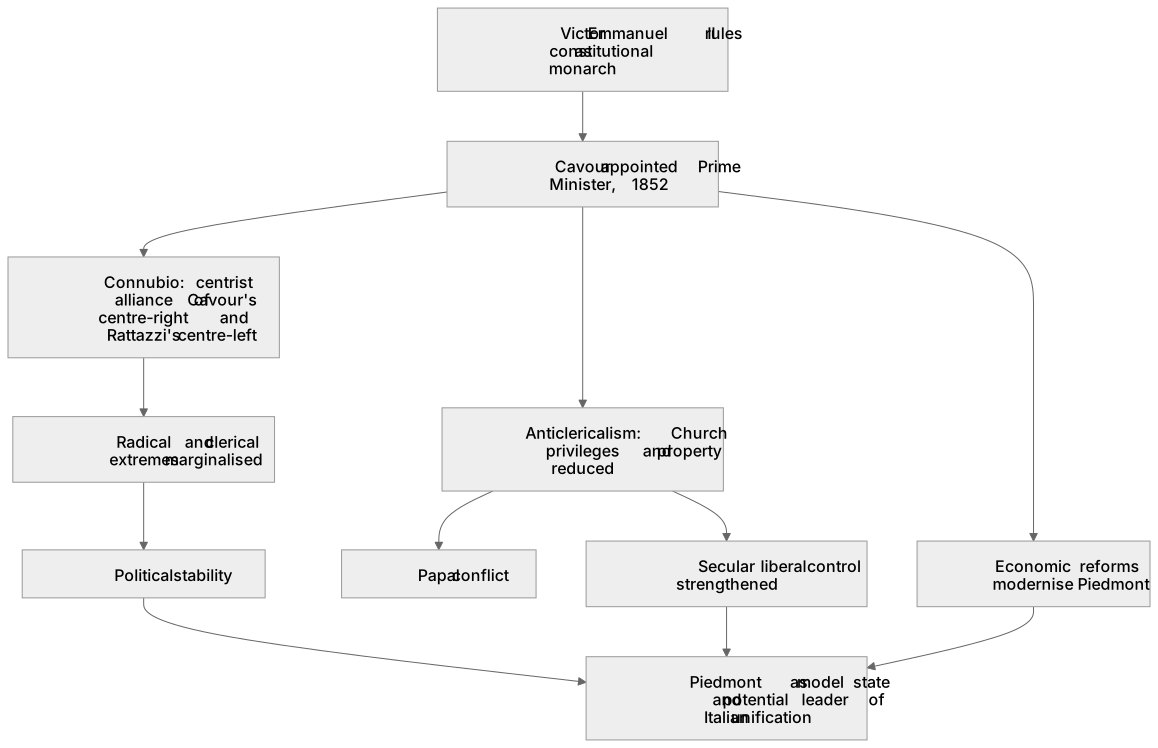
Key words
Say what each word means before you turn the card.
Constitutional monarchy under the Statuto
Try answering aloud or in your head before turning the card.
Cavour's political strategy and the Connubio
Try answering aloud or in your head before turning the card.
Anticlericalism and state–Church conflict
Try answering aloud or in your head before turning the card.
See every definition
- Constitutional monarchy under the Statuto
- Victor Emmanuel II ruled Piedmont after 1849 as a constitutional monarch under the Statuto, balancing royal authority with parliamentary government.
- Cavour's political strategy and the Connubio
- Cavour used the Connubio, a centrist alliance between his centre-right and Rattazzi's centre-left, to marginalise radical and clerical extremes and create political stability.
- Anticlericalism and state–Church conflict
- Cavour's anticlericalism reduced Church privileges and property, provoking papal conflict but strengthening secular liberal control.
Label the diagram
Some boxes have lost their names. Pick the right name for each number.
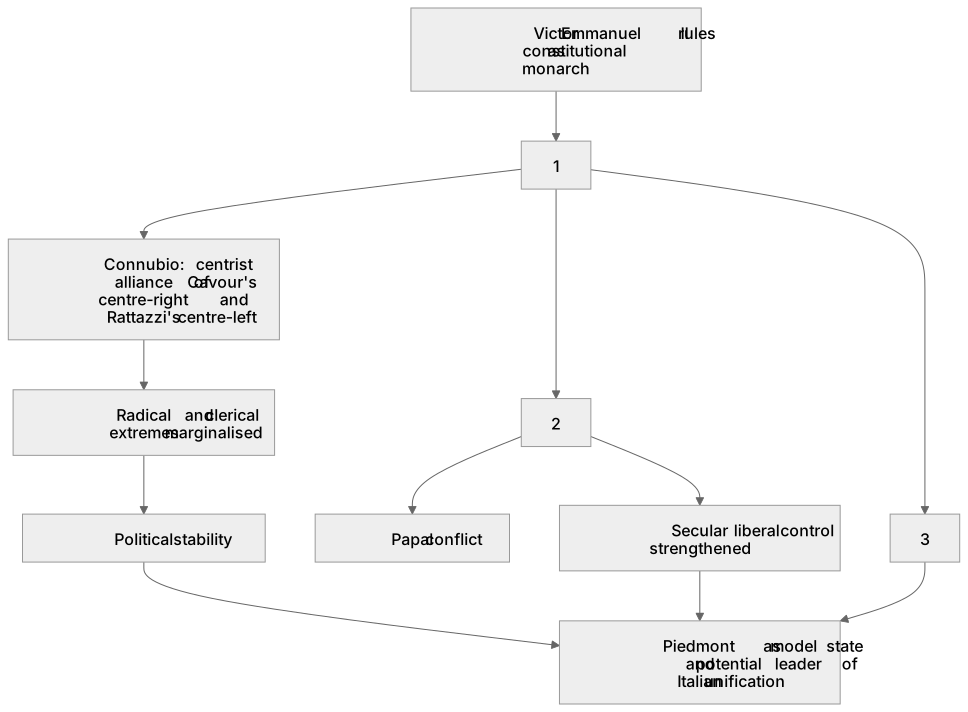
1Box 1
2Box 2
3Box 3
There is more to this lesson
The full lesson goes on to check your understanding and help you earn the marks. Create a free account to carry on, with your progress saved.
A week of Premium from your first lesson · Then the free plan continues · No card, no charge
Test your understanding of Paper 2, Option 2D.1: The unification of Italy, c1830–70 - 2 The rise of Piedmont, 1849–56: Political developments in Piedmont: the rule of Victor Emmanuel II; the appointment of Cavour 1852 and its impact; anticlericalism; policies to create political stability; liberal and nationalist influences.
Active recall beats re-reading. Take an instant quiz now to test what you’ve learned and lock it into long-term memory.
A week of Premium from your first lesson · Then the free plan continues · No card, no charge