Pearson Edexcel · A-Level · History
Course version: 9HI0 · Version from Sept 2015
The unification of Germany, c1840–71 - 3 Austro- Prussian rivalry,…
Full specification wording
Paper 2, Option 2D.2: The unification of Germany, c1840–71 - 3 Austro- Prussian rivalry, 1852–66: Austrian strengths and weaknesses: political influence in Germany; economic and financial problems; rejection from the Zollverein; international setbacks.
Austria's position in Germany rested on political influence, especially its presidency of the German Confederation, which let it shape the Bund's agenda and block Prussian initiatives.
Checked against the Pearson Edexcel 9HI0 specification (opens in a new tab) on .
- Point 1 of 4
Study notes
From the checked teaching notes for this specification point.
The idea
Austria's position in Germany rested on political influence, especially its presidency of the German Confederation, which let it shape the Bund's agenda and block Prussian initiatives. However, its economic and financial problems undermined this: the state was heavily indebted, tax revenue lagged behind Prussia's, and industrialisation was slower. Its exclusion from the Zollverein, confirmed when Prussia renewed the customs union in 1853 without Austria, weakened its economic leverage over smaller German states. Internationally, Austria suffered setbacks in the Crimean War and the Italian War of 1859, losing Lombardy and prestige. These factors combined to erode Austria's ability to lead Germany against a rising Prussia.
What earns the marks
- Political influence: Austria chaired the German Confederation's Federal Diet, giving it a platform to coordinate conservative states and resist Prussian expansion.
- Economic and financial problems: high public debt, budget deficits, and reliance on agrarian revenues limited Austria's capacity to fund modernisation or military reform.
- Rejection from the Zollverein: Prussia's renewal of the customs union in 1853 excluded Austria, denying it access to a growing German market and weakening its economic ties with smaller states.
- International setbacks: defeat in the Italian War of 1859 (loss of Lombardy) and diplomatic isolation during the Crimean War damaged Austria's great-power standing and military reputation.
- Interaction of factors: political influence could not compensate for economic weakness, and international defeats further reduced Austria's credibility among German states.
Common mistakes and how to put them right
Claiming Austria was expelled from the Zollverein in 1853.
Put it right: Austria was never a member of the Zollverein; the 1853 renewal by Prussia simply rejected Austria's attempts to join, cementing its exclusion.
Stating that Austria's political influence was negligible.
Put it right: Austria retained the presidency of the German Confederation and significant influence over smaller states, even as its economic and military position declined.
Treating the 1859 Italian War as a minor event.
Put it right: The loss of Lombardy was a major international setback that exposed Austrian military weakness and encouraged Prussia's ambitions.
Exam tips
- When analysing Austrian weaknesses, link each factor to its impact on Austro-Prussian rivalry, for example how exclusion from the Zollverein reduced Austria's leverage over German states.
- Use precise dates and terms: 1853 Zollverein renewal, 1859 Treaty of Zurich, German Confederation, Federal Diet.
- Avoid simple lists; explain how political, economic, and international factors interacted to weaken Austria's position by the early 1860s.
Try the lesson
The start of the Paper 2, Option 2D.2: The unification of Germany, c1840–71 - 3 Austro- Prussian rivalry, 1852–66: Austrian strengths and weaknesses: political influence in Germany; economic and financial problems; rejection from the Zollverein; international setbacks. lesson, made from checked teaching notes for this specification point.
Have a go first
Which body gave Austria a leading voice in German affairs during the 1850s?
Listen
Austria's position in Germany rested on political influence, especially its presidency of the German Confederation, which let it shape the Bund's agenda and block Prussian initiatives. However, its economic and financial problems undermined this: the state was heavily indebted, tax revenue lagged behind Prussia's, and industrialisation was slower. Its exclusion from the Zollverein, confirmed when Prussia renewed the customs union in 1853 without Austria, weakened its economic leverage over smaller German states. Internationally, Austria suffered setbacks in the Crimean War and the Italian War of 1859, losing Lombardy and prestige. These factors combined to erode Austria's ability to lead Germany against a rising Prussia. A strong answer earns marks for these points. Political influence: Austria chaired the German Confederation's Federal Diet, giving it a platform to coordinate conservative states and resist Prussian expansion. Economic and financial problems: high public debt, budget deficits, and reliance on agrarian revenues limited Austria's capacity to fund modernisation or military reform. Rejection from the Zollverein: Prussia's renewal of the customs union in 1853 excluded Austria, denying it access to a growing German market and weakening its economic ties with smaller states. International setbacks: defeat in the Italian War of 1859 (loss of Lombardy) and diplomatic isolation during the Crimean War damaged Austria's great-power standing and military reputation. A common slip: Claiming Austria was expelled from the Zollverein in 1853. Instead, Austria was never a member of the Zollverein; the 1853 renewal by Prussia simply rejected Austria's attempts to join, cementing its exclusion. Exam tip: When analysing Austrian weaknesses, link each factor to its impact on Austro-Prussian rivalry, for example how exclusion from the Zollverein reduced Austria's leverage over German states.
See it
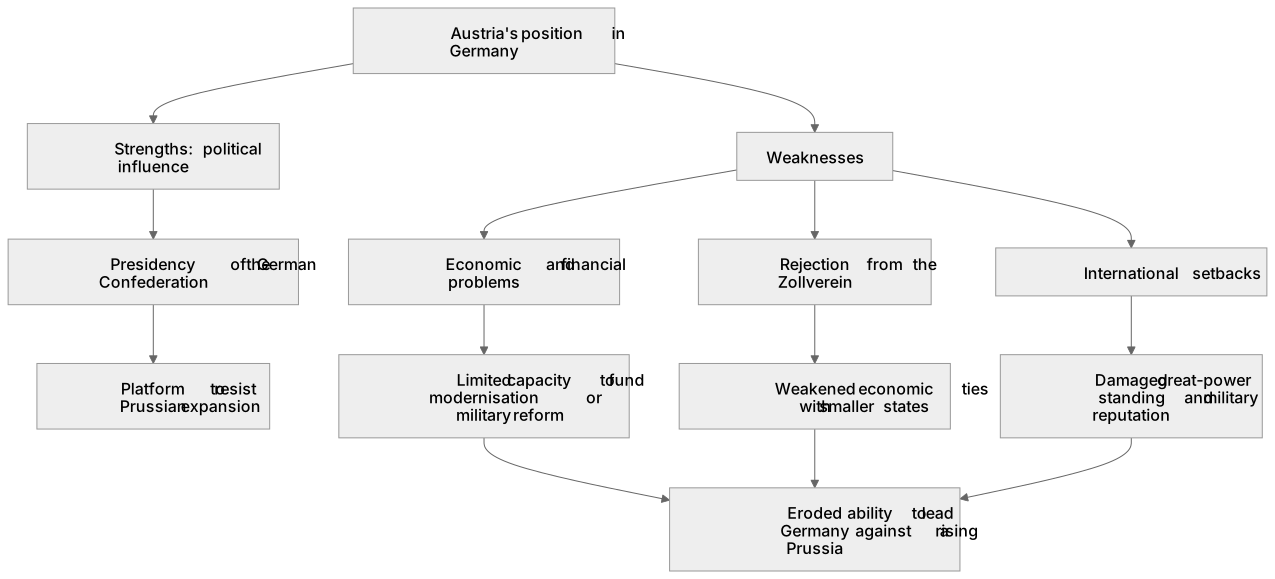
Label the diagram
Some boxes have lost their names. Pick the right name for each number.
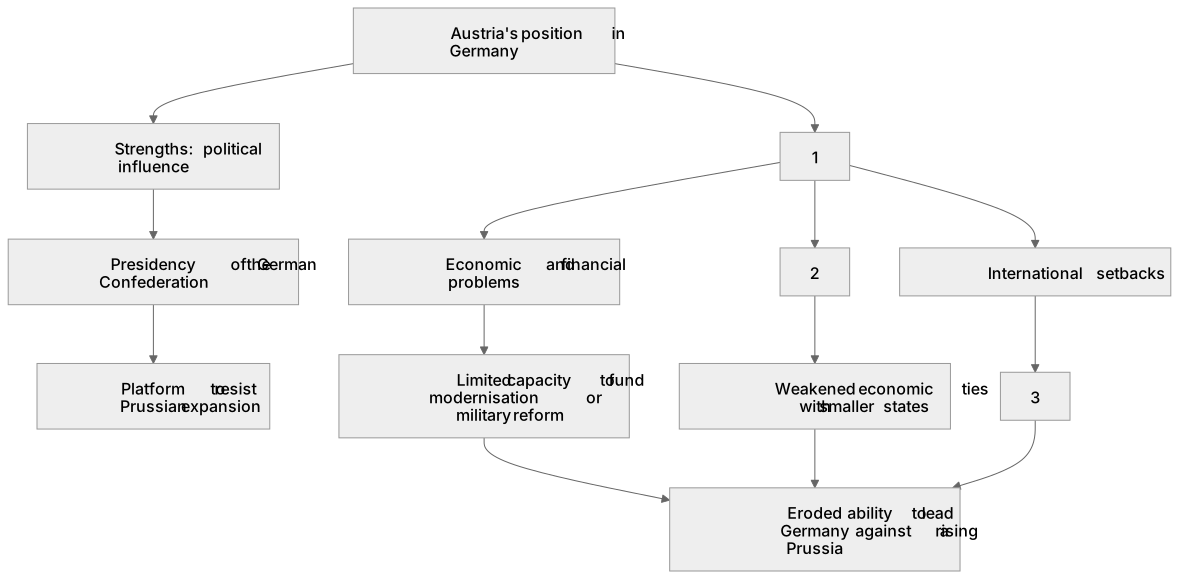
1Box 1
2Box 2
3Box 3
There is more to this lesson
The full lesson goes on to check your understanding and help you earn the marks. Create a free account to carry on, with your progress saved.
A week of Premium from your first lesson · Then the free plan continues · No card, no charge
Test your understanding of Paper 2, Option 2D.2: The unification of Germany, c1840–71 - 3 Austro- Prussian rivalry, 1852–66: Austrian strengths and weaknesses: political influence in Germany; economic and financial problems; rejection from the Zollverein; international setbacks.
Active recall beats re-reading. Take an instant quiz now to test what you’ve learned and lock it into long-term memory.
A week of Premium from your first lesson · Then the free plan continues · No card, no charge