Pearson Edexcel · A-Level · History
Course version: 9HI0 · Version from Sept 2015
The USA, c1920–55: boom, bust and recovery - 3 Impact of the New Deal and…
Full specification wording
Paper 2, Option 2H.1: The USA, c1920–55: boom, bust and recovery - 3 Impact of the New Deal and the Second World War on the USA to 1945: The war and the economy, 1941–45: the collapse of unemployment; women and the war effort; the contribution of young people; growing power of trade unions; migration to urban and industrial centres; the growth of new industries.
This topic examines the economic transformation of the USA during the Second World War.
Checked against the Pearson Edexcel 9HI0 specification (opens in a new tab) on .
- Point 4 of 4
- 4 key terms
Study notes
From the checked teaching notes for this specification point.
The idea
This topic examines the economic transformation of the USA during the Second World War. Rearmament and total war ended mass unemployment, with millions drawn into war production. Women entered factories and auxiliary services in unprecedented numbers, though often in lower-paid roles and expected to leave after the war. Young people contributed through war work, cadet schemes and early enlistment. Trade unions grew in membership and influence, negotiating wages and conditions in defence plants, though strikes caused tension. Migration to urban and industrial centres, especially on the West Coast and in the North, reshaped population patterns. New industries such as aircraft, shipbuilding, synthetic rubber and electronics expanded rapidly, laying foundations for post-war prosperity.
What earns the marks
- Explains how war production absorbed the unemployed and reduced joblessness by 1945.
- Assesses women's wartime work in factories and services, including pay and post-war expectations.
- Analyses the contribution of young people through work, cadet training and military service.
- Evaluates the growing power of trade unions in defence industries and the tensions caused by strikes.
- Examines migration to urban and industrial centres and its social consequences.
- Discusses the growth of new industries such as aircraft, shipbuilding and synthetic rubber.
Common mistakes and how to put them right
Claiming unemployment disappeared entirely.
Put it right by noting residual joblessness and regional variation.
Assuming women achieved equal pay and permanent status.
Put it right by explaining lower wages and post-war pressure to leave.
Treating union growth as uncontested.
Put it right by noting employer resistance and government intervention.
Exam tips
- Use economic data and specific industries to support your analysis.
- Connect wartime economic change to the wider theme of federal power and social impact.
- Balance coverage of workers, unions, migration and new industries in your answer.
Try the lesson
The start of the Paper 2, Option 2H.1: The USA, c1920–55: boom, bust and recovery - 3 Impact of the New Deal and the Second World War on the USA to 1945: The war and the economy, 1941–45: the collapse of unemployment; women and the war effort; the contribution of young people; growing power of trade unions; migration to urban and industrial centres; the growth of new industries. lesson, made from checked teaching notes for this specification point.
Have a go first
Which of the following best describes the nature of the collapse in unemployment in the USA between 1941 and 1945?
Listen
This topic examines the economic transformation of the USA during the Second World War. Rearmament and total war ended mass unemployment, with millions drawn into war production. Women entered factories and auxiliary services in unprecedented numbers, though often in lower-paid roles and expected to leave after the war. Young people contributed through war work, cadet schemes and early enlistment. Trade unions grew in membership and influence, negotiating wages and conditions in defence plants, though strikes caused tension. Migration to urban and industrial centres, especially on the West Coast and in the North, reshaped population patterns. New industries such as aircraft, shipbuilding, synthetic rubber and electronics expanded rapidly, laying foundations for post-war prosperity. A strong answer earns marks for these points. Explains how war production absorbed the unemployed and reduced joblessness by 1945. Assesses women's wartime work in factories and services, including pay and post-war expectations. Analyses the contribution of young people through work, cadet training and military service. Evaluates the growing power of trade unions in defence industries and the tensions caused by strikes. A common slip: Claiming unemployment disappeared entirely. Instead, noting residual joblessness and regional variation. Exam tip: Use economic data and specific industries to support your analysis.
See it

Key words
Say what each word means before you turn the card.
War production and employment
Try answering aloud or in your head before turning the card.
Gender and youth in the workforce
Try answering aloud or in your head before turning the card.
Labour organisation and industrial conflict
Try answering aloud or in your head before turning the card.
Migration and industrial expansion
Try answering aloud or in your head before turning the card.
See every definition
- War production and employment
- Rearmament and total war ended mass unemployment, with millions drawn into war production.
- Gender and youth in the workforce
- Women entered factories and auxiliary services in unprecedented numbers, often in lower-paid roles and expected to leave after the war, while young people contributed through war work, cadet schemes and early enlistment.
- Labour organisation and industrial conflict
- Trade unions grew in membership and influence, negotiating wages and conditions in defence plants, though strikes caused tension.
- Migration and industrial expansion
- Migration to urban and industrial centres, especially on the West Coast and in the North, reshaped population patterns, while new industries such as aircraft, shipbuilding, synthetic rubber and electronics expanded rapidly.
Label the diagram
Some boxes have lost their names. Pick the right name for each number.
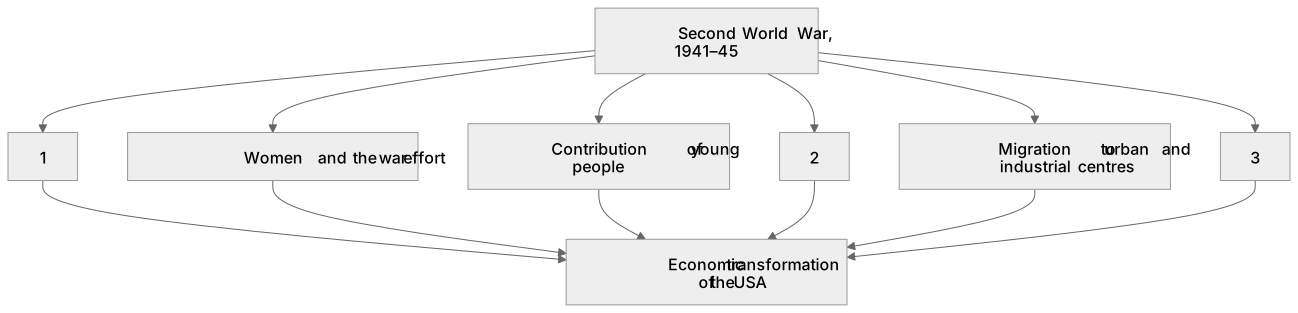
1Box 1
2Box 2
3Box 3
There is more to this lesson
The full lesson goes on to check your understanding and help you earn the marks. Create a free account to carry on, with your progress saved.
A week of Premium from your first lesson · Then the free plan continues · No card, no charge
Test your understanding of Paper 2, Option 2H.1: The USA, c1920–55: boom, bust and recovery - 3 Impact of the New Deal and the Second World War on the USA to 1945: The war and the economy, 1941–45: the collapse of unemployment; women and the war effort; the contribution of young people; growing power of trade unions; migration to urban and industrial centres; the growth of new industries.
Active recall beats re-reading. Take an instant quiz now to test what you’ve learned and lock it into long-term memory.
A week of Premium from your first lesson · Then the free plan continues · No card, no charge