Pearson Edexcel · A-Level · History
Course version: 9HI0 · Version from Sept 2015
Lancastrians, Yorkists and Henry VII, 1399–1509 - 1 Changing relationships…
Full specification wording
Paper 3, Option 30: Lancastrians, Yorkists and Henry VII, 1399–1509 - 1 Changing relationships between crown and the nobility: 'over- mighty subjects': Major landowners and their role in governing the kingdom, 1399–1509: lands, offices of state and church patronage; necessary props to the crown but potential rivals (key developments: the crushing of the conspiracy against Henry V in 1415, the execution of Warwick in 1499). The importance of retaining, 1399–1509: livery and maintenance; the concept of 'bastard feudalism' (key developments: statutes in 1468 and 1504 against retaining).
Between 1399 and 1509 major landowners were essential to royal government but also dangerous rivals.
Checked against the Pearson Edexcel 9HI0 specification (opens in a new tab) on .
- Point 1 of 2
- 4 key terms
Study notes
From the checked teaching notes for this specification point.
The idea
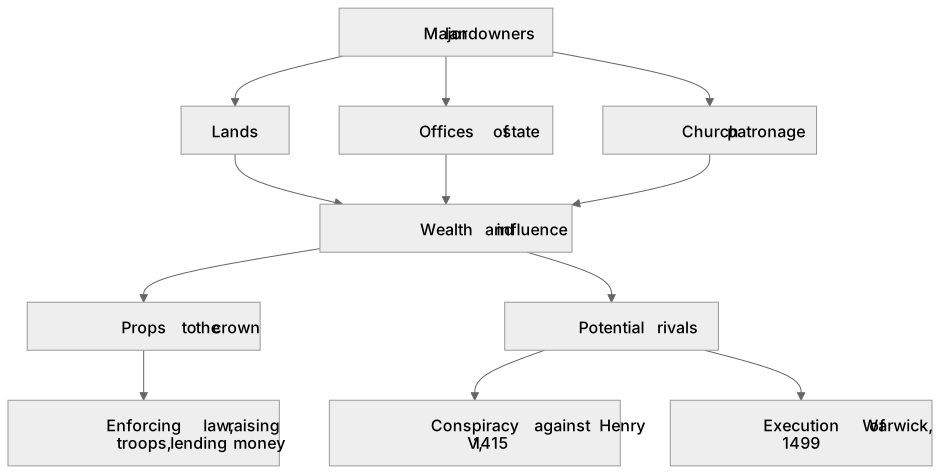
Between 1399 and 1509 major landowners were essential to royal government but also dangerous rivals. Crown lands, offices of state and church patronage gave them wealth and influence; they acted as props by enforcing law, raising troops and lending money, yet could challenge the king. Henry V crushed the Southampton Plot in 1415, showing how quickly conspiracy could be defeated. Retaining, using livery and maintenance, bound followers to lords and is often called 'bastard feudalism'. Statutes in 1468 and 1504 tried to limit retaining, and Warwick's execution in 1499 showed royal determination to control over-mighty subjects. Assess how far such measures restored order.
What earns the marks
- Explains how lands, offices of state and church patronage gave major landowners power to govern localities on the crown's behalf.
- Analyses the dual role of the nobility as necessary props to the crown and potential rivals, using examples such as the 1415 conspiracy or Warwick's execution in 1499.
- Explains retaining through livery and maintenance, and evaluates the concept of 'bastard feudalism' as a description of lord–retainer relationships.
- Assesses the significance of the statutes of 1468 and 1504 against retaining, considering whether they were effective or limited in practice.
- Reaches a substantiated judgement on change and continuity in crown–nobility relations across 1399–1509.
Common mistakes and how to put them right
Treating 'bastard feudalism' as a simple synonym for all retaining.
Put it right: It is a contested concept describing the use of indentures, money and livery to build affinity groups that could undermine royal authority.
Assuming the 1468 and 1504 statutes immediately ended retaining.
Put it right: Retaining continued, and enforcement depended on royal will and local circumstances.
Confusing the leaders of the 1415 conspiracy against Henry V.
Put it right: The Southampton Plot was led by Cambridge, Scrope and Sir Thomas Grey, whereas Edmund Mortimer was the intended claimant who actually revealed the plot to the king.
Exam tips
- Plan around the twin themes of service and threat, using named individuals and dates to support each point.
- When discussing retaining, distinguish between livery (badges and clothing) and maintenance (protection and legal support) to show precise knowledge.
- Use the key developments as evidence within an argument about change over time, not as isolated narrative.
Try the lesson
The start of the Paper 3, Option 30: Lancastrians, Yorkists and Henry VII, 1399–1509 - 1 Changing relationships between crown and the nobility: 'over- mighty subjects': Major landowners and their role in governing the kingdom, 1399–1509: lands, offices of state and church patronage; necessary props to the crown but potential rivals (key developments: the crushing of the conspiracy against Henry V in 1415, the execution of Warwick in 1499). The importance of retaining, 1399–1509: livery and maintenance; the concept of 'bastard feudalism' (key developments: statutes in 1468 and 1504 against retaining). lesson, made from checked teaching notes for this specification point.
Have a go first
Which practice involved a major landowner giving his followers distinctive clothing as a badge of service in return for their support?
Listen
Between 1399 and 1509 major landowners were essential to royal government but also dangerous rivals. Crown lands, offices of state and church patronage gave them wealth and influence; they acted as props by enforcing law, raising troops and lending money, yet could challenge the king. Henry V crushed the Southampton Plot in 1415, showing how quickly conspiracy could be defeated. Retaining, using livery and maintenance, bound followers to lords and is often called 'bastard feudalism'. Statutes in 1468 and 1504 tried to limit retaining, and Warwick's execution in 1499 showed royal determination to control over-mighty subjects. Assess how far such measures restored order. A strong answer earns marks for these points. Explains how lands, offices of state and church patronage gave major landowners power to govern localities on the crown's behalf. Analyses the dual role of the nobility as necessary props to the crown and potential rivals, using examples such as the 1415 conspiracy or Warwick's execution in 1499. Explains retaining through livery and maintenance, and evaluates the concept of 'bastard feudalism' as a description of lord–retainer relationships. Assesses the significance of the statutes of 1468 and 1504 against retaining, considering whether they were effective or limited in practice. A common slip: Treating 'bastard feudalism' as a simple synonym for all retaining. Instead, it is a contested concept describing the use of indentures, money and livery to build affinity groups that could undermine royal authority. Exam tip: Plan around the twin themes of service and threat, using named individuals and dates to support each point.
See it
Key words
Say what each word means before you turn the card.
Crown–nobility relations
Try answering aloud or in your head before turning the card.
Patronage and power
Try answering aloud or in your head before turning the card.
Retaining and 'bastard feudalism'
Try answering aloud or in your head before turning the card.
Rebellion and royal authority
Try answering aloud or in your head before turning the card.
See every definition
- Crown–nobility relations
- The relationship in which major landowners were necessary props to the crown but also potential rivals between 1399 and 1509.
- Patronage and power
- Lands, offices of state and church patronage gave major landowners wealth and influence to govern localities on the crown's behalf.
- Retaining and 'bastard feudalism'
- Binding followers to lords through livery and maintenance, often called 'bastard feudalism', with statutes in 1468 and 1504 against retaining.
- Rebellion and royal authority
- Conspiracy could be defeated quickly, as when the conspiracy against Henry V was crushed in 1415, and Warwick's execution in 1499 showed royal determination.
Label the diagram
Some boxes have lost their names. Pick the right name for each number.
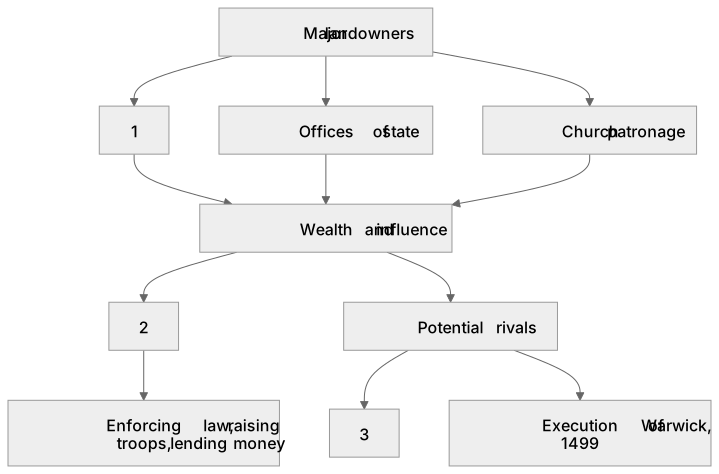
1Box 1
2Box 2
3Box 3
There is more to this lesson
The full lesson goes on to check your understanding and help you earn the marks. Create a free account to carry on, with your progress saved.
A week of Premium from your first lesson · Then the free plan continues · No card, no charge
Test your understanding of Paper 3, Option 30: Lancastrians, Yorkists and Henry VII, 1399–1509 - 1 Changing relationships between crown and the nobility: 'over- mighty subjects': Major landowners and their role in governing the kingdom, 1399–1509: lands, offices of state and church patronage; necessary props to the crown but potential rivals (key developments: the crushing of the conspiracy against Henry V in 1415, the execution of Warwick in 1499). The importance of retaining, 1399–1509: livery and maintenance; the concept of 'bastard feudalism' (key developments: statutes in 1468 and 1504 against retaining).
Active recall beats re-reading. Take an instant quiz now to test what you’ve learned and lock it into long-term memory.
A week of Premium from your first lesson · Then the free plan continues · No card, no charge