Pearson Edexcel · A-Level · History
Course version: 9HI0 · Version from Sept 2015
Lancastrians, Yorkists and Henry VII, 1399–1509 - 1 The crises of…
Full specification wording
Paper 3, Option 30: Lancastrians, Yorkists and Henry VII, 1399–1509 - 1 The crises of 1399–1405: The crisis of 1399: reasons for Bolingbroke's seizure of the crown from Richard II.
In 1399 Henry Bolingbroke, exiled Duke of Lancaster, returned to England while Richard II campaigned in Ireland.
Checked against the Pearson Edexcel 9HI0 specification (opens in a new tab) on .
- Point 1 of 3
- 4 key terms
Study notes
From the checked teaching notes for this specification point.
The idea
In 1399 Henry Bolingbroke, exiled Duke of Lancaster, returned to England while Richard II campaigned in Ireland. Richard's arbitrary rule had alienated the nobility: the 1397 Revenge Parliament executed or exiled opponents. In September 1398 at Coventry, Richard exiled Bolingbroke, and following John of Gaunt's death in 1399, the king confiscated the Lancastrian inheritance. Bolingbroke landed at Ravenspur, gathered support, captured Richard and forced his abdication; Parliament then accepted Henry as king. Historians weigh personal ambition against structural grievance, and Richard's lack of an heir made deposition easier.
What earns the marks
- Explains Richard II's arbitrary and personal style of kingship, including the 1397 Revenge Parliament and the treatment of the Appellant lords.
- Analyses the confiscation of the Lancastrian inheritance after John of Gaunt's death in 1399 as the trigger for Bolingbroke's return.
- Assesses Bolingbroke's personal ambition and his claim through descent from Henry III, alongside his promise to restore good governance.
- Evaluates the role of noble defections, including the Percy family, in making the seizure of the crown possible.
- Considers Richard's absence in Ireland and the weakness of his military position on Bolingbroke's landing at Ravenspur.
- Weighs the significance of Richard's childlessness and the absence of a clear direct heir in enabling deposition and succession.
- Examines the constitutional and parliamentary processes by which Richard was deposed and Henry recognised as king.
Common mistakes and how to put them right
Treating 1399 as a sudden event.
Put it right: Is to trace the build-up from the 1386–88 crisis, the 1397 Revenge Parliament and the 1398 exile of Bolingbroke at Coventry.
Assuming the Lancastrian inheritance was confiscated before Gaunt's death.
Put it right: Is that confiscation followed John of Gaunt's death in 1399.
Presenting Bolingbroke's return as purely a bid for the throne.
Put it right: Is to weigh his initial claim to recover his inheritance against later seizure of the crown.
Exam tips
- Plan by factor, for example Richard's misrule, the inheritance dispute, noble support and Richard's absence, then reach a supported judgement.
- Use precise dates and named events such as 1397, 1398, Ravenspur and the deposition Parliament to anchor analysis.
- Integrate interpretations of ambition versus structural grievance rather than listing them separately at the end.
Try the lesson
The start of the Paper 3, Option 30: Lancastrians, Yorkists and Henry VII, 1399–1509 - 1 The crises of 1399–1405: The crisis of 1399: reasons for Bolingbroke's seizure of the crown from Richard II. lesson, made from checked teaching notes for this specification point.
Have a go first
Which action by Richard II in early 1399 directly provoked Henry Bolingbroke into returning to England to challenge the king?
Listen
In 1399 Henry Bolingbroke, exiled Duke of Lancaster, returned to England while Richard II campaigned in Ireland. Richard's arbitrary rule had alienated the nobility: the 1397 Revenge Parliament executed or exiled opponents. In September 1398 at Coventry, Richard exiled Bolingbroke, and following John of Gaunt's death in 1399, the king confiscated the Lancastrian inheritance. Bolingbroke landed at Ravenspur, gathered support, captured Richard and forced his abdication; Parliament then accepted Henry as king. Historians weigh personal ambition against structural grievance, and Richard's lack of an heir made deposition easier. A strong answer earns marks for these points. Explains Richard II's arbitrary and personal style of kingship, including the 1397 Revenge Parliament and the treatment of the Appellant lords. Analyses the confiscation of the Lancastrian inheritance after John of Gaunt's death in 1399 as the trigger for Bolingbroke's return. Assesses Bolingbroke's personal ambition and his claim through descent from Henry III, alongside his promise to restore good governance. Evaluates the role of noble defections, including the Percy family, in making the seizure of the crown possible. A common slip: Treating 1399 as a sudden event. Instead, is to trace the build-up from the 1386–88 crisis, the 1397 Revenge Parliament and the 1398 exile of Bolingbroke at Coventry. Exam tip: Plan by factor, for example Richard's misrule, the inheritance dispute, noble support and Richard's absence, then reach a supported judgement.
See it
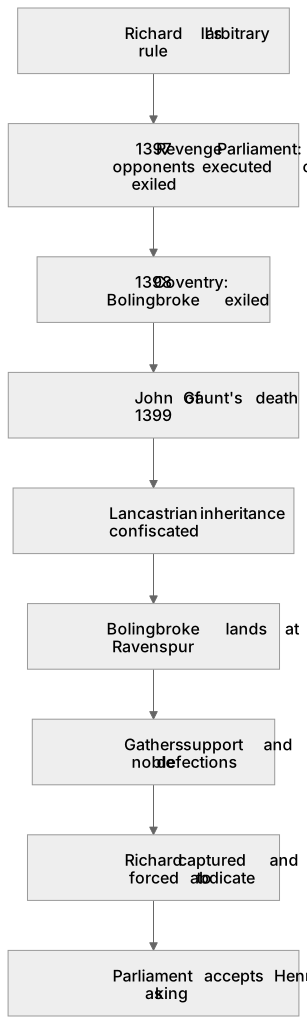
Put the events in order
Put these events in the order they happened, earliest first.
- 1. The Revenge Parliament executed or exiled Richard's opponents
- 2. Bolingbroke landed at Ravenspur and forced Richard's abdication
- 3. Richard exiled Bolingbroke at Coventry
Key words
Say what each word means before you turn the card.
Kingship and misrule
Try answering aloud or in your head before turning the card.
Dynastic inheritance and legitimacy
Try answering aloud or in your head before turning the card.
Deposition and succession
Try answering aloud or in your head before turning the card.
Noble faction and patronage
Try answering aloud or in your head before turning the card.
See every definition
- Kingship and misrule
- Richard II's arbitrary and personal style of rule, including the 1397 Revenge Parliament, had alienated the nobility.
- Dynastic inheritance and legitimacy
- The confiscation of the Lancastrian inheritance after John of Gaunt's death in 1399 triggered Bolingbroke's return, and Richard's childlessness made deposition easier.
- Deposition and succession
- Bolingbroke captured Richard and forced his abdication, and Parliament then accepted Henry as king.
- Noble faction and patronage
- Noble defections, including the Percy family, helped make the seizure of the crown possible.
Label the diagram
Some boxes have lost their names. Pick the right name for each number.
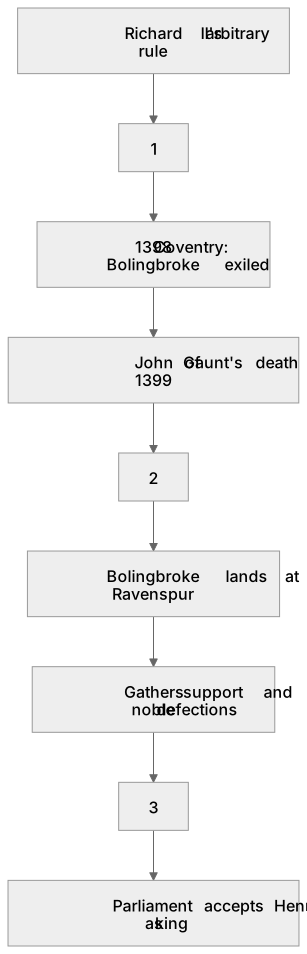
1Box 1
2Box 2
3Box 3
There is more to this lesson
The full lesson goes on to check your understanding and help you earn the marks. Create a free account to carry on, with your progress saved.
A week of Premium from your first lesson · Then the free plan continues · No card, no charge
Test your understanding of Paper 3, Option 30: Lancastrians, Yorkists and Henry VII, 1399–1509 - 1 The crises of 1399–1405: The crisis of 1399: reasons for Bolingbroke's seizure of the crown from Richard II.
Active recall beats re-reading. Take an instant quiz now to test what you’ve learned and lock it into long-term memory.
A week of Premium from your first lesson · Then the free plan continues · No card, no charge