Pearson Edexcel · A-Level · History
Course version: 9HI0 · Version from Sept 2015
Lancastrians, Yorkists and Henry VII, 1399–1509 - 2 Henry V and the…
Full specification wording
Paper 3, Option 30: Lancastrians, Yorkists and Henry VII, 1399–1509 - 2 Henry V and the conquest of France, 1413–21: The importance of the Burgundian Alliance 1419; the significance of the conquest of Normandy and the Treaty of Troyes, 1417–20: the basis, impact and cost of success.
The conquest of Normandy (1417–19) was highly significant, providing Henry V with a secure territorial base and demonstrating his military effectiveness.
Checked against the Pearson Edexcel 9HI0 specification (opens in a new tab) on .
- Point 3 of 3
- 3 key terms
Study notes
From the checked teaching notes for this specification point.
The idea
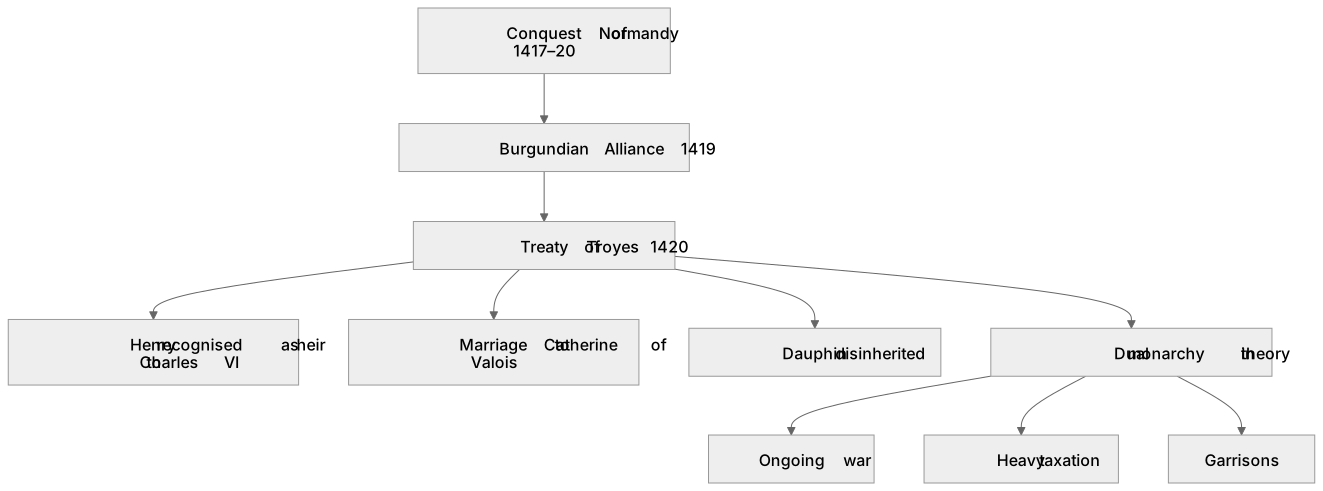
The conquest of Normandy (1417–19) was highly significant, providing Henry V with a secure territorial base and demonstrating his military effectiveness. Following this, the Burgundian Alliance of 1419 was crucial; after the murder of John the Fearless, it removed a major French ally from the Valois cause and gave Henry a powerful partner. This diplomatic advantage paved the way for the Treaty of Troyes in 1420. The treaty recognised Henry as heir to Charles VI and arranged his marriage to Catherine of Valois, but excluded the dauphin.
What earns the marks
- Explains the significance of the conquest of Normandy 1417–20: Henry’s campaign secured key towns, providing a base for further conquest and strengthening his bargaining position.
- Explains the importance of the 1419 Burgundian Alliance: it isolated the dauphin and gave Henry V a crucial ally after the murder of John the Fearless.
- Explains the Treaty of Troyes 1420: Henry was recognised as heir to Charles VI and married Catherine of Valois, but the dauphin was disinherited.
- Explains the basis of success: military victories, diplomatic divisions among the French, and Henry’s ability to present himself as a legitimate heir.
- Explains the impact and cost of success: the treaty created a dual monarchy in theory, but required ongoing war, heavy taxation and garrisons.
Common mistakes and how to put them right
Treating the Treaty of Troyes as a complete victory.
Put it right: Recognise it excluded the dauphin and required continued military effort to enforce.
Ignoring the financial cost of the conquest.
Put it right: Include the expense of garrisons, administration and further campaigns, which strained English resources.
Confusing the chronology of events.
Put it right: The conquest of Normandy largely preceded the 1419 Burgundian Alliance, which then facilitated the 1420 Treaty of Troyes.
Exam tips
- Structure your answer around the three elements in the statement: the alliance, the conquest and the treaty, then assess their basis, impact and cost.
- Evaluate both short-term success and long-term fragility, linking the treaty’s terms to later financial and military problems.
Try the lesson
The start of the Paper 3, Option 30: Lancastrians, Yorkists and Henry VII, 1399–1509 - 2 Henry V and the conquest of France, 1413–21: The importance of the Burgundian Alliance 1419; the significance of the conquest of Normandy and the Treaty of Troyes, 1417–20: the basis, impact and cost of success. lesson, made from checked teaching notes for this specification point.
Have a go first
Which event in 1419 brought Henry V an alliance with the Burgundian faction during the Hundred Years' War?
Listen
The conquest of Normandy (1417–19) was highly significant, providing Henry V with a secure territorial base and demonstrating his military effectiveness. Following this, the Burgundian Alliance of 1419 was crucial; after the murder of John the Fearless, it removed a major French ally from the Valois cause and gave Henry a powerful partner. This diplomatic advantage paved the way for the Treaty of Troyes in 1420. The treaty recognised Henry as heir to Charles VI and arranged his marriage to Catherine of Valois, but excluded the dauphin. A strong answer earns marks for these points. Explains the significance of the conquest of Normandy 1417–20: Henry’s campaign secured key towns, providing a base for further conquest and strengthening his bargaining position. Explains the importance of the 1419 Burgundian Alliance: it isolated the dauphin and gave Henry V a crucial ally after the murder of John the Fearless. Explains the Treaty of Troyes 1420: Henry was recognised as heir to Charles VI and married Catherine of Valois, but the dauphin was disinherited. Explains the basis of success: military victories, diplomatic divisions among the French, and Henry’s ability to present himself as a legitimate heir. A common slip: Treating the Treaty of Troyes as a complete victory. Instead, recognise it excluded the dauphin and required continued military effort to enforce. Exam tip: Structure your answer around the three elements in the statement: the alliance, the conquest and the treaty, then assess their basis, impact and cost.
See it
Put the events in order
Put these events in the order they happened, earliest first.
- 1. Henry V's conquest of Normandy secured key towns as a base
- 2. The Treaty of Troyes recognised Henry as heir to Charles VI
- 3. The Burgundian Alliance gave Henry a crucial ally
Key words
Say what each word means before you turn the card.
Diplomacy and alliance
Try answering aloud or in your head before turning the card.
Military conquest and occupation
Try answering aloud or in your head before turning the card.
Cost of war and royal finance
Try answering aloud or in your head before turning the card.
See every definition
- Diplomacy and alliance
- The Burgundian Alliance of 1419 removed a major French ally from the Valois cause and gave Henry a powerful partner, isolating the dauphin.
- Military conquest and occupation
- The conquest of Normandy provided Henry V with a secure territorial base and demonstrated his military effectiveness.
- Cost of war and royal finance
- Success required ongoing war, heavy taxation and garrisons, and the expense of garrisons, administration and further campaigns strained English resources.
Label the diagram
Some boxes have lost their names. Pick the right name for each number.
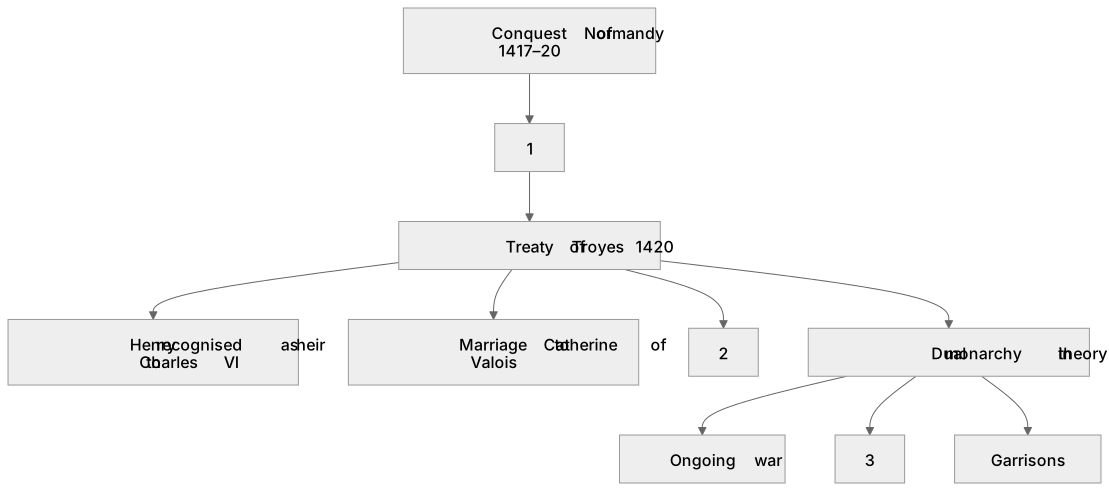
1Box 1
2Box 2
3Box 3
There is more to this lesson
The full lesson goes on to check your understanding and help you earn the marks. Create a free account to carry on, with your progress saved.
A week of Premium from your first lesson · Then the free plan continues · No card, no charge
Test your understanding of Paper 3, Option 30: Lancastrians, Yorkists and Henry VII, 1399–1509 - 2 Henry V and the conquest of France, 1413–21: The importance of the Burgundian Alliance 1419; the significance of the conquest of Normandy and the Treaty of Troyes, 1417–20: the basis, impact and cost of success.
Active recall beats re-reading. Take an instant quiz now to test what you’ve learned and lock it into long-term memory.
A week of Premium from your first lesson · Then the free plan continues · No card, no charge