Pearson Edexcel · A-Level · History
Course version: 9HI0 · Version from Sept 2015
Lancastrians, Yorkists and Henry VII, 1399–1509 - 3 Renewed crises and…
Full specification wording
Paper 3, Option 30: Lancastrians, Yorkists and Henry VII, 1399–1509 - 3 Renewed crises and challenges, c1449–61: The importance of the Duke of York's protectorate and his growing ambitions, 1454–60; the Battle of Towton and the reasons for the triumph of Edward IV 1461: the importance of the Earl of Warwick.
This topic examines how Richard, Duke of York, moved from protector to claimant, and why Edward IV won in 1461.
Checked against the Pearson Edexcel 9HI0 specification (opens in a new tab) on .
- Point 3 of 3
- 4 key terms
Study notes
From the checked teaching notes for this specification point.
The idea
This topic examines how Richard, Duke of York, moved from protector to claimant, and why Edward IV won in 1461. York's first protectorate (1454–55) arose from Henry VI's incapacity; it gave York control of government but depended on noble support and ended when the king recovered. York's ambitions grew: by 1460 he claimed the throne, was recognised as heir in the Act of Accord, and died at Wakefield. Edward IV's triumph at Towton (29 March 1461) rested on Yorkist control of London, superior resources, tactical decisions, and the political and military backing of Richard Neville, Earl of Warwick, whose influence in Wales, the Midlands and the south-east helped secure the crown.
What earns the marks
- Analyses the shift in York's aims from reform and protection of his position to an open claim to the throne in 1460, including the Act of Accord and the reaction of Lancastrian and neutral lords.
- Evaluates Warwick's contribution: his role as a power broker, his military command, his estates and affinity, and his influence over Edward IV's early kingship, while recognising that other factors also mattered.
Common mistakes and how to put them right
Treating York's protectorate as a fully independent reign.
Put it right by explaining that it was a temporary office dependent on parliamentary and noble support, and that Henry VI's recovery ended it.
Assuming Warwick alone won the crown for Edward IV.
Put it right by weighing Warwick's importance alongside Edward's own leadership, London's support, and Lancastrian weaknesses.
Confusing the Act of Accord (1460) with a final settlement.
Put it right by noting it made York heir but did not end conflict, as shown by York's death at Wakefield and the continued war.
Exam tips
- Plan your answer around the stated themes: protectorate, growing ambitions, Towton, and Warwick's importance, so every clause is addressed.
- Use precise chronology and named events (for example, 1454 protectorate, 1460 Act of Accord, 1461 Towton) to support analysis rather than narrative.
- When discussing Warwick, distinguish between his roles as a magnate, military commander, and political ally, and link each to the outcome.
Try the lesson
The start of the Paper 3, Option 30: Lancastrians, Yorkists and Henry VII, 1399–1509 - 3 Renewed crises and challenges, c1449–61: The importance of the Duke of York's protectorate and his growing ambitions, 1454–60; the Battle of Towton and the reasons for the triumph of Edward IV 1461: the importance of the Earl of Warwick. lesson, made from checked teaching notes for this specification point.
Have a go first
In which year did Richard, Duke of York, first serve as Protector of England during the illness of Henry VI?
Listen
This topic examines how Richard, Duke of York, moved from protector to claimant, and why Edward IV won in 1461. York's first protectorate (1454–55) arose from Henry VI's incapacity; it gave York control of government but depended on noble support and ended when the king recovered. York's ambitions grew: by 1460 he claimed the throne, was recognised as heir in the Act of Accord, and died at Wakefield. Edward IV's triumph at Towton (29 March 1461) rested on Yorkist control of London, superior resources, tactical decisions, and the political and military backing of Richard Neville, Earl of Warwick, whose influence in Wales, the Midlands and the south-east helped secure the crown. A strong answer earns marks for these points. Explains how Henry VI's mental collapse created the political vacancy that allowed York to become Protector in 1454, and how the protectorate's limits (reliance on the nobility, financial constraints, and the king's recovery) shaped York's later ambitions. Analyses the shift in York's aims from reform and protection of his position to an open claim to the throne in 1460, including the Act of Accord and the reaction of Lancastrian and neutral lords. Assesses the military and political reasons for Edward IV's victory at Towton, such as Yorkist control of London and the south-east, recruitment, weather conditions, leadership, and the collapse of Lancastrian resistance. Evaluates Warwick's contribution: his role as a power broker, his military command, his estates and affinity, and his influence over Edward IV's early kingship, while recognising that other factors also mattered. A common slip: Treating York's protectorate as a fully independent reign. Instead, explaining that it was a temporary office dependent on parliamentary and noble support, and that Henry VI's recovery ended it. Exam tip: Plan your answer around the stated themes: protectorate, growing ambitions, Towton, and Warwick's importance, so every clause is addressed.
See it
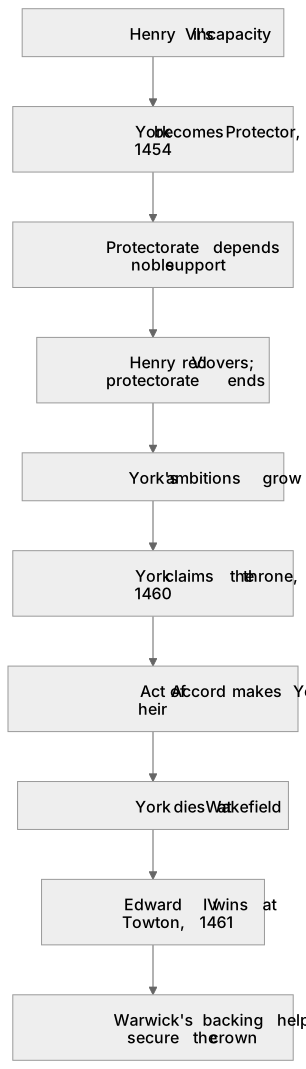
Put the events in order
Put these events in the order they happened, earliest first.
- 1. York becomes Protector after Henry VI's mental collapse
- 2. Edward IV triumphs at the Battle of Towton
- 3. York claims the throne and is recognised as heir in the Act of Accord
Key words
Say what each word means before you turn the card.
Protectorate
Try answering aloud or in your head before turning the card.
Act of Accord
Try answering aloud or in your head before turning the card.
Battle of Towton
Try answering aloud or in your head before turning the card.
Earl of Warwick
Try answering aloud or in your head before turning the card.
See every definition
- Protectorate
- A temporary office arising from Henry VI's incapacity that gave York control of government but depended on noble support and ended when the king recovered.
- Act of Accord
- The settlement of 1460 that recognised York as heir but did not end conflict, as shown by his death at Wakefield and the continued war.
- Battle of Towton
- The battle of 29 March 1461 where Edward IV triumphed through Yorkist control of London, superior resources, tactical decisions and Warwick's backing.
- Earl of Warwick
- Richard Neville, whose influence in Wales, the Midlands and the south-east and whose political and military backing helped secure the crown for Edward IV.
Label the diagram
Some boxes have lost their names. Pick the right name for each number.
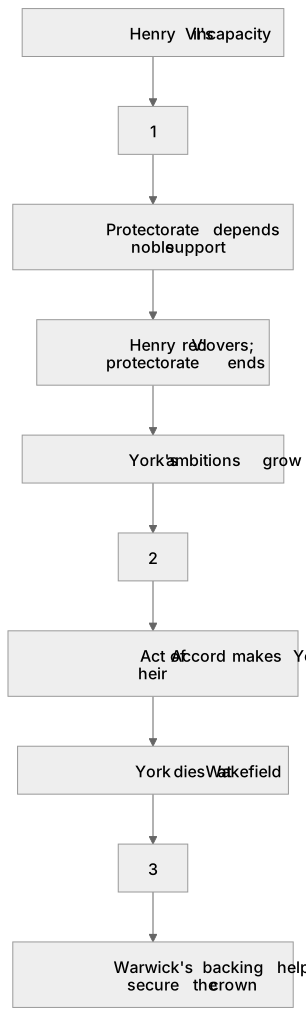
1Box 1
2Box 2
3Box 3
There is more to this lesson
The full lesson goes on to check your understanding and help you earn the marks. Create a free account to carry on, with your progress saved.
A week of Premium from your first lesson · Then the free plan continues · No card, no charge
Test your understanding of Paper 3, Option 30: Lancastrians, Yorkists and Henry VII, 1399–1509 - 3 Renewed crises and challenges, c1449–61: The importance of the Duke of York's protectorate and his growing ambitions, 1454–60; the Battle of Towton and the reasons for the triumph of Edward IV 1461: the importance of the Earl of Warwick.
Active recall beats re-reading. Take an instant quiz now to test what you’ve learned and lock it into long-term memory.
A week of Premium from your first lesson · Then the free plan continues · No card, no charge