Pearson Edexcel · A-Level · History
Course version: 9HI0 · Version from Sept 2015
Rebellion and disorder under the Tudors, 1485–1603 - 1 Changes in…
Full specification wording
Paper 3, Option 31: Rebellion and disorder under the Tudors, 1485–1603 - 1 Changes in governance at the centre: Crown, church and parliament, 1485–1603: church-state relations, including the impact of the Reformation (key developments: the Acts of Supremacy of 1534 and 1559, the Elizabethan religious settlement); development of the concepts of sovereignty of statute and parliamentary privilege; the extent of change in the relationship between crown and parliament.
This topic traces how the crown, church and parliament interacted across the Tudor century.
Checked against the Pearson Edexcel 9HI0 specification (opens in a new tab) on .
- Point 2 of 2
- 4 key terms
Study notes
From the checked teaching notes for this specification point.
The idea
This topic traces how the crown, church and parliament interacted across the Tudor century. Church-state relations were transformed by the Reformation: the Act of Supremacy 1534 made Henry VIII head of the Church of England, while the Act of Supremacy 1559 restored royal supremacy under Elizabeth I. The Elizabethan religious settlement of 1559 combined the Act of Uniformity and the Royal Injunctions to create a via media. These changes encouraged the concept of sovereignty of statute, meaning that law made in parliament could define doctrine and succession. Parliamentary privilege, especially freedom of speech and freedom from arrest, also developed as MPs debated religious and political matters. The extent of change in crown-parliament relations is debated: some historians stress growing institutional confidence, others emphasise continued royal control through patronage and management.
What earns the marks
- Explains how the Act of Supremacy 1534 transferred headship of the church from the pope to Henry VIII and how this reshaped church-state relations.
- Analyses the Act of Supremacy 1559 and the Elizabethan religious settlement as a deliberate compromise between Catholic and Protestant practice.
- Assesses the development of sovereignty of statute, showing how parliamentary law became the instrument for defining religious settlement and royal authority.
- Evaluates parliamentary privilege, including freedom of speech and freedom from arrest, and how these were asserted in Tudor parliaments.
- Judges the extent of change in crown-parliament relations, weighing evidence of growing parliamentary assertiveness against continued monarchical dominance.
Common mistakes and how to put them right
Treating the 1534 and 1559 Acts of Supremacy as identical.
Put it right: Distinguish Henry VIII's break with Rome from Elizabeth I's restoration of royal supremacy after Mary I.
Assuming the Elizabethan religious settlement was fully Protestant.
Put it right: Recognise its deliberately ambiguous, via media character, retaining some Catholic forms while asserting Protestant doctrine.
Describing parliamentary privilege as modern democracy.
Put it right: Explain it as limited Tudor privileges, not sovereignty of the people or universal suffrage.
Exam tips
- Link each key development to the concept it illustrates, for example the 1534 Act to sovereignty of statute and the 1559 settlement to royal management of religion.
- Use precise dates and names of measures to show secure knowledge rather than general statements about the Reformation.
- When judging extent of change, set criteria such as who initiated legislation, how often parliament met, and whether the crown could still control outcomes.
Try the lesson
The start of the Paper 3, Option 31: Rebellion and disorder under the Tudors, 1485–1603 - 1 Changes in governance at the centre: Crown, church and parliament, 1485–1603: church-state relations, including the impact of the Reformation (key developments: the Acts of Supremacy of 1534 and 1559, the Elizabethan religious settlement); development of the concepts of sovereignty of statute and parliamentary privilege; the extent of change in the relationship between crown and parliament. lesson, made from checked teaching notes for this specification point.
Have a go first
Which body did the Act of Supremacy of 1559 recognise as the supreme governor of the Church of England?
Listen
This topic traces how the crown, church and parliament interacted across the Tudor century. Church-state relations were transformed by the Reformation: the Act of Supremacy 1534 made Henry VIII head of the Church of England, while the Act of Supremacy 1559 restored royal supremacy under Elizabeth I. The Elizabethan religious settlement of 1559 combined the Act of Uniformity and the Royal Injunctions to create a via media. These changes encouraged the concept of sovereignty of statute, meaning that law made in parliament could define doctrine and succession. Parliamentary privilege, especially freedom of speech and freedom from arrest, also developed as MPs debated religious and political matters. The extent of change in crown-parliament relations is debated: some historians stress growing institutional confidence, others emphasise continued royal control through patronage and management. A strong answer earns marks for these points. Explains how the Act of Supremacy 1534 transferred headship of the church from the pope to Henry VIII and how this reshaped church-state relations. Analyses the Act of Supremacy 1559 and the Elizabethan religious settlement as a deliberate compromise between Catholic and Protestant practice. Assesses the development of sovereignty of statute, showing how parliamentary law became the instrument for defining religious settlement and royal authority. Evaluates parliamentary privilege, including freedom of speech and freedom from arrest, and how these were asserted in Tudor parliaments. A common slip: Treating the 1534 and 1559 Acts of Supremacy as identical. Instead, distinguish Henry VIII's break with Rome from Elizabeth I's restoration of royal supremacy after Mary I. Exam tip: Link each key development to the concept it illustrates, for example the 1534 Act to sovereignty of statute and the 1559 settlement to royal management of religion.
See it
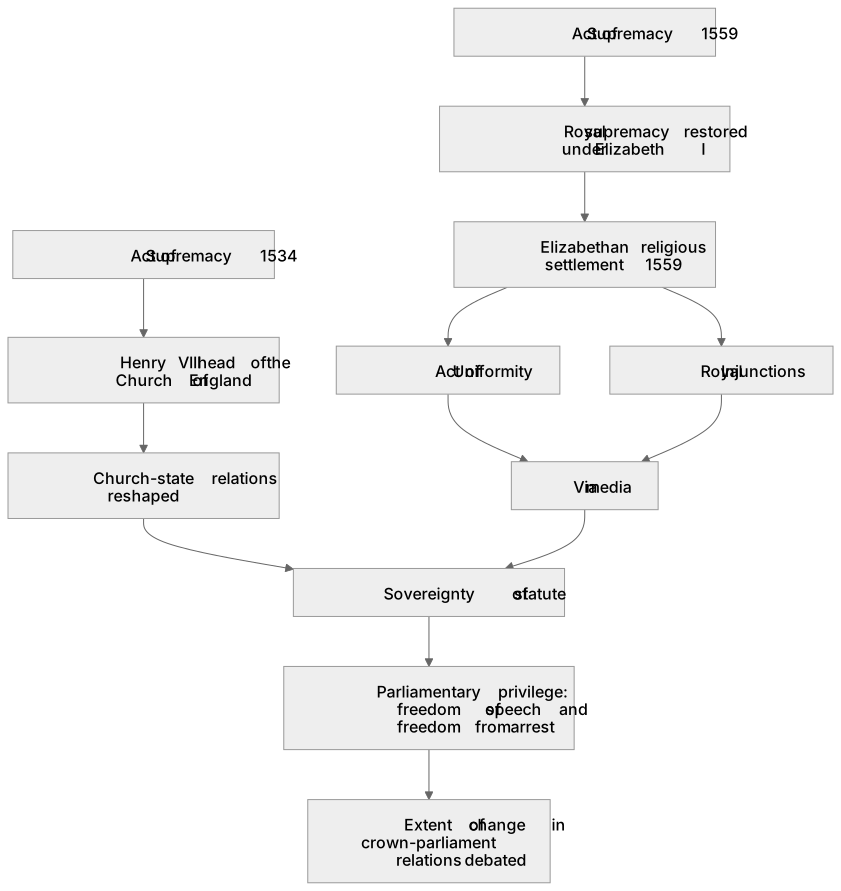
Key words
Say what each word means before you turn the card.
Royal supremacy and the break with Rome
Try answering aloud or in your head before turning the card.
The Elizabethan religious settlement as compromise
Try answering aloud or in your head before turning the card.
Sovereignty of statute and the role of parliamentary law
Try answering aloud or in your head before turning the card.
Parliamentary privilege and crown-parliament relations
Try answering aloud or in your head before turning the card.
See every definition
- Royal supremacy and the break with Rome
- The Act of Supremacy 1534 made Henry VIII head of the Church of England, transferring headship of the church from the pope to the monarch.
- The Elizabethan religious settlement as compromise
- The settlement of 1559 combined the Act of Uniformity and the Royal Injunctions to create a via media, deliberately ambiguous between Catholic and Protestant practice.
- Sovereignty of statute and the role of parliamentary law
- The concept that law made in parliament could define doctrine and succession, with parliamentary law becoming the instrument for defining religious settlement and royal authority.
- Parliamentary privilege and crown-parliament relations
- Limited Tudor privileges, especially freedom of speech and freedom from arrest, developed as MPs debated religious and political matters, though royal control continued through patronage and management.
Label the diagram
Some boxes have lost their names. Pick the right name for each number.
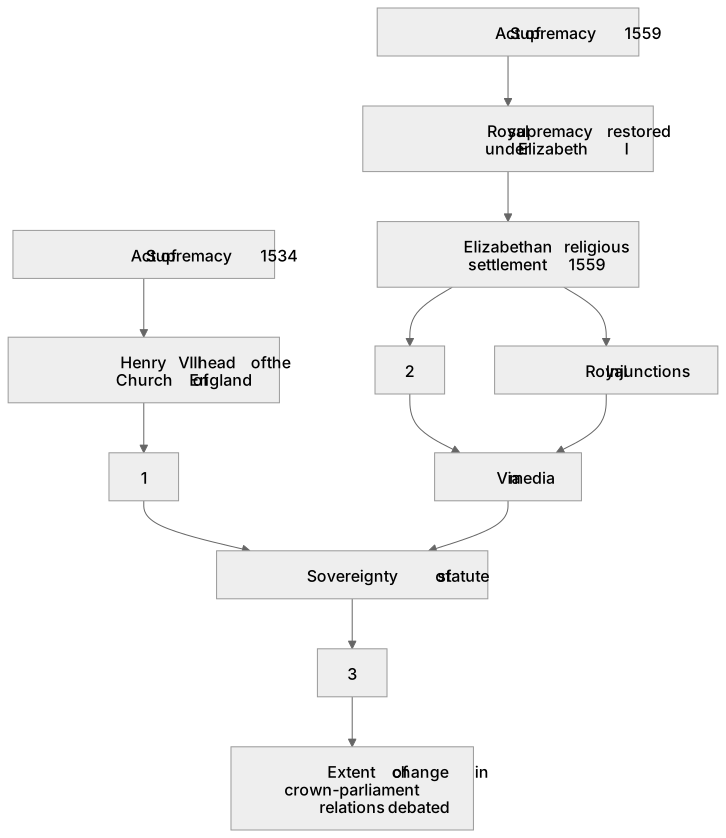
1Box 1
2Box 2
3Box 3
There is more to this lesson
The full lesson goes on to check your understanding and help you earn the marks. Create a free account to carry on, with your progress saved.
A week of Premium from your first lesson · Then the free plan continues · No card, no charge
Test your understanding of Paper 3, Option 31: Rebellion and disorder under the Tudors, 1485–1603 - 1 Changes in governance at the centre: Crown, church and parliament, 1485–1603: church-state relations, including the impact of the Reformation (key developments: the Acts of Supremacy of 1534 and 1559, the Elizabethan religious settlement); development of the concepts of sovereignty of statute and parliamentary privilege; the extent of change in the relationship between crown and parliament.
Active recall beats re-reading. Take an instant quiz now to test what you’ve learned and lock it into long-term memory.
A week of Premium from your first lesson · Then the free plan continues · No card, no charge