Pearson Edexcel · A-Level · History
Course version: 9HI0 · Version from Sept 2015
Rebellion and disorder under the Tudors, 1485–1603 - 2 Challenging…
Full specification wording
Paper 3, Option 31: Rebellion and disorder under the Tudors, 1485–1603 - 2 Challenging religious changes, 1533–37: The impact of Henrician religious changes, 1533–37: the break with Rome and the dissolution of the monasteries.
Between 1533 and 1537 Henry VIII's religious changes reshaped England.
Checked against the Pearson Edexcel 9HI0 specification (opens in a new tab) on .
- Point 1 of 3
- 4 key terms
Study notes
From the checked teaching notes for this specification point.
The idea
Between 1533 and 1537 Henry VIII's religious changes reshaped England. The break with Rome began when the Act in Restraint of Appeals (1533) denied papal jurisdiction, followed by the Act of Supremacy (1534) making Henry supreme head of the Church, and the Treason Act (1534) criminalising denial of that title. Thomas Cromwell, as vicegerent, drove reform: the Valor Ecclesiasticus (1535) surveyed church wealth, and the Act for the Dissolution of the Smaller Monasteries (1536) closed houses worth under £200 a year, transferring lands to the Crown. The Pilgrimage of Grace (1536) and the Act for the Dissolution of the Larger Monasteries (1539) followed. Impact included royal control of the Church, huge land transfer, loss of monastic charity and education, and deep resentment in the north.
What earns the marks
- Explains the legal steps of the break with Rome: the Act in Restraint of Appeals (1533), the Act of Supremacy (1534) and the Treason Act (1534), showing how each removed papal authority and asserted royal supremacy.
- Analyses the dissolution of the monasteries as a two-stage process: the 1535 Valor Ecclesiasticus survey, the 1536 Act closing smaller houses worth under £200 a year, and the later closure of larger houses.
- Assesses the religious, political, economic and social impact: royal supremacy over doctrine, Crown acquisition of monastic lands and wealth, loss of charity, education and hospitality, and increased northern grievance.
- Evaluates the extent of change by comparing the break with Rome as a jurisdictional revolution with the dissolution as a material and institutional transformation, and by considering continuity in parish religion.
- Uses specific evidence, such as Cromwell's role as vicegerent, the Court of Augmentations handling monastic revenue, and the connection between dissolution and the 1536 rebellions.
Common mistakes and how to put them right
Treating the break with Rome as a single event in 1534 rather than a sequence of statutes from 1533 onwards.
Put it right by dating each Act and explaining its distinct legal effect.
Confusing the dissolution of the smaller monasteries (1536) with the dissolution of all monasteries.
Put it right by distinguishing the 1536 Act from the later closure of larger houses.
Assuming the dissolution was purely religious.
Put it right by weighing economic motives, such as Crown revenue and land transfer, alongside religious reform.
Describing the monasteries as uniformly corrupt without evidence.
Put it right by using the Valor Ecclesiasticus and visitation reports critically as partial sources.
Exam tips
- Anchor each impact claim to a named statute, date or institution so the argument is precise rather than general.
- Plan essays around categories of impact (religious, political, economic, social) and reach a judgement on which was most significant.
- When using the dissolution, link it explicitly to the rebellions of 1536 to show causation and consequence.
- Integrate short quotations or figures, such as the £200 threshold, to support analysis without narrating the whole process.
Try the lesson
The start of the Paper 3, Option 31: Rebellion and disorder under the Tudors, 1485–1603 - 2 Challenging religious changes, 1533–37: The impact of Henrician religious changes, 1533–37: the break with Rome and the dissolution of the monasteries. lesson, made from checked teaching notes for this specification point.
Have a go first
Which measure of 1534 confirmed that Henry VIII was the supreme head of the Church of England?
Listen
Between 1533 and 1537 Henry VIII's religious changes reshaped England. The break with Rome began when the Act in Restraint of Appeals (1533) denied papal jurisdiction, followed by the Act of Supremacy (1534) making Henry supreme head of the Church, and the Treason Act (1534) criminalising denial of that title. Thomas Cromwell, as vicegerent, drove reform: the Valor Ecclesiasticus (1535) surveyed church wealth, and the Act for the Dissolution of the Smaller Monasteries (1536) closed houses worth under £200 a year, transferring lands to the Crown. The Pilgrimage of Grace (1536) and the Act for the Dissolution of the Larger Monasteries (1539) followed. Impact included royal control of the Church, huge land transfer, loss of monastic charity and education, and deep resentment in the north. A strong answer earns marks for these points. Explains the legal steps of the break with Rome: the Act in Restraint of Appeals (1533), the Act of Supremacy (1534) and the Treason Act (1534), showing how each removed papal authority and asserted royal supremacy. Analyses the dissolution of the monasteries as a two-stage process: the 1535 Valor Ecclesiasticus survey, the 1536 Act closing smaller houses worth under £200 a year, and the later closure of larger houses. Assesses the religious, political, economic and social impact: royal supremacy over doctrine, Crown acquisition of monastic lands and wealth, loss of charity, education and hospitality, and increased northern grievance. Evaluates the extent of change by comparing the break with Rome as a jurisdictional revolution with the dissolution as a material and institutional transformation, and by considering continuity in parish religion. A common slip: Treating the break with Rome as a single event in 1534 rather than a sequence of statutes from 1533 onwards. Instead, dating each Act and explaining its distinct legal effect. Exam tip: Anchor each impact claim to a named statute, date or institution so the argument is precise rather than general.
See it
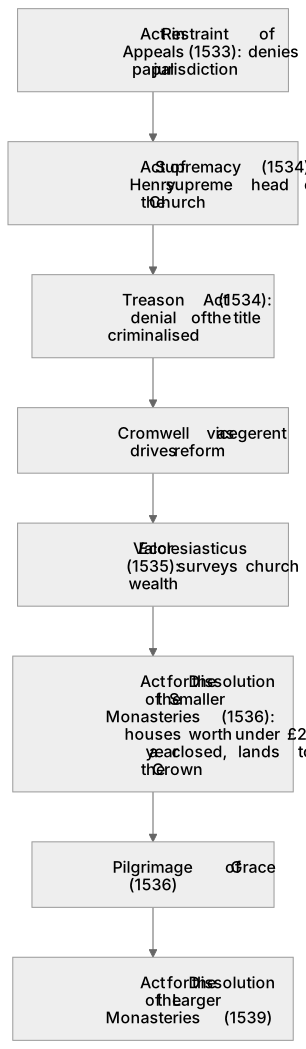
Put it in order
Put these steps in the order they happen.
- 1. Valor Ecclesiasticus (1535): surveys church wealth
- 2. Act for the Dissolution of the Larger Monasteries (1539)
- 3. Act for the Dissolution of the Smaller Monasteries (1536): houses worth under £200 a year closed, lands to the Crown
- 4. Act in Restraint of Appeals (1533): denies papal jurisdiction
- 5. Act of Supremacy (1534): Henry supreme head of the Church
- 6. Pilgrimage of Grace (1536)
- 7. Treason Act (1534): denial of the title criminalised
- 8. Cromwell as vicegerent drives reform
Put the events in order
Put these events in the order they happened, earliest first.
- 1. Act of Supremacy made Henry supreme head of the Church
- 2. Act in Restraint of Appeals denied papal jurisdiction
- 3. Act for the Dissolution of the Larger Monasteries followed
- 4. Valor Ecclesiasticus surveyed church wealth
- 5. Act closed smaller monasteries and Pilgrimage of Grace followed
Key words
Say what each word means before you turn the card.
Royal supremacy
Try answering aloud or in your head before turning the card.
Thomas Cromwell
Try answering aloud or in your head before turning the card.
Dissolution of the monasteries
Try answering aloud or in your head before turning the card.
Pilgrimage of Grace
Try answering aloud or in your head before turning the card.
See every definition
- Royal supremacy
- The position created by the Act of Supremacy (1534) making Henry supreme head of the Church, with the Treason Act (1534) criminalising denial of that title.
- Thomas Cromwell
- As vicegerent he drove reform, and the Valor Ecclesiasticus (1535) surveyed church wealth.
- Dissolution of the monasteries
- A two-stage process: the 1536 Act closed houses worth under £200 a year, transferring lands to the Crown, and the later closure of larger houses followed.
- Pilgrimage of Grace
- A rebellion in 1536 that followed the religious changes, reflecting deep resentment in the north.
Label the diagram
Some boxes have lost their names. Pick the right name for each number.
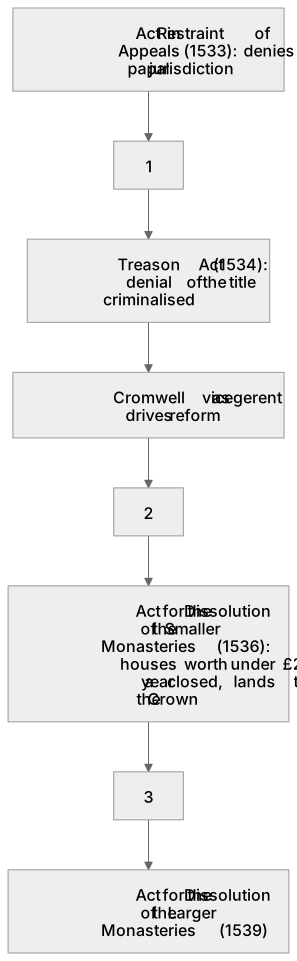
1Box 1
2Box 2
3Box 3
There is more to this lesson
The full lesson goes on to check your understanding and help you earn the marks. Create a free account to carry on, with your progress saved.
A week of Premium from your first lesson · Then the free plan continues · No card, no charge
Test your understanding of Paper 3, Option 31: Rebellion and disorder under the Tudors, 1485–1603 - 2 Challenging religious changes, 1533–37: The impact of Henrician religious changes, 1533–37: the break with Rome and the dissolution of the monasteries.
Active recall beats re-reading. Take an instant quiz now to test what you’ve learned and lock it into long-term memory.
A week of Premium from your first lesson · Then the free plan continues · No card, no charge