Pearson Edexcel · A-Level · History
Course version: 9HI0 · Version from Sept 2015
Rebellion and disorder under the Tudors, 1485–1603 - 2 Challenging…
Full specification wording
Paper 3, Option 31: Rebellion and disorder under the Tudors, 1485–1603 - 2 Challenging religious changes, 1533–37: The role of leaders in challenge and suppression: Robert Aske and Francis Bigod; Thomas Cromwell, Henry VIII and the Duke of Norfolk; the extent of repression in 1537.
Leadership shaped both the Pilgrimage of Grace and its defeat.
Checked against the Pearson Edexcel 9HI0 specification (opens in a new tab) on .
- Point 3 of 3
- 4 key terms
Study notes
From the checked teaching notes for this specification point.
The idea
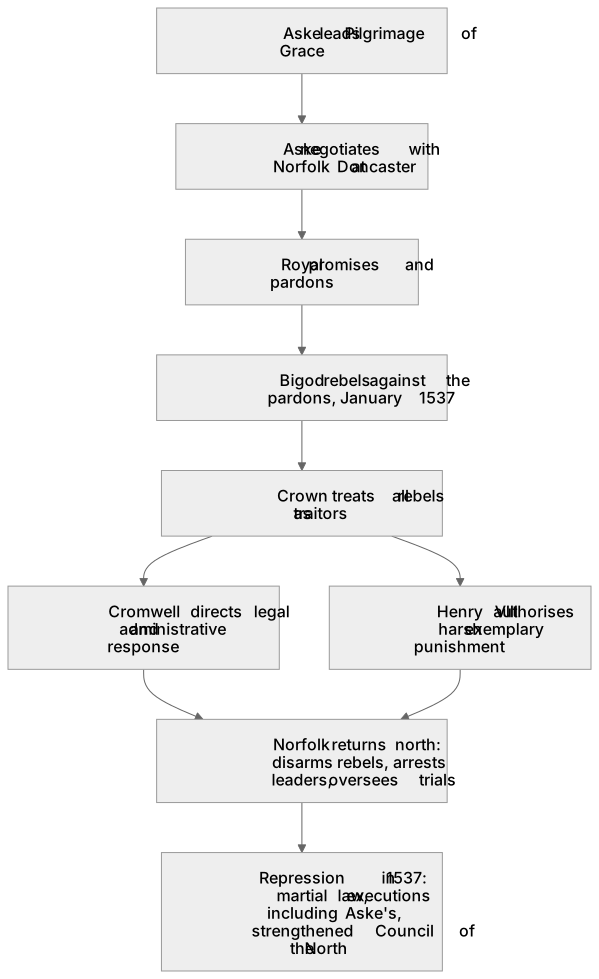
Leadership shaped both the Pilgrimage of Grace and its defeat. Robert Aske, a Yorkshire lawyer, gave the rising discipline and a coherent programme defending the monasteries and the old faith, negotiating at Doncaster and trusting royal promises. Francis Bigod, a reformist gentleman, broke that unity in early 1537 by rebelling against the pardons, giving Henry VIII grounds to treat all rebels as traitors. Suppression was directed by Thomas Cromwell as vicegerent, with Henry VIII authorising harsh exemplary punishment and the Duke of Norfolk commanding forces in the north and presiding over trials. In 1537 martial law and executions, including Aske's, plus the Council of the North's strengthened role, produced extensive repression.
What earns the marks
- Explains Cromwell's role as chief minister and vicegerent in orchestrating the dissolution of the smaller monasteries, gathering intelligence and directing the legal and administrative response to rebellion.
- Explains Henry VIII's personal role: he rejected the pilgrims' demands, used promises and pardons tactically, and authorised severe exemplary punishment to deter future disorder.
- Explains Norfolk's role as commander in the north: he negotiated at Doncaster, then returned in 1537 to disarm the rebels, arrest leaders and oversee trials and executions.
Common mistakes and how to put them right
Treating the Pilgrimage of Grace as a single spontaneous riot.
Put it right by showing Aske imposed discipline, a common oath and a negotiated strategy, which is why leadership is central to the enquiry.
Assuming Bigod was a Catholic loyalist like Aske.
Put it right by noting Bigod was a reformist who objected to the pardons and the settlement, so his rising split the rebel cause rather than continuing it.
Describing 1537 as indiscriminate slaughter of all northerners.
Put it right by explaining that punishment was exemplary and targeted at leaders and renewed rebels, though it was still severe and intimidating.
Exam tips
- Plan answers around the command word: for 'how far' or 'to what extent' questions, weigh Aske's unifying leadership against Bigod's divisive rising and reach a supported judgement.
- Use named individuals precisely: link Aske to negotiation, Bigod to renewed rebellion, Cromwell to policy and administration, Henry VIII to royal authority, and Norfolk to military suppression.
- Integrate the extent of repression into your argument rather than bolting it on at the end; use it as evidence when judging how effectively the Crown restored control.
Try the lesson
The start of the Paper 3, Option 31: Rebellion and disorder under the Tudors, 1485–1603 - 2 Challenging religious changes, 1533–37: The role of leaders in challenge and suppression: Robert Aske and Francis Bigod; Thomas Cromwell, Henry VIII and the Duke of Norfolk; the extent of repression in 1537. lesson, made from checked teaching notes for this specification point.
Have a go first
Which nobleman was sent north by Henry VIII to negotiate with the Pilgrimage of Grace and offer the rebels a pardon?
Listen
Leadership shaped both the Pilgrimage of Grace and its defeat. Robert Aske, a Yorkshire lawyer, gave the rising discipline and a coherent programme defending the monasteries and the old faith, negotiating at Doncaster and trusting royal promises. Francis Bigod, a reformist gentleman, broke that unity in early 1537 by rebelling against the pardons, giving Henry VIII grounds to treat all rebels as traitors. Suppression was directed by Thomas Cromwell as vicegerent, with Henry VIII authorising harsh exemplary punishment and the Duke of Norfolk commanding forces in the north and presiding over trials. In 1537 martial law and executions, including Aske's, plus the Council of the North's strengthened role, produced extensive repression. A strong answer earns marks for these points. Explains how Aske's leadership gave the Pilgrimage of Grace coherence: he organised the pilgrims, articulated grievances about the dissolution of the monasteries and the Statute of Uses, and negotiated with Norfolk at Doncaster rather than seeking outright war. Explains how Bigod's rebellion in January 1537 undermined the settlement: his rising in the East Riding against the royal pardons allowed the Crown to present all participants as having broken their oaths, justifying renewed military action. Explains Cromwell's role as chief minister and vicegerent in orchestrating the dissolution of the smaller monasteries, gathering intelligence and directing the legal and administrative response to rebellion. Explains Henry VIII's personal role: he rejected the pilgrims' demands, used promises and pardons tactically, and authorised severe exemplary punishment to deter future disorder. A common slip: Treating the Pilgrimage of Grace as a single spontaneous riot. Instead, showing Aske imposed discipline, a common oath and a negotiated strategy, which is why leadership is central to the enquiry. Exam tip: Plan answers around the command word: for 'how far' or 'to what extent' questions, weigh Aske's unifying leadership against Bigod's divisive rising and reach a supported judgement.
See it
Key words
Say what each word means before you turn the card.
Leadership and unity in rebellion
Try answering aloud or in your head before turning the card.
Faction and royal policy at court
Try answering aloud or in your head before turning the card.
Negotiation versus coercion
Try answering aloud or in your head before turning the card.
Punishment, deterrence and royal authority in the north
Try answering aloud or in your head before turning the card.
See every definition
- Leadership and unity in rebellion
- Robert Aske gave the rising discipline and a coherent programme, organising the pilgrims and negotiating rather than seeking outright war, while Francis Bigod broke that unity by rebelling against the pardons.
- Faction and royal policy at court
- Thomas Cromwell directed the response as vicegerent, while Henry VIII rejected the pilgrims' demands, used promises and pardons tactically and authorised severe exemplary punishment.
- Negotiation versus coercion
- Aske negotiated with Norfolk at Doncaster and trusted royal promises, whereas Henry VIII used promises and pardons tactically before authorising harsh exemplary punishment.
- Punishment, deterrence and royal authority in the north
- In 1537 martial law and executions, including Aske's, plus the Council of the North's strengthened role, produced extensive repression that was selective rather than a blanket massacre.
Label the diagram
Some boxes have lost their names. Pick the right name for each number.
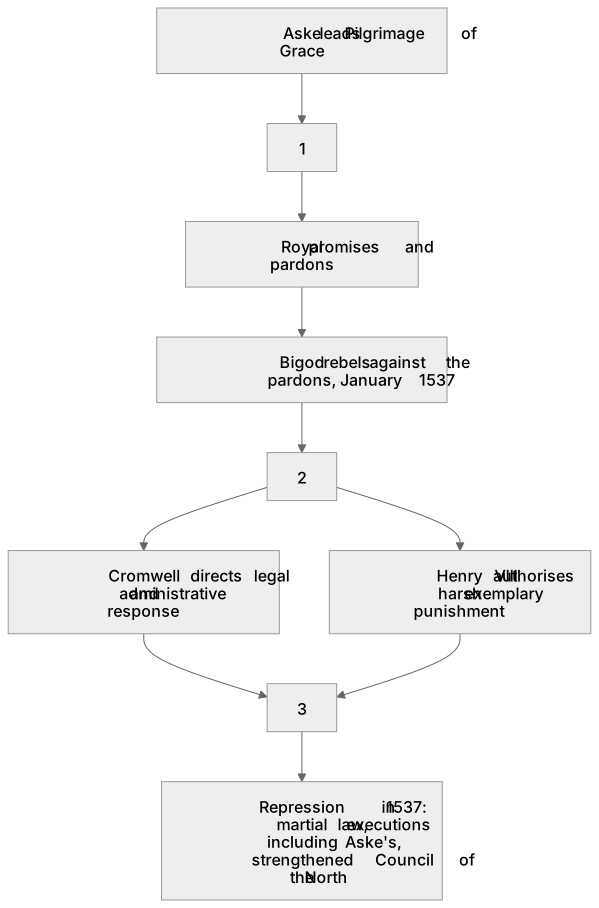
1Box 1
2Box 2
3Box 3
There is more to this lesson
The full lesson goes on to check your understanding and help you earn the marks. Create a free account to carry on, with your progress saved.
A week of Premium from your first lesson · Then the free plan continues · No card, no charge
Test your understanding of Paper 3, Option 31: Rebellion and disorder under the Tudors, 1485–1603 - 2 Challenging religious changes, 1533–37: The role of leaders in challenge and suppression: Robert Aske and Francis Bigod; Thomas Cromwell, Henry VIII and the Duke of Norfolk; the extent of repression in 1537.
Active recall beats re-reading. Take an instant quiz now to test what you’ve learned and lock it into long-term memory.
A week of Premium from your first lesson · Then the free plan continues · No card, no charge