Pearson Edexcel · A-Level · History
Course version: 9HI0 · Version from Sept 2015
The Golden Age of Spain, 1474–1598 - 1 Changing geographical reach of…
Full specification wording
Paper 3, Option 32: The Golden Age of Spain, 1474–1598 - 1 Changing geographical reach of Spanish power: The reasons for the expansion and maintenance of Spanish power throughout Italy and the Mediterranean, 1474–1598; the struggle with France and the Turks (key developments: Ferdinand being recognised as King of Naples 1504; the Battle of Pavia and the capture of Francis I in 1525; the capture of Tunis 1535; the siege of Malta 1565).
Spanish power in Italy and the Mediterranean rested on dynastic claims, military victories and naval defence.
Checked against the Pearson Edexcel 9HI0 specification (opens in a new tab) on .
- Point 1 of 2
- 3 key terms
Study notes
From the checked teaching notes for this specification point.
The idea
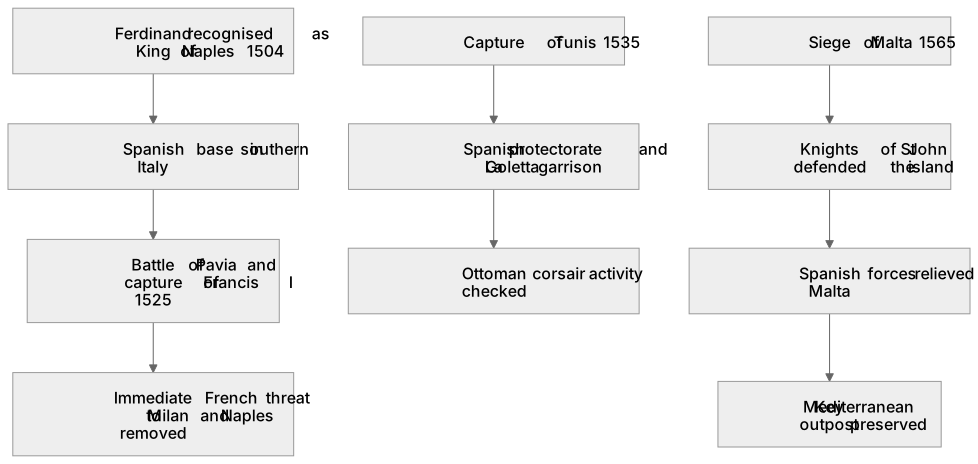
Spanish power in Italy and the Mediterranean rested on dynastic claims, military victories and naval defence. Ferdinand's recognition as King of Naples in 1504 gave Spain a base in southern Italy, while the capture of Francis I at Pavia in 1525 removed the immediate French threat to Milan and Naples. Charles I's capture of Tunis in 1535 checked Ottoman corsair activity and established a Spanish protectorate with a garrison at La Goletta, maintained until 1574. The siege of Malta in 1565, defended by the Knights of St John, was relieved by Spanish forces, preserving a key Mediterranean outpost. These developments show how Spain expanded and maintained power against France and the Turks.
What earns the marks
- Explains how Ferdinand's recognition as King of Naples in 1504 secured a Spanish dynastic claim and provided a strategic base for further Italian involvement.
- Analyses the significance of the Battle of Pavia in 1525, including the capture of Francis I, in removing the immediate French threat to Spanish possessions in Italy.
- Assesses the capture of Tunis in 1535 as a demonstration of Spanish naval reach, establishing a protectorate and the La Goletta garrison to check Ottoman and corsair power.
- Evaluates the siege of Malta in 1565 as a defensive success that preserved a crucial Mediterranean outpost and limited Ottoman expansion.
- Discusses the broader reasons for expansion and maintenance, such as dynastic inheritance, military resources, alliances and the need to defend lines of communication.
- Compares the relative importance of struggles with France and with the Turks in shaping Spanish power across the period.
Common mistakes and how to put them right
Treating the capture of Tunis in 1535 as a fleeting raid.
Put it right: Explain that it established a Spanish protectorate and the La Goletta garrison, which Spain maintained for 39 years until 1574.
Assuming the siege of Malta in 1565 was won by Spanish troops alone.
Put it right: Note that the Knights of St John defended the island and Spanish relief forces played a crucial supporting role.
Confusing the Battle of Pavia in 1525 with a naval engagement.
Put it right: Describe it as a land battle in Italy where Francis I was captured, and link it to the French struggle over Milan and Naples.
Exam tips
- Use the key developments as precise evidence, but always link them to the reasons for expansion or maintenance of Spanish power.
- When discussing the struggle with France and the Turks, compare their relative impact on Spain's ability to hold Italy and the Mediterranean.
- Plan answers around themes such as dynastic claims, military strength, naval power and defensive needs to avoid a narrative list.
Try the lesson
The start of the Paper 3, Option 32: The Golden Age of Spain, 1474–1598 - 1 Changing geographical reach of Spanish power: The reasons for the expansion and maintenance of Spanish power throughout Italy and the Mediterranean, 1474–1598; the struggle with France and the Turks (key developments: Ferdinand being recognised as King of Naples 1504; the Battle of Pavia and the capture of Francis I in 1525; the capture of Tunis 1535; the siege of Malta 1565). lesson, made from checked teaching notes for this specification point.
Have a go first
Which key development of 1504 established Ferdinand of Aragon's position in southern Italy?
Listen
Spanish power in Italy and the Mediterranean rested on dynastic claims, military victories and naval defence. Ferdinand's recognition as King of Naples in 1504 gave Spain a base in southern Italy, while the capture of Francis I at Pavia in 1525 removed the immediate French threat to Milan and Naples. Charles I's capture of Tunis in 1535 checked Ottoman corsair activity and established a Spanish protectorate with a garrison at La Goletta, maintained until 1574. The siege of Malta in 1565, defended by the Knights of St John, was relieved by Spanish forces, preserving a key Mediterranean outpost. These developments show how Spain expanded and maintained power against France and the Turks. A strong answer earns marks for these points. Explains how Ferdinand's recognition as King of Naples in 1504 secured a Spanish dynastic claim and provided a strategic base for further Italian involvement. Analyses the significance of the Battle of Pavia in 1525, including the capture of Francis I, in removing the immediate French threat to Spanish possessions in Italy. Assesses the capture of Tunis in 1535 as a demonstration of Spanish naval reach, establishing a protectorate and the La Goletta garrison to check Ottoman and corsair power. Evaluates the siege of Malta in 1565 as a defensive success that preserved a crucial Mediterranean outpost and limited Ottoman expansion. A common slip: Treating the capture of Tunis in 1535 as a fleeting raid. Instead, explain that it established a Spanish protectorate and the La Goletta garrison, which Spain maintained for 39 years until 1574. Exam tip: Use the key developments as precise evidence, but always link them to the reasons for expansion or maintenance of Spanish power.
See it
Put the events in order
Put these events in the order they happened, earliest first.
- 1. Siege of Malta
- 2. Ferdinand recognised as King of Naples
- 3. Capture of Tunis
- 4. Battle of Pavia and capture of Francis I
Key words
Say what each word means before you turn the card.
Dynastic claims and inheritance in Italy
Try answering aloud or in your head before turning the card.
Military conflict with France
Try answering aloud or in your head before turning the card.
Naval and defensive struggle against the Ottoman Turks
Try answering aloud or in your head before turning the card.
See every definition
- Dynastic claims and inheritance in Italy
- Basis of Spanish power in Italy and the Mediterranean, illustrated by Ferdinand being recognised as King of Naples in 1504, giving Spain a base in southern Italy.
- Military conflict with France
- Struggle in which the capture of Francis I at Pavia in 1525 removed the immediate French threat to Milan and Naples.
- Naval and defensive struggle against the Ottoman Turks
- Struggle shown by the capture of Tunis in 1535, which checked Ottoman corsair activity, and the siege of Malta in 1565, relieved by Spanish forces.
Label the diagram
Some boxes have lost their names. Pick the right name for each number.
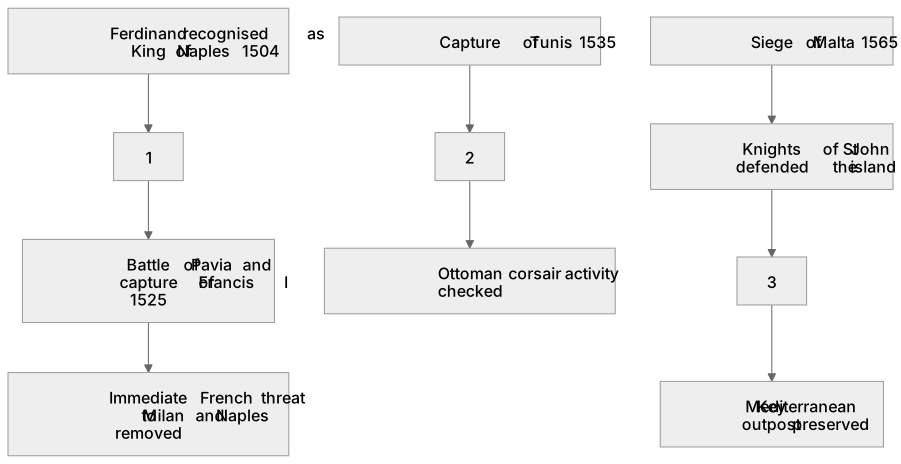
1Box 1
2Box 2
3Box 3
There is more to this lesson
The full lesson goes on to check your understanding and help you earn the marks. Create a free account to carry on, with your progress saved.
A week of Premium from your first lesson · Then the free plan continues · No card, no charge
Test your understanding of Paper 3, Option 32: The Golden Age of Spain, 1474–1598 - 1 Changing geographical reach of Spanish power: The reasons for the expansion and maintenance of Spanish power throughout Italy and the Mediterranean, 1474–1598; the struggle with France and the Turks (key developments: Ferdinand being recognised as King of Naples 1504; the Battle of Pavia and the capture of Francis I in 1525; the capture of Tunis 1535; the siege of Malta 1565).
Active recall beats re-reading. Take an instant quiz now to test what you’ve learned and lock it into long-term memory.
A week of Premium from your first lesson · Then the free plan continues · No card, no charge