Pearson Edexcel · A-Level · History
Course version: 9HI0 · Version from Sept 2015
The Golden Age of Spain, 1474–1598 - 1 The Spanish Inquisition and the…
Full specification wording
Paper 3, Option 32: The Golden Age of Spain, 1474–1598 - 1 The Spanish Inquisition and the persecution of the Jews, 1478–92: The reasons for the foundation of the Inquisition in 1478–80; the roles of Queen Isabella and Tomás de Torquemada; the methods of the Inquisition and its impact on conversos.
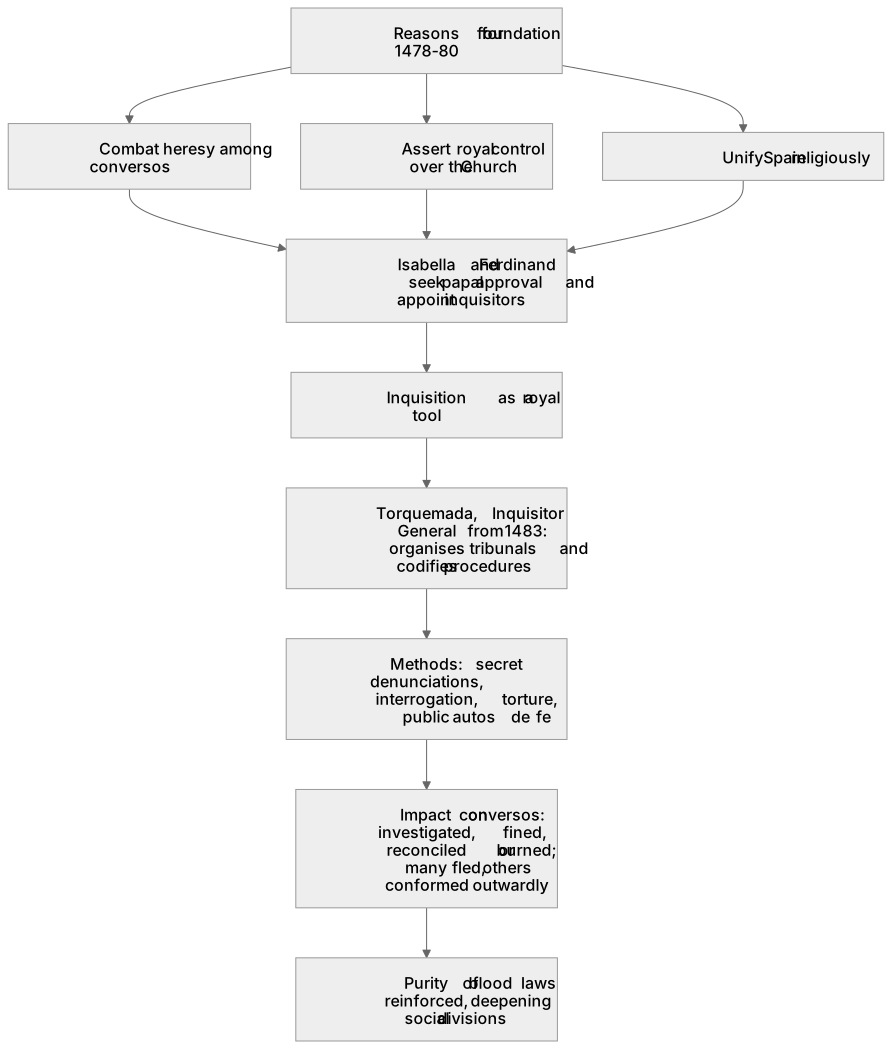
The Spanish Inquisition was founded in 1478–80 for several reasons: to combat heresy among conversos, to assert royal control over the Church, and to unify Spain religiously.
Checked against the Pearson Edexcel 9HI0 specification (opens in a new tab) on .
- Point 2 of 3
- 4 key terms
Study notes
From the checked teaching notes for this specification point.
The idea
The Spanish Inquisition was founded in 1478–80 for several reasons: to combat heresy among conversos, to assert royal control over the Church, and to unify Spain religiously. Queen Isabella, with Ferdinand, sought papal approval and appointed inquisitors, making the institution a royal tool. Tomás de Torquemada, as Inquisitor General from 1483, organised tribunals and codified procedures. Methods included secret denunciations, interrogation, torture and public autos de fe, leading to thousands of conversos being investigated, fined, reconciled or burned. The impact on conversos was severe: many fled, others conformed outwardly, and the Inquisition reinforced purity of blood laws, deepening social divisions.
What earns the marks
- Explains the religious, political and social reasons for founding the Inquisition, including the converso heresy problem and royal centralisation.
- Analyses the roles of Isabella and Ferdinand in securing papal approval and establishing royal control over the Inquisition.
- Assesses Torquemada's contribution as Inquisitor General, including his organisation of tribunals and compilation of instructions.
- Describes the methods of the Inquisition, such as denunciation, secret trials, torture and autos de fe, and evaluates their effectiveness.
- Evaluates the impact on conversos, including emigration, assimilation, economic penalties and social stigmatisation.
Common mistakes and how to put them right
Claiming the Inquisition was solely a papal institution.
Put it right: It was under royal control, though papal approval was needed.
Overstating the number of executions.
Put it right: While thousands were tried, only a minority were executed, with many receiving lesser penalties.
Attributing the foundation entirely to Torquemada.
Put it right: Isabella and Ferdinand initiated it, and Torquemada became Inquisitor General later.
Exam tips
- Use precise dates, such as the papal bull of 1478 and the appointment of Torquemada in 1483, to show chronological understanding.
- Balance the roles of monarchs and Torquemada, avoiding a single-person explanation.
- Link methods to impact, explaining how procedures affected converso communities.
Try the lesson
The start of the Paper 3, Option 32: The Golden Age of Spain, 1474–1598 - 1 The Spanish Inquisition and the persecution of the Jews, 1478–92: The reasons for the foundation of the Inquisition in 1478–80; the roles of Queen Isabella and Tomás de Torquemada; the methods of the Inquisition and its impact on conversos. lesson, made from checked teaching notes for this specification point.
Have a go first
In which year did Pope Sixtus IV issue the bull authorising the Spanish Inquisition?
Listen
The Spanish Inquisition was founded in 1478–80 for several reasons: to combat heresy among conversos, to assert royal control over the Church, and to unify Spain religiously. Queen Isabella, with Ferdinand, sought papal approval and appointed inquisitors, making the institution a royal tool. Tomás de Torquemada, as Inquisitor General from 1483, organised tribunals and codified procedures. Methods included secret denunciations, interrogation, torture and public autos de fe, leading to thousands of conversos being investigated, fined, reconciled or burned. The impact on conversos was severe: many fled, others conformed outwardly, and the Inquisition reinforced purity of blood laws, deepening social divisions. A strong answer earns marks for these points. Explains the religious, political and social reasons for founding the Inquisition, including the converso heresy problem and royal centralisation. Analyses the roles of Isabella and Ferdinand in securing papal approval and establishing royal control over the Inquisition. Assesses Torquemada's contribution as Inquisitor General, including his organisation of tribunals and compilation of instructions. Describes the methods of the Inquisition, such as denunciation, secret trials, torture and autos de fe, and evaluates their effectiveness. A common slip: Claiming the Inquisition was solely a papal institution. Instead, it was under royal control, though papal approval was needed. Exam tip: Use precise dates, such as the papal bull of 1478 and the appointment of Torquemada in 1483, to show chronological understanding.
See it
Key words
Say what each word means before you turn the card.
Religious uniformity and heresy
Try answering aloud or in your head before turning the card.
Royal power and institutional control
Try answering aloud or in your head before turning the card.
Inquisitorial procedure and evidence
Try answering aloud or in your head before turning the card.
Social consequences and resistance
Try answering aloud or in your head before turning the card.
See every definition
- Religious uniformity and heresy
- The Inquisition was founded partly to combat heresy among conversos and to unify Spain religiously.
- Royal power and institutional control
- The Inquisition asserted royal control over the Church and became a royal tool, though papal approval was needed.
- Inquisitorial procedure and evidence
- Methods included secret denunciations, interrogation, torture and public autos de fe, with tribunals organised and procedures codified.
- Social consequences and resistance
- The impact on conversos was severe: many fled, others conformed outwardly, and purity of blood laws deepened social divisions.
Label the diagram
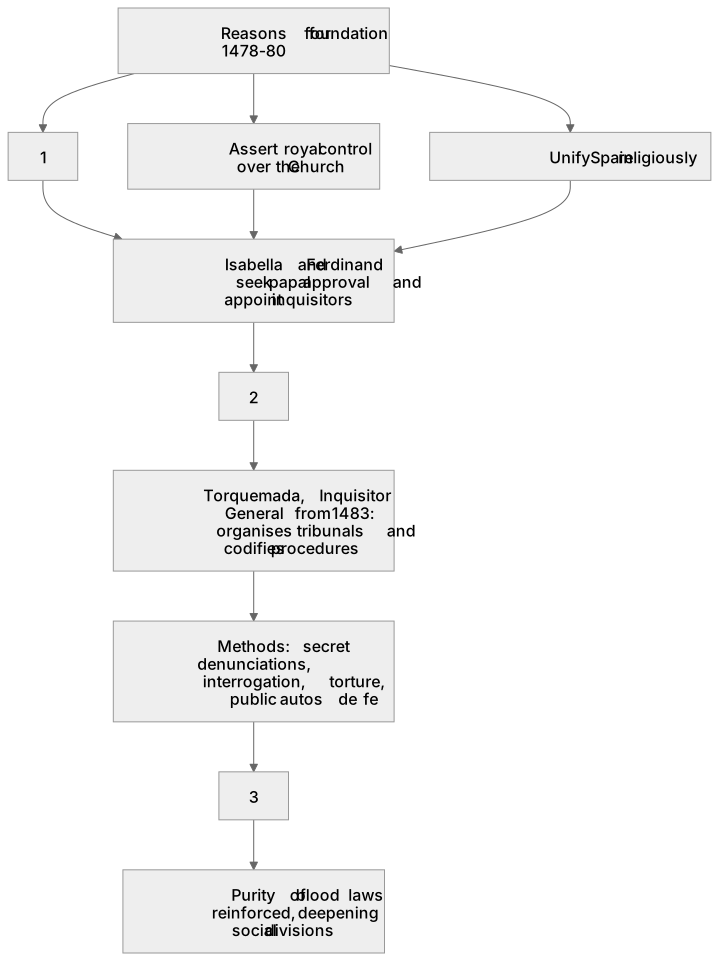
Some boxes have lost their names. Pick the right name for each number.
1Box 1
2Box 2
3Box 3
There is more to this lesson
The full lesson goes on to check your understanding and help you earn the marks. Create a free account to carry on, with your progress saved.
A week of Premium from your first lesson · Then the free plan continues · No card, no charge
Test your understanding of Paper 3, Option 32: The Golden Age of Spain, 1474–1598 - 1 The Spanish Inquisition and the persecution of the Jews, 1478–92: The reasons for the foundation of the Inquisition in 1478–80; the roles of Queen Isabella and Tomás de Torquemada; the methods of the Inquisition and its impact on conversos.
Active recall beats re-reading. Take an instant quiz now to test what you’ve learned and lock it into long-term memory.
A week of Premium from your first lesson · Then the free plan continues · No card, no charge