Pearson Edexcel · A-Level · History
Course version: 9HI0 · Version from Sept 2015
The Golden Age of Spain, 1474–1598 - 2 Changing military and financial…
Full specification wording
Paper 3, Option 32: The Golden Age of Spain, 1474–1598 - 2 Changing military and financial power: The growing power of the Spanish army, 1474–1598 and key figures: Gonzalo de Córdoba, the Duke of Alba and Alexander Farnese, Prince of Parma. The significance of naval power, 1474–1598 (key developments: the use of Genoa and Andrea Doria from 1528, galley building from 1560, the Battle of Lepanto 1571, the acquisition of the Portuguese fleet 1580, the defeat of the Spanish Armada 1588).
Between 1474 and 1598 Spain moved from a union of crowns with improvised forces to the dominant military machine in Europe.
Checked against the Pearson Edexcel 9HI0 specification (opens in a new tab) on .
- Point 1 of 2
- 4 key terms
Study notes
From the checked teaching notes for this specification point.
The idea
Between 1474 and 1598 Spain moved from a union of crowns with improvised forces to the dominant military machine in Europe. Gonzalo de Córdoba reorganised infantry around pike and shot, the tercio, and won in Italy; the Duke of Alba supplied ruthless discipline and the march to the Netherlands; Alexander Farnese, Prince of Parma, combined siegecraft, engineering and amphibious planning. At sea, Spain hired Genoese galleys and Andrea Doria from 1528, expanded galley building from 1560, helped destroy Ottoman naval power at Lepanto in 1571, absorbed the Portuguese fleet in 1580, yet lost the Armada in 1588.
What earns the marks
- Explains how Gonzalo de Córdoba combined pikes, arquebuses and cavalry to create the flexible tercio, and links this to Spanish victories in Italy and the wider growth of army power.
- Analyses the Duke of Alba's contribution through discipline, training, logistics and harsh command, including the march to the Netherlands, and weighs this against the political cost of his methods.
- Explains the naval significance of hiring Genoese galleys and Andrea Doria from 1528, showing how this gave Spain Mediterranean reach without owning every ship.
- Links galley building from 1560 to increased Mediterranean capability and the ability to contest Ottoman fleets.
- Evaluates the Battle of Lepanto in 1571 as a major Christian naval victory that checked Ottoman expansion but did not end Ottoman sea power.
- Explains how the acquisition of the Portuguese fleet in 1580 added ocean-going ships and imperial reach, and how the defeat of the Spanish Armada in 1588 exposed the limits of that power.
- Reaches a supported judgement on how far Spanish military and naval power grew across the period, balancing successes against later failures.
Common mistakes and how to put them right
Treating the tercio as simply a block of pikemen.
Put it right: Describe it as a combined-arms formation mixing pikes, shot and supporting cavalry.
Assuming Lepanto in 1571 permanently destroyed Ottoman naval power.
Put it right: Explain that it checked expansion while the Ottomans rebuilt their fleet.
Presenting the Armada defeat as proof that Spanish sea power collapsed.
Put it right: Show that Spain retained major naval and imperial capacity after 1588.
Exam tips
- Anchor each key figure to a specific development or campaign so the answer shows change over time rather than a list of names.
- When discussing naval power, separate Mediterranean galley warfare from Atlantic ocean-going warfare and explain why both mattered.
- Plan an argument about growth and limits, then use the key figures and naval developments as evidence for that argument.
Try the lesson
The start of the Paper 3, Option 32: The Golden Age of Spain, 1474–1598 - 2 Changing military and financial power: The growing power of the Spanish army, 1474–1598 and key figures: Gonzalo de Córdoba, the Duke of Alba and Alexander Farnese, Prince of Parma. The significance of naval power, 1474–1598 (key developments: the use of Genoa and Andrea Doria from 1528, galley building from 1560, the Battle of Lepanto 1571, the acquisition of the Portuguese fleet 1580, the defeat of the Spanish Armada 1588). lesson, made from checked teaching notes for this specification point.
Have a go first
Which commander is credited with reorganising the Spanish infantry into the tercio formations that dominated battlefields in the early sixteenth century?
Listen
Between 1474 and 1598 Spain moved from a union of crowns with improvised forces to the dominant military machine in Europe. Gonzalo de Córdoba reorganised infantry around pike and shot, the tercio, and won in Italy; the Duke of Alba supplied ruthless discipline and the march to the Netherlands; Alexander Farnese, Prince of Parma, combined siegecraft, engineering and amphibious planning. At sea, Spain hired Genoese galleys and Andrea Doria from 1528, expanded galley building from 1560, helped destroy Ottoman naval power at Lepanto in 1571, absorbed the Portuguese fleet in 1580, yet lost the Armada in 1588. A strong answer earns marks for these points. Explains how Gonzalo de Córdoba combined pikes, arquebuses and cavalry to create the flexible tercio, and links this to Spanish victories in Italy and the wider growth of army power. Analyses the Duke of Alba's contribution through discipline, training, logistics and harsh command, including the march to the Netherlands, and weighs this against the political cost of his methods. Assesses Alexander Farnese, Prince of Parma, as a siege and amphibious commander whose engineering and planning restored Spanish control in the Netherlands, while noting the limits imposed by resources and English intervention. Explains the naval significance of hiring Genoese galleys and Andrea Doria from 1528, showing how this gave Spain Mediterranean reach without owning every ship. A common slip: Treating the tercio as simply a block of pikemen. Instead, describe it as a combined-arms formation mixing pikes, shot and supporting cavalry. Exam tip: Anchor each key figure to a specific development or campaign so the answer shows change over time rather than a list of names.
See it

Put the events in order
Put these events in the order they happened, earliest first.
- 1. Galley building expanded
- 2. Spain hired Genoese galleys and Andrea Doria
- 3. The Spanish Armada was defeated
- 4. Battle of Lepanto checked Ottoman expansion
- 5. Spain acquired the Portuguese fleet
Key words
Say what each word means before you turn the card.
tercio
Try answering aloud or in your head before turning the card.
Battle of Lepanto
Try answering aloud or in your head before turning the card.
defeat of the Spanish Armada
Try answering aloud or in your head before turning the card.
Andrea Doria
Try answering aloud or in your head before turning the card.
See every definition
- tercio
- A combined-arms formation mixing pikes, shot and supporting cavalry, created by Gonzalo de Córdoba.
- Battle of Lepanto
- A major Christian naval victory in 1571 that checked Ottoman expansion but did not end Ottoman sea power.
- defeat of the Spanish Armada
- The 1588 defeat that exposed the limits of Spanish power, though Spain retained major naval and imperial capacity afterwards.
- Andrea Doria
- Genoese commander whose galleys were hired from 1528, giving Spain Mediterranean reach without owning every ship.
Label the diagram
Some boxes have lost their names. Pick the right name for each number.
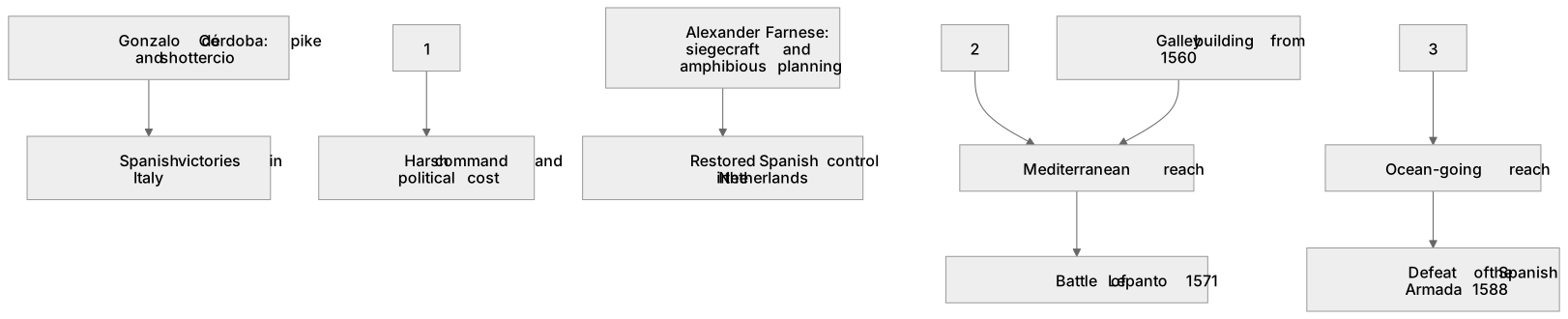
1Box 1
2Box 2
3Box 3
There is more to this lesson
The full lesson goes on to check your understanding and help you earn the marks. Create a free account to carry on, with your progress saved.
A week of Premium from your first lesson · Then the free plan continues · No card, no charge
Test your understanding of Paper 3, Option 32: The Golden Age of Spain, 1474–1598 - 2 Changing military and financial power: The growing power of the Spanish army, 1474–1598 and key figures: Gonzalo de Córdoba, the Duke of Alba and Alexander Farnese, Prince of Parma. The significance of naval power, 1474–1598 (key developments: the use of Genoa and Andrea Doria from 1528, galley building from 1560, the Battle of Lepanto 1571, the acquisition of the Portuguese fleet 1580, the defeat of the Spanish Armada 1588).
Active recall beats re-reading. Take an instant quiz now to test what you’ve learned and lock it into long-term memory.
A week of Premium from your first lesson · Then the free plan continues · No card, no charge