Pearson Edexcel · A-Level · History
Course version: 9HI0 · Version from Sept 2015
The Golden Age of Spain, 1474–1598 - 2 The accession of Charles and the…
Full specification wording
Paper 3, Option 32: The Golden Age of Spain, 1474–1598 - 2 The accession of Charles and the revolt of the Comuneros, 1516–29: The significance of Charles von Habsburg's accession in 1516; the importance of Cardinal Jiménez de Cisneros.
Examine two connected developments.
Checked against the Pearson Edexcel 9HI0 specification (opens in a new tab) on .
- Point 1 of 3
- 4 key terms
Study notes
From the checked teaching notes for this specification point.
The idea
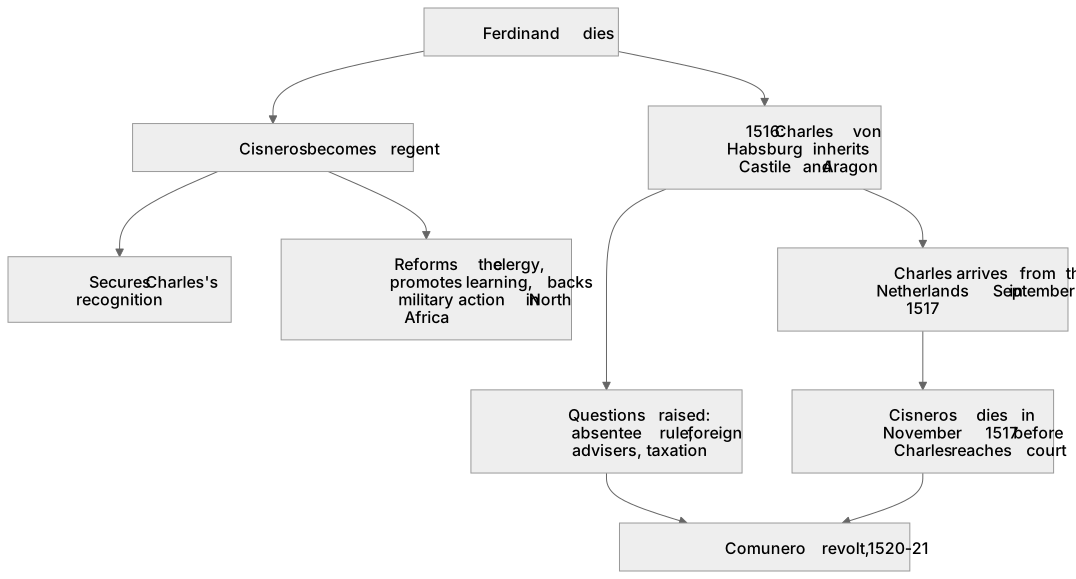
Examine two connected developments. In 1516 Charles von Habsburg inherited Castile and Aragon after Ferdinand's death, arriving from the Netherlands in September 1517. His accession raised questions about absentee rule, foreign advisers and taxation, helping to provoke the Comunero revolt of 1520–21. Assess its significance: a new dynasty, a wider Habsburg inheritance, and tensions between royal authority and Castilian towns. Then assess Cardinal Jiménez de Cisneros, regent after Ferdinand's death. He secured Charles's recognition, reformed the clergy, promoted learning and backed military action in North Africa. His death in November 1517 removed a stabilising figure before Charles reached court. Weigh how far he preserved continuity and how far his actions shaped the crisis that followed.
What earns the marks
- Explains the circumstances of Charles's accession in 1516, including his inheritance from Ferdinand and his Netherlandish background.
- Explains the political significance of accession: absentee monarchy, foreign advisers, and growing tension with Castilian towns.
- Explains Cisneros's role as regent, including securing recognition of Charles and maintaining order before the new king assumed government.
- Explains Cisneros's wider importance: religious reform, promotion of learning, and military activity in North Africa.
- Evaluates the link between accession and the Comunero revolt, weighing Charles's policies against longer-standing grievances.
- Uses specific evidence, such as the dates 1516 and 1517, Charles's arrival in 1517, or Cisneros's regency, to support the argument.
Common mistakes and how to put them right
Confusing Charles's accession with his arrival.
Put it right by distinguishing the 1516 inheritance from his landing in September 1517.
Reducing Cisneros to a caretaker.
Put it right by crediting his reform, learning and military initiatives.
Treating the Comunero revolt as caused only by Charles's foreignness.
Put it right by including taxation and urban grievances.
Stating Cisneros died before Charles arrived in Spain.
Put it right by noting Charles landed in September 1517 and Cisneros died in November before Charles reached court.
Exam tips
- Separate the two parts of the statement clearly, then link them in a judgement.
- Use dates and names precisely, such as 1516, 1517 and Cisneros, to show secure knowledge.
- Explain significance rather than narrating events, focusing on consequences and importance.
Try the lesson
The start of the Paper 3, Option 32: The Golden Age of Spain, 1474–1598 - 2 The accession of Charles and the revolt of the Comuneros, 1516–29: The significance of Charles von Habsburg's accession in 1516; the importance of Cardinal Jiménez de Cisneros. lesson, made from checked teaching notes for this specification point.
Have a go first
In which year did Charles von Habsburg begin his rule in Spain as King Charles I?
Listen
Examine two connected developments. In 1516 Charles von Habsburg inherited Castile and Aragon after Ferdinand's death, arriving from the Netherlands in September 1517. His accession raised questions about absentee rule, foreign advisers and taxation, helping to provoke the Comunero revolt of 1520–21. Assess its significance: a new dynasty, a wider Habsburg inheritance, and tensions between royal authority and Castilian towns. Then assess Cardinal Jiménez de Cisneros, regent after Ferdinand's death. He secured Charles's recognition, reformed the clergy, promoted learning and backed military action in North Africa. His death in November 1517 removed a stabilising figure before Charles reached court. Weigh how far he preserved continuity and how far his actions shaped the crisis that followed. A strong answer earns marks for these points. Explains the circumstances of Charles's accession in 1516, including his inheritance from Ferdinand and his Netherlandish background. Explains the political significance of accession: absentee monarchy, foreign advisers, and growing tension with Castilian towns. Explains Cisneros's role as regent, including securing recognition of Charles and maintaining order before the new king assumed government. Explains Cisneros's wider importance: religious reform, promotion of learning, and military activity in North Africa. A common slip: Confusing Charles's accession with his arrival. Instead, distinguishing the 1516 inheritance from his landing in September 1517. Exam tip: Separate the two parts of the statement clearly, then link them in a judgement.
See it
Key words
Say what each word means before you turn the card.
Dynastic change and Habsburg inheritance
Try answering aloud or in your head before turning the card.
Absentee monarchy and foreign advisers
Try answering aloud or in your head before turning the card.
Regency and political continuity
Try answering aloud or in your head before turning the card.
Religious reform and learning
Try answering aloud or in your head before turning the card.
See every definition
- Dynastic change and Habsburg inheritance
- In 1516 Charles von Habsburg inherited Castile and Aragon after Ferdinand's death, bringing a new dynasty and a wider Habsburg inheritance.
- Absentee monarchy and foreign advisers
- Charles's accession raised questions about absentee rule and foreign advisers, contributing to tension between royal authority and Castilian towns.
- Regency and political continuity
- Cardinal Jiménez de Cisneros was regent after Ferdinand's death, securing Charles's recognition and maintaining order before the new king assumed government.
- Religious reform and learning
- Cisneros reformed the clergy, promoted learning and backed military action in North Africa, showing his wider importance beyond a caretaker role.
Label the diagram
Some boxes have lost their names. Pick the right name for each number.
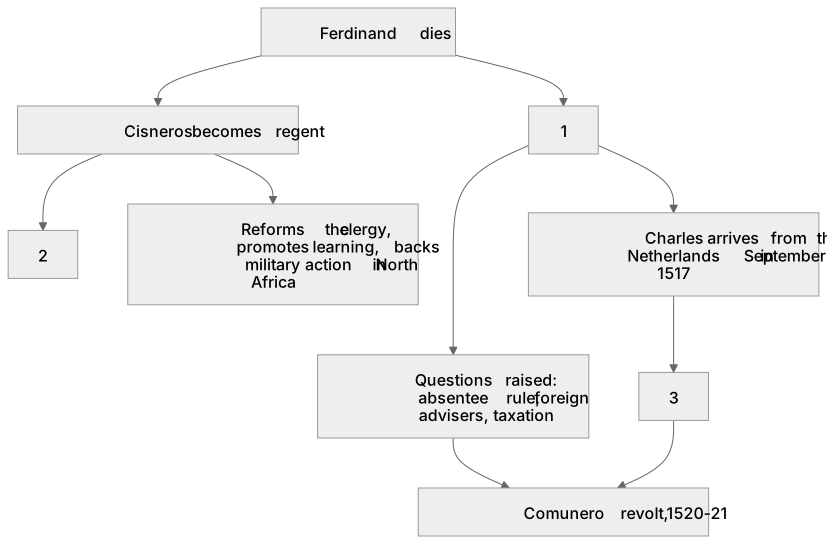
1Box 1
2Box 2
3Box 3
There is more to this lesson
The full lesson goes on to check your understanding and help you earn the marks. Create a free account to carry on, with your progress saved.
A week of Premium from your first lesson · Then the free plan continues · No card, no charge
Test your understanding of Paper 3, Option 32: The Golden Age of Spain, 1474–1598 - 2 The accession of Charles and the revolt of the Comuneros, 1516–29: The significance of Charles von Habsburg's accession in 1516; the importance of Cardinal Jiménez de Cisneros.
Active recall beats re-reading. Take an instant quiz now to test what you’ve learned and lock it into long-term memory.
A week of Premium from your first lesson · Then the free plan continues · No card, no charge