Pearson Edexcel · A-Level · History
Course version: 9HI0 · Version from Sept 2015
The Golden Age of Spain, 1474–1598 - 3 The price revolution and its…
Full specification wording
Paper 3, Option 32: The Golden Age of Spain, 1474–1598 - 3 The price revolution and its impact, c1500–c1570: The impact on prices of population growth in towns and countryside. The social impact of the price revolution: winners and losers; changing social values.
Population growth in Castilian towns and countryside raised demand for food, fuel and cloth while supply lagged, so prices climbed steadily from about 1500 to the 1560s.
Checked against the Pearson Edexcel 9HI0 specification (opens in a new tab) on .
- Point 3 of 3
- 4 key terms
Study notes
From the checked teaching notes for this specification point.
The idea
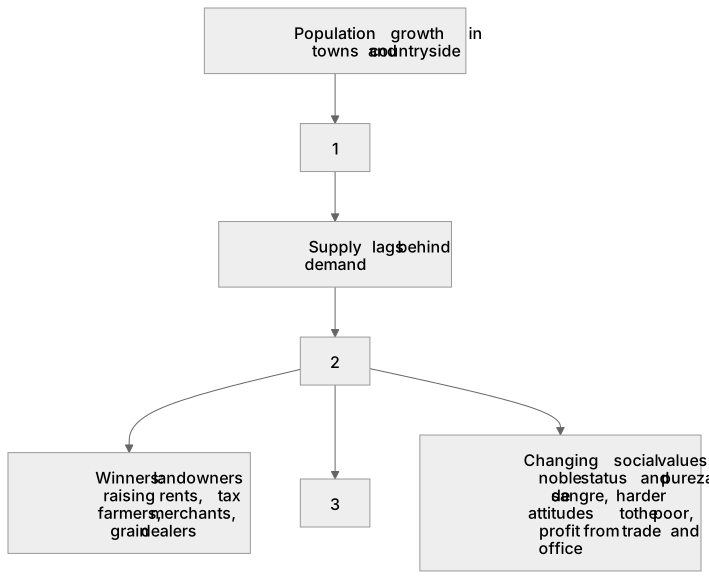
Population growth in Castilian towns and countryside raised demand for food, fuel and cloth while supply lagged, so prices climbed steadily from about 1500 to the 1560s. Urban growth around Seville, Toledo and Valladolid pulled in rural migrants, and rising rural numbers pressed on land, pushing up rents and grain prices. The result is the price revolution: a sustained, general rise in prices, not a single spike. Winners included landowners who raised rents, tax farmers, merchants and grain dealers; losers included wage earners, the landless poor and those on fixed incomes, whose money bought less. Social values shifted too: noble status and pureza de sangre mattered more, charity hardened towards the undeserving poor, and wealth from trade and office challenged older ideals of honour.
What earns the marks
- Explains that population growth in towns and countryside increased demand for food and basic goods faster than supply could respond, producing sustained price rises.
- Distinguishes the price revolution as a general, long-run rise in prices across the period c1500–c1570 rather than a short-term fluctuation.
- Identifies winners such as landowners able to raise rents, merchants, tax farmers and grain dealers who profited from higher prices.
- Identifies losers such as wage labourers, the landless poor and recipients of fixed incomes whose purchasing power fell.
- Explains changing social values, including sharper attitudes to poverty, the prestige of noble status and the growing acceptability of profit from trade and office.
- Links urban and rural population pressure to specific consequences such as higher rents, dearer grain and migration into towns.
Common mistakes and how to put them right
Treating the price revolution as a single sudden event.
Put it right by presenting it as cumulative inflation over decades driven by population pressure.
Assuming all landowners gained equally.
Put it right by distinguishing those who could raise rents or farm taxes from those on fixed customary dues.
Describing social change only as economic.
Put it right by explaining shifts in values, such as attitudes to poverty, honour and noble status.
Exam tips
- Anchor answers in the stated period c1500–c1570 and refer explicitly to both towns and countryside.
- Use the winners and losers framework to structure analysis, but support each group with a concrete example such as rising rents or falling real wages.
- When discussing social values, connect them to material change rather than listing attitudes in isolation.
Try the lesson
The start of the Paper 3, Option 32: The Golden Age of Spain, 1474–1598 - 3 The price revolution and its impact, c1500–c1570: The impact on prices of population growth in towns and countryside. The social impact of the price revolution: winners and losers; changing social values. lesson, made from checked teaching notes for this specification point.
Have a go first
During the period c1500–c1570, the population of Castile grew steadily in both its towns and its countryside. What was the direct effect of this population growth on prices?
Listen
Population growth in Castilian towns and countryside raised demand for food, fuel and cloth while supply lagged, so prices climbed steadily from about 1500 to the 1560s. Urban growth around Seville, Toledo and Valladolid pulled in rural migrants, and rising rural numbers pressed on land, pushing up rents and grain prices. The result is the price revolution: a sustained, general rise in prices, not a single spike. Winners included landowners who raised rents, tax farmers, merchants and grain dealers; losers included wage earners, the landless poor and those on fixed incomes, whose money bought less. Social values shifted too: noble status and pureza de sangre mattered more, charity hardened towards the undeserving poor, and wealth from trade and office challenged older ideals of honour. A strong answer earns marks for these points. Explains that population growth in towns and countryside increased demand for food and basic goods faster than supply could respond, producing sustained price rises. Distinguishes the price revolution as a general, long-run rise in prices across the period c1500–c1570 rather than a short-term fluctuation. Identifies winners such as landowners able to raise rents, merchants, tax farmers and grain dealers who profited from higher prices. Identifies losers such as wage labourers, the landless poor and recipients of fixed incomes whose purchasing power fell. A common slip: Treating the price revolution as a single sudden event. Instead, presenting it as cumulative inflation over decades driven by population pressure. Exam tip: Anchor answers in the stated period c1500–c1570 and refer explicitly to both towns and countryside.
See it

Key words
Say what each word means before you turn the card.
Demographic pressure and inflation
Try answering aloud or in your head before turning the card.
Urbanisation and rural change
Try answering aloud or in your head before turning the card.
Social hierarchy and poverty
Try answering aloud or in your head before turning the card.
Changing values and status
Try answering aloud or in your head before turning the card.
See every definition
- Demographic pressure and inflation
- Population growth in towns and countryside raised demand for food, fuel and cloth while supply lagged, so prices climbed steadily.
- Urbanisation and rural change
- Urban growth pulled in rural migrants, and rising rural numbers pressed on land, pushing up rents and grain prices.
- Social hierarchy and poverty
- Noble status and pureza de sangre mattered more, and charity hardened towards the undeserving poor.
- Changing values and status
- Wealth from trade and office challenged older ideals of honour.
Label the diagram
Some boxes have lost their names. Pick the right name for each number.
1Box 1
2Box 2
3Box 3
There is more to this lesson
The full lesson goes on to check your understanding and help you earn the marks. Create a free account to carry on, with your progress saved.
A week of Premium from your first lesson · Then the free plan continues · No card, no charge
Test your understanding of Paper 3, Option 32: The Golden Age of Spain, 1474–1598 - 3 The price revolution and its impact, c1500–c1570: The impact on prices of population growth in towns and countryside. The social impact of the price revolution: winners and losers; changing social values.
Active recall beats re-reading. Take an instant quiz now to test what you’ve learned and lock it into long-term memory.
A week of Premium from your first lesson · Then the free plan continues · No card, no charge