Pearson Edexcel · A-Level · History
Course version: 9HI0 · Version from Sept 2015
The Golden Age of Spain, 1474–1598 - 3 The price revolution and its…
Full specification wording
Paper 3, Option 32: The Golden Age of Spain, 1474–1598 - 3 The price revolution and its impact, c1500–c1570: The significance of inflation in these years: extent and contemporary comment as a new and puzzling phenomenon.
Inflation in Spain across c1500–c1570 was a sustained rise in prices, most visible in Castile, where grain, wool and manufactured goods roughly doubled or trebled in money terms over the period.
Checked against the Pearson Edexcel 9HI0 specification (opens in a new tab) on .
- Point 1 of 3
- 4 key terms
Study notes
From the checked teaching notes for this specification point.
The idea
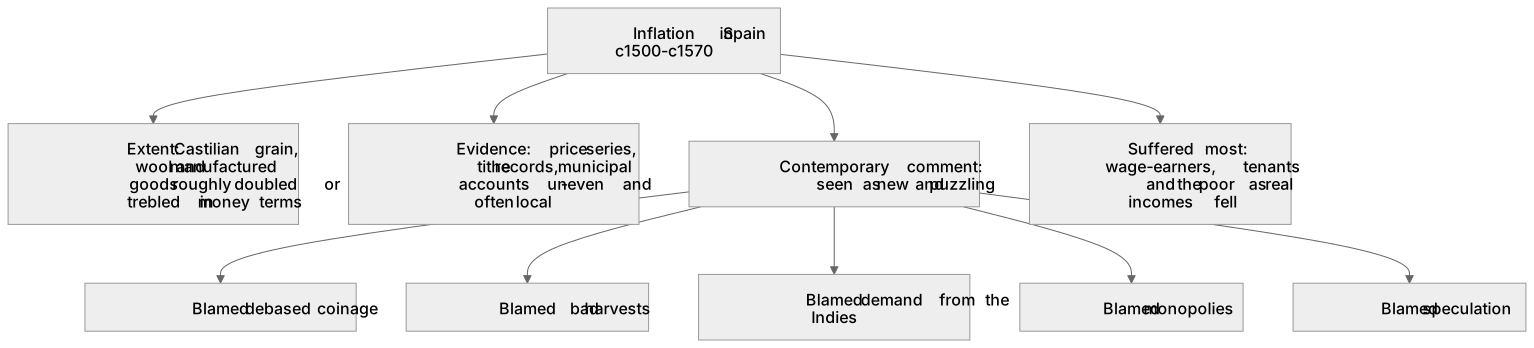
Inflation in Spain across c1500–c1570 was a sustained rise in prices, most visible in Castile, where grain, wool and manufactured goods roughly doubled or trebled in money terms over the period. Its extent can be measured from price series, tithe records and municipal accounts, though these are uneven and often local. Contemporaries found it new and puzzling because they expected stable or customary prices; they blamed debased coinage, bad harvests, demand from the Indies, monopolies and speculation. Writers such as the arbitristas and theologians debated causes, while wage-earners, tenants and the poor suffered most as real incomes fell. Assess significance by weighing how far inflation reshaped government finance, trade and social tension, and how far it was a monetary or a real shock.
What earns the marks
- Explains the extent of inflation using evidence such as Castilian grain and wool prices rising substantially across c1500–c1570, while noting regional and annual variation.
- Analyses contemporary comment as a new and puzzling phenomenon, showing that observers lacked a settled theory and offered competing explanations.
- Evaluates significance by linking inflation to real wages, rents, Crown borrowing and social unrest rather than treating it as a single price figure.
- Distinguishes monetary causes, such as bullion inflows and coin debasement, from real causes, such as harvest failure, population pressure and demand.
- Judges how far inflation was genuinely novel by comparing it with earlier medieval price movements and customary expectations.
Common mistakes and how to put them right
Treating inflation as a uniform national rate.
Put it right by noting regional and commodity variation and the limits of surviving price data.
Assuming all contemporaries agreed on one cause.
Put it right by showing a range of explanations, including coinage, harvests, demand and monopoly.
Confusing rising money prices with falling living standards for everyone.
Put it right by distinguishing debtors, landlords and wage-earners, whose experiences differed.
Exam tips
- Anchor each claim about extent in a specific commodity, place or period rather than a vague national trend.
- Use contemporary writers as evidence of contemporary comment, but assess their reliability and bias.
- Conclude on significance by ranking causes and consequences, not by listing them.
Try the lesson
The start of the Paper 3, Option 32: The Golden Age of Spain, 1474–1598 - 3 The price revolution and its impact, c1500–c1570: The significance of inflation in these years: extent and contemporary comment as a new and puzzling phenomenon. lesson, made from checked teaching notes for this specification point.
Have a go first
Why did sixteenth-century Castilians find the inflation of the period especially puzzling?
Listen
Inflation in Spain across c1500–c1570 was a sustained rise in prices, most visible in Castile, where grain, wool and manufactured goods roughly doubled or trebled in money terms over the period. Its extent can be measured from price series, tithe records and municipal accounts, though these are uneven and often local. Contemporaries found it new and puzzling because they expected stable or customary prices; they blamed debased coinage, bad harvests, demand from the Indies, monopolies and speculation. Writers such as the arbitristas and theologians debated causes, while wage-earners, tenants and the poor suffered most as real incomes fell. Assess significance by weighing how far inflation reshaped government finance, trade and social tension, and how far it was a monetary or a real shock. A strong answer earns marks for these points. Explains the extent of inflation using evidence such as Castilian grain and wool prices rising substantially across c1500–c1570, while noting regional and annual variation. Analyses contemporary comment as a new and puzzling phenomenon, showing that observers lacked a settled theory and offered competing explanations. Evaluates significance by linking inflation to real wages, rents, Crown borrowing and social unrest rather than treating it as a single price figure. Distinguishes monetary causes, such as bullion inflows and coin debasement, from real causes, such as harvest failure, population pressure and demand. A common slip: Treating inflation as a uniform national rate. Instead, noting regional and commodity variation and the limits of surviving price data. Exam tip: Anchor each claim about extent in a specific commodity, place or period rather than a vague national trend.
See it
Key words
Say what each word means before you turn the card.
Price revolution and monetary change
Try answering aloud or in your head before turning the card.
Contemporary economic thought and puzzlement
Try answering aloud or in your head before turning the card.
Social and regional inequality
Try answering aloud or in your head before turning the card.
Crown finance and imperial demand
Try answering aloud or in your head before turning the card.
See every definition
- Price revolution and monetary change
- A sustained rise in prices across c1500–c1570, most visible in Castile, where grain, wool and manufactured goods roughly doubled or trebled in money terms.
- Contemporary economic thought and puzzlement
- Observers found inflation new and puzzling because they expected stable or customary prices, and they blamed debased coinage, bad harvests, demand from the Indies, monopolies and speculation.
- Social and regional inequality
- Wage-earners, tenants and the poor suffered most as real incomes fell, while experiences differed between debtors, landlords and wage-earners.
- Crown finance and imperial demand
- Inflation reshaped government finance and trade, and demand from the Indies was among the explanations contemporaries offered for rising prices.
Label the diagram
Some boxes have lost their names. Pick the right name for each number.

1Box 1
2Box 2
3Box 3
There is more to this lesson
The full lesson goes on to check your understanding and help you earn the marks. Create a free account to carry on, with your progress saved.
A week of Premium from your first lesson · Then the free plan continues · No card, no charge
Test your understanding of Paper 3, Option 32: The Golden Age of Spain, 1474–1598 - 3 The price revolution and its impact, c1500–c1570: The significance of inflation in these years: extent and contemporary comment as a new and puzzling phenomenon.
Active recall beats re-reading. Take an instant quiz now to test what you’ve learned and lock it into long-term memory.
A week of Premium from your first lesson · Then the free plan continues · No card, no charge