Pearson Edexcel · A-Level · History
Course version: 9HI0 · Version from Sept 2015
The Golden Age of Spain, 1474–1598 - 4 The campaign for orthodoxy,…
Full specification wording
Paper 3, Option 32: The Golden Age of Spain, 1474–1598 - 4 The campaign for orthodoxy, 1558–70: The reasons for the Great Rebellion 1568: the Morisco 'problem’; the impact of Turkish raids; the role of the Marquis de Mondéjar; the significance of the decrees reforming Morisco customs in Granada 1566–67.
The Great Rebellion of 1568 in Granada stemmed from the Morisco 'problem': a large, culturally distinct Muslim population that resisted assimilation.
Checked against the Pearson Edexcel 9HI0 specification (opens in a new tab) on .
- Point 2 of 3
- 4 key terms
Study notes
From the checked teaching notes for this specification point.
The idea
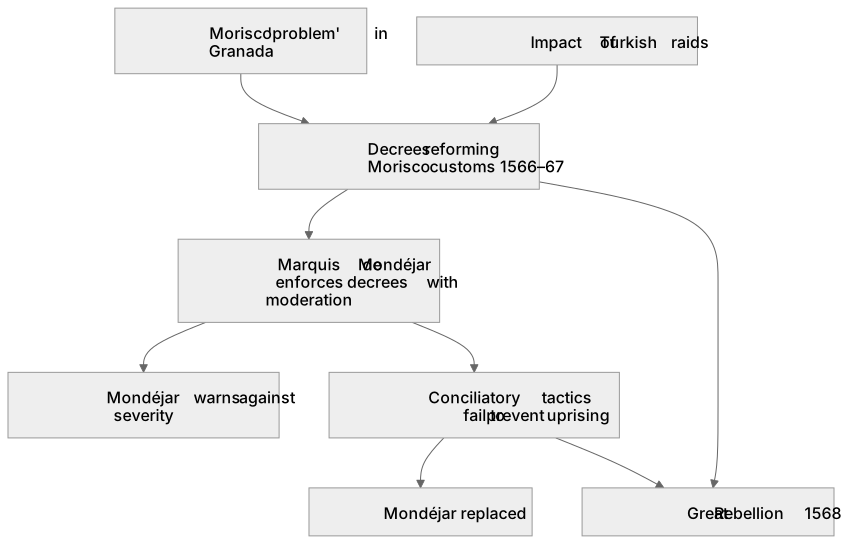
The Great Rebellion of 1568 in Granada stemmed from the Morisco 'problem': a large, culturally distinct Muslim population that resisted assimilation. Turkish raids heightened fears of a fifth column, prompting Philip II to support hardline policies. This culminated in the decrees of 1566–67, which banned Morisco customs, language and dress, directly provoking revolt. The Marquis de Mondéjar, Captain General of Granada, attempted to enforce these decrees with moderation and warned against their severity, but his conciliatory tactics failed to prevent the uprising and he was replaced. The rebellion thus arose from religious intolerance, strategic insecurity and the failure of gradual reform.
What earns the marks
- Explains the Morisco 'problem' as the presence of a large, unassimilated Muslim population in Granada, seen as a threat to religious and political unity.
- Assesses the impact of Turkish raids: they increased fears of Morisco collaboration with the Ottoman Empire, leading to harsher policies from Philip II.
- Evaluates the role of the Marquis de Mondéjar: his attempts to enforce the decrees with moderation, his warnings against hardline policies, and his subsequent replacement.
- Analyses the significance of the decrees of 1566–67: they banned Morisco customs, language and dress, acting as the immediate trigger for the rebellion.
- Shows how these factors interlinked: the decrees were a response to the 'problem' and Turkish raids, while Mondéjar's failure to suppress dissent contributed to the outbreak.
Common mistakes and how to put them right
Treating the Morisco 'problem' as solely religious.
Put it right: It was also cultural, economic and political, involving distinct language, dress and customs.
Claiming Philip II supported Mondéjar's conciliatory approach.
Put it right: Philip II backed the hardliners who issued the 1566–67 decrees, while Mondéjar was left to enforce them.
Overstating Mondéjar's role as a cause.
Put it right: He was a moderating figure whose failure to prevent revolt led to his replacement, not the instigator of the rebellion itself.
Exam tips
- Link the four factors explicitly: show how the Morisco 'problem' and Turkish raids created a context in which the decrees were issued, and how Mondéjar's enforcement failed.
- Use precise dates and names: 1566–67 decrees, Marquis de Mondéjar, 1568 rebellion.
- Avoid narrative; analyse causation by weighing the relative importance of each factor.
Try the lesson
The start of the Paper 3, Option 32: The Golden Age of Spain, 1474–1598 - 4 The campaign for orthodoxy, 1558–70: The reasons for the Great Rebellion 1568: the Morisco 'problem’; the impact of Turkish raids; the role of the Marquis de Mondéjar; the significance of the decrees reforming Morisco customs in Granada 1566–67. lesson, made from checked teaching notes for this specification point.
Have a go first
Which of the following was a key feature of the 1566–67 decrees that provoked the Great Rebellion of 1568 in Granada?
Listen
The Great Rebellion of 1568 in Granada stemmed from the Morisco 'problem': a large, culturally distinct Muslim population that resisted assimilation. Turkish raids heightened fears of a fifth column, prompting Philip II to support hardline policies. This culminated in the decrees of 1566–67, which banned Morisco customs, language and dress, directly provoking revolt. The Marquis de Mondéjar, Captain General of Granada, attempted to enforce these decrees with moderation and warned against their severity, but his conciliatory tactics failed to prevent the uprising and he was replaced. The rebellion thus arose from religious intolerance, strategic insecurity and the failure of gradual reform. A strong answer earns marks for these points. Explains the Morisco 'problem' as the presence of a large, unassimilated Muslim population in Granada, seen as a threat to religious and political unity. Assesses the impact of Turkish raids: they increased fears of Morisco collaboration with the Ottoman Empire, leading to harsher policies from Philip II. Evaluates the role of the Marquis de Mondéjar: his attempts to enforce the decrees with moderation, his warnings against hardline policies, and his subsequent replacement. Analyses the significance of the decrees of 1566–67: they banned Morisco customs, language and dress, acting as the immediate trigger for the rebellion. A common slip: treating the Morisco 'problem' as solely religious. Instead, it was also cultural, economic and political, involving distinct language, dress and customs. Exam tip: Link the four factors explicitly: show how the Morisco 'problem' and Turkish raids created a context in which the decrees were issued, and how Mondéjar's enforcement failed.
See it
Key words
Say what each word means before you turn the card.
Morisco 'problem'
Try answering aloud or in your head before turning the card.
Turkish raids
Try answering aloud or in your head before turning the card.
Decrees of 1566–67
Try answering aloud or in your head before turning the card.
Marquis de Mondéjar
Try answering aloud or in your head before turning the card.
See every definition
- Morisco 'problem'
- The presence of a large, culturally distinct Muslim population in Granada that resisted assimilation and was seen as a threat to religious and political unity.
- Turkish raids
- Attacks that heightened fears of a fifth column and of Morisco collaboration with the Ottoman Empire, prompting Philip II to support hardline policies.
- Decrees of 1566–67
- Reforms that banned Morisco customs, language and dress in Granada, acting as the immediate trigger for the rebellion.
- Marquis de Mondéjar
- Captain General of Granada who attempted to enforce the decrees with moderation and warned against their severity, but failed to prevent the uprising and was replaced.
Label the diagram
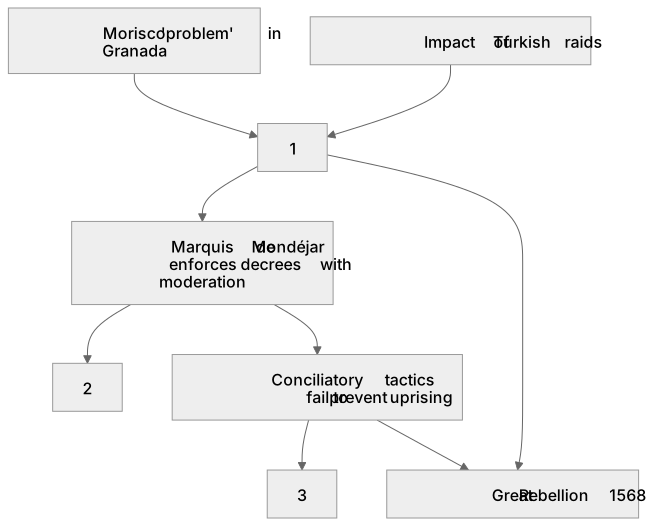
Some boxes have lost their names. Pick the right name for each number.
1Box 1
2Box 2
3Box 3
There is more to this lesson
The full lesson goes on to check your understanding and help you earn the marks. Create a free account to carry on, with your progress saved.
A week of Premium from your first lesson · Then the free plan continues · No card, no charge
Test your understanding of Paper 3, Option 32: The Golden Age of Spain, 1474–1598 - 4 The campaign for orthodoxy, 1558–70: The reasons for the Great Rebellion 1568: the Morisco 'problem’; the impact of Turkish raids; the role of the Marquis de Mondéjar; the significance of the decrees reforming Morisco customs in Granada 1566–67.
Active recall beats re-reading. Take an instant quiz now to test what you’ve learned and lock it into long-term memory.
A week of Premium from your first lesson · Then the free plan continues · No card, no charge