Pearson Edexcel · A-Level · History
Course version: 9HI0 · Version from Sept 2015
The Golden Age of Spain, 1474–1598 - 5 The crisis in Aragon, 1590–93: The…
Full specification wording
Paper 3, Option 32: The Golden Age of Spain, 1474–1598 - 5 The crisis in Aragon, 1590–93: The impact of the revolt and the consequences for Philip II and royal power in Aragón.
The Aragonese revolt of 1591–92 began when Philip II tried to enforce royal authority over Antonio Pérez, who had fled Castile.
Checked against the Pearson Edexcel 9HI0 specification (opens in a new tab) on .
- Point 3 of 3
- 4 key terms
Study notes
From the checked teaching notes for this specification point.
The idea
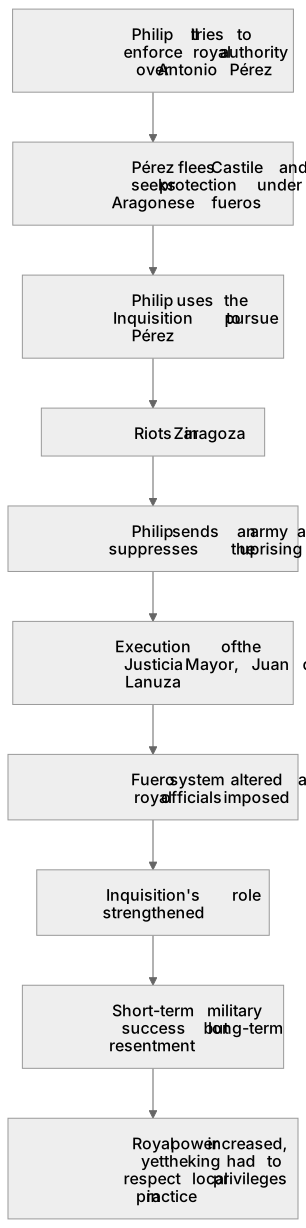
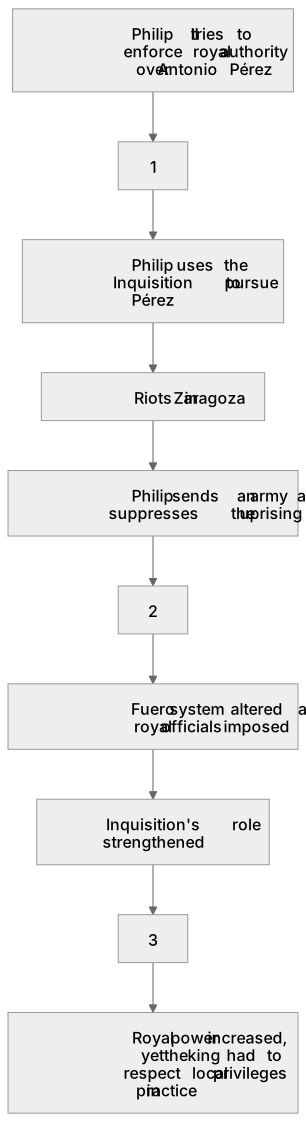
The Aragonese revolt of 1591–92 began when Philip II tried to enforce royal authority over Antonio Pérez, who had fled Castile. Pérez sought protection under Aragonese fueros, but Philip used the Inquisition to pursue him, triggering riots in Zaragoza. The revolt tested the balance between the Crown and Aragonese liberties. Philip sent an army, suppressed the uprising, and executed the Justicia Mayor, Juan de Lanuza. He then altered the fuero system, imposed royal officials, and strengthened the Inquisition's role. The consequences for Philip II included a short-term military success but long-term resentment, as Aragonese institutions were curtailed. Royal power increased, yet the king had to respect local privileges in practice. This episode shows how Philip managed a crisis that threatened his authority and the unity of his kingdoms.
What earns the marks
- Explains the causes of the revolt: Philip II's pursuit of Antonio Pérez and the use of the Inquisition in Aragón.
- Describes the course of the revolt: riots in Zaragoza, the flight of Pérez, and the intervention of royal troops.
- Analyses the consequences for Philip II: enhanced royal authority but at the cost of alienating Aragonese elites.
- Assesses the impact on royal power in Aragón: the execution of Juan de Lanuza, changes to the fuero system, and the increased role of the Inquisition.
- Evaluates the longer-term significance: the revolt exposed tensions between Castilian centralism and Aragonese federalism.
Common mistakes and how to put them right
Treating the revolt as a purely local riot.
Put it right: It was a constitutional crisis involving the Crown, the Inquisition, and Aragonese law.
Assuming Philip II completely abolished Aragonese fueros.
Put it right: He modified them and asserted royal authority, but many privileges remained.
Overlooking the role of Antonio Pérez.
Put it right: His flight and exploitation of Aragonese privileges were central triggers of the revolt.
Exam tips
- Link the revolt to the broader theme of Philip II's style of kingship and his handling of multiple kingdoms.
- Use specific evidence such as the execution of Juan de Lanuza and the changes to the office of Justicia Mayor.
- Consider both short-term and long-term consequences for royal power in Aragón.
Try the lesson
The start of the Paper 3, Option 32: The Golden Age of Spain, 1474–1598 - 5 The crisis in Aragon, 1590–93: The impact of the revolt and the consequences for Philip II and royal power in Aragón. lesson, made from checked teaching notes for this specification point.
Have a go first
As a consequence of the 1591 revolt, what significant change did Philip II make regarding the governance of Aragón at the Cortes of Tarazona in 1592?
Listen
The Aragonese revolt of 1591–92 began when Philip II tried to enforce royal authority over Antonio Pérez, who had fled Castile. Pérez sought protection under Aragonese fueros, but Philip used the Inquisition to pursue him, triggering riots in Zaragoza. The revolt tested the balance between the Crown and Aragonese liberties. Philip sent an army, suppressed the uprising, and executed the Justicia Mayor, Juan de Lanuza. He then altered the fuero system, imposed royal officials, and strengthened the Inquisition's role. The consequences for Philip II included a short-term military success but long-term resentment, as Aragonese institutions were curtailed. Royal power increased, yet the king had to respect local privileges in practice. This episode shows how Philip managed a crisis that threatened his authority and the unity of his kingdoms. A strong answer earns marks for these points. Explains the causes of the revolt: Philip II's pursuit of Antonio Pérez and the use of the Inquisition in Aragón. Describes the course of the revolt: riots in Zaragoza, the flight of Pérez, and the intervention of royal troops. Analyses the consequences for Philip II: enhanced royal authority but at the cost of alienating Aragonese elites. Assesses the impact on royal power in Aragón: the execution of Juan de Lanuza, changes to the fuero system, and the increased role of the Inquisition. A common slip: Treating the revolt as a purely local riot. Instead, It was a constitutional crisis involving the Crown, the Inquisition, and Aragonese law. Exam tip: Link the revolt to the broader theme of Philip II's style of kingship and his handling of multiple kingdoms.
See it
Key words
Say what each word means before you turn the card.
Royal authority versus local liberties
Try answering aloud or in your head before turning the card.
The role of the Inquisition in political crises
Try answering aloud or in your head before turning the card.
The limits of centralisation in a composite monarchy
Try answering aloud or in your head before turning the card.
The impact of rebellion on royal policy
Try answering aloud or in your head before turning the card.
See every definition
- Royal authority versus local liberties
- The balance between the Crown and Aragonese liberties, which the revolt tested.
- The role of the Inquisition in political crises
- Philip used the Inquisition to pursue Antonio Pérez, triggering riots in Zaragoza.
- The limits of centralisation in a composite monarchy
- Royal power increased, yet the king had to respect local privileges in practice.
- The impact of rebellion on royal policy
- Philip altered the fuero system, imposed royal officials, and strengthened the Inquisition's role.
Label the diagram
Some boxes have lost their names. Pick the right name for each number.
1Box 1
2Box 2
3Box 3
There is more to this lesson
The full lesson goes on to check your understanding and help you earn the marks. Create a free account to carry on, with your progress saved.
A week of Premium from your first lesson · Then the free plan continues · No card, no charge
Test your understanding of Paper 3, Option 32: The Golden Age of Spain, 1474–1598 - 5 The crisis in Aragon, 1590–93: The impact of the revolt and the consequences for Philip II and royal power in Aragón.
Active recall beats re-reading. Take an instant quiz now to test what you’ve learned and lock it into long-term memory.
A week of Premium from your first lesson · Then the free plan continues · No card, no charge