Pearson Edexcel · A-Level · History
Course version: 9HI0 · Version from Sept 2015
The witch craze in Britain, Europe and North America, c1580–c1750 - 1…
Full specification wording
Paper 3, Option 33: The witch craze in Britain, Europe and North America, c1580–c1750 - 1 Changing attitudes to witchcraft in Britain: The existence and growth of scepticism, c1580–c1750: the impact of notable frauds and doubtful cases (key developments: the case of the Boy of Burton 1597, the Pendle Swindle 1634, the Demon Drummer of Tedworth 1662, the case of Jane Wenham in 1712); the influence of Lord Chief Justice Sir John Holt, 1689–1710.
Between c1580 and c1750, scepticism about witchcraft grew as notable frauds and doubtful cases exposed the unreliability of accusations.
Checked against the Pearson Edexcel 9HI0 specification (opens in a new tab) on .
- Point 1 of 2
- 4 key terms
Study notes
From the checked teaching notes for this specification point.
The idea
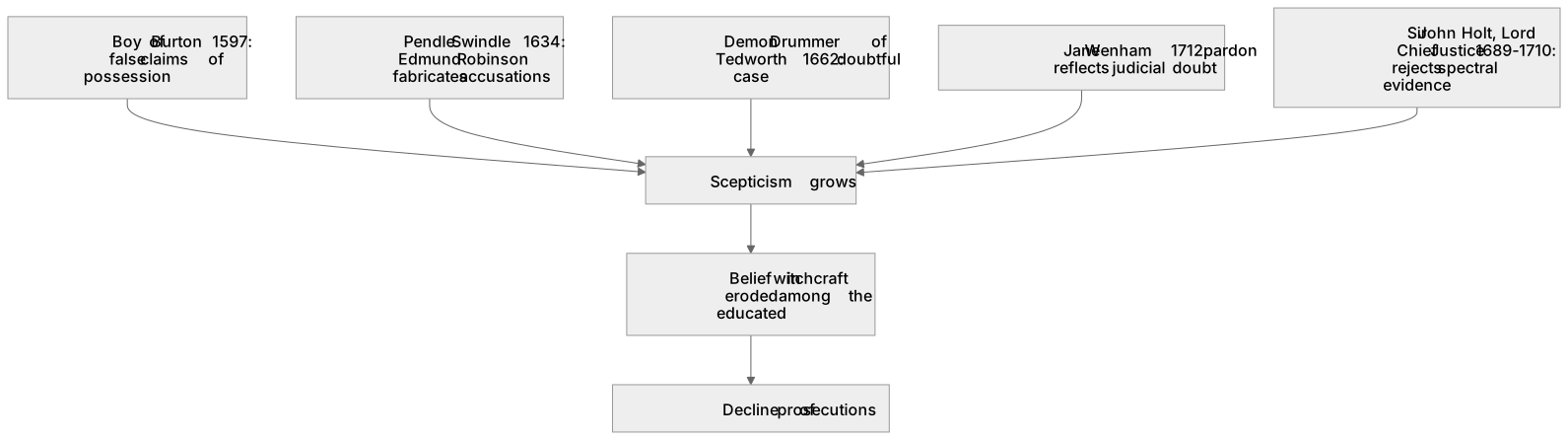
Between c1580 and c1750, scepticism about witchcraft grew as notable frauds and doubtful cases exposed the unreliability of accusations. The Boy of Burton (1597) involved a boy's false claims of possession, undermining credence in demonic evidence. The Pendle Swindle (1634) saw a boy, Edmund Robinson, fabricate accusations, leading to a royal investigation that discredited the case. The Demon Drummer of Tedworth (1662) was a poltergeist story that sceptics like John Webster used to question witchcraft. The case of Jane Wenham (1712) ended in a pardon, reflecting judicial doubt. Sir John Holt, Lord Chief Justice 1689–1710, influenced scepticism by rejecting spectral evidence and securing acquittals. These developments eroded belief in witchcraft among the educated, contributing to the decline of prosecutions.
What earns the marks
- Explains how the Boy of Burton case (1597) exposed fraudulent possession and weakened belief in witchcraft.
- Describes the Pendle Swindle (1634) and its role in discrediting witchcraft accusations through royal investigation.
- Analyses the Demon Drummer of Tedworth (1662) as a doubtful case that fuelled sceptical debate.
- Assesses the impact of the Jane Wenham case (1712) in demonstrating judicial scepticism and the decline of convictions.
- Evaluates the influence of Sir John Holt (1689–1710) in rejecting spectral evidence and promoting legal scepticism.
Common mistakes and how to put them right
Confusing the Pendle Swindle with the Pendle witch trials of 1612.
Put it right: The Swindle occurred in 1634 and involved fabricated accusations by Edmund Robinson.
Assuming scepticism grew uniformly across society.
Put it right: Scepticism was more pronounced among the educated and judiciary, while popular belief persisted.
Overstating the impact of a single case.
Put it right: Scepticism developed cumulatively through multiple frauds and doubtful cases over the period.
Exam tips
- Use the named cases as specific evidence to illustrate the growth of scepticism.
- Link the role of Sir John Holt to wider legal and intellectual changes.
- Consider how frauds and doubtful cases influenced both elite and popular attitudes.
Try the lesson
The start of the Paper 3, Option 33: The witch craze in Britain, Europe and North America, c1580–c1750 - 1 Changing attitudes to witchcraft in Britain: The existence and growth of scepticism, c1580–c1750: the impact of notable frauds and doubtful cases (key developments: the case of the Boy of Burton 1597, the Pendle Swindle 1634, the Demon Drummer of Tedworth 1662, the case of Jane Wenham in 1712); the influence of Lord Chief Justice Sir John Holt, 1689–1710. lesson, made from checked teaching notes for this specification point.
Have a go first
Which 1597 case, in which a boy's apparent possession was later exposed as a fraud, became a notable example used to encourage scepticism about witchcraft accusations?
Listen
Between c1580 and c1750, scepticism about witchcraft grew as notable frauds and doubtful cases exposed the unreliability of accusations. The Boy of Burton (1597) involved a boy's false claims of possession, undermining credence in demonic evidence. The Pendle Swindle (1634) saw a boy, Edmund Robinson, fabricate accusations, leading to a royal investigation that discredited the case. The Demon Drummer of Tedworth (1662) was a poltergeist story that sceptics like John Webster used to question witchcraft. The case of Jane Wenham (1712) ended in a pardon, reflecting judicial doubt. Sir John Holt, Lord Chief Justice 1689–1710, influenced scepticism by rejecting spectral evidence and securing acquittals. These developments eroded belief in witchcraft among the educated, contributing to the decline of prosecutions. A strong answer earns marks for these points. Explains how the Boy of Burton case (1597) exposed fraudulent possession and weakened belief in witchcraft. Describes the Pendle Swindle (1634) and its role in discrediting witchcraft accusations through royal investigation. Analyses the Demon Drummer of Tedworth (1662) as a doubtful case that fuelled sceptical debate. Assesses the impact of the Jane Wenham case (1712) in demonstrating judicial scepticism and the decline of convictions. A common slip: Confusing the Pendle Swindle with the Pendle witch trials of 1612. Instead, The Swindle occurred in 1634 and involved fabricated accusations by Edmund Robinson. Exam tip: Use the named cases as specific evidence to illustrate the growth of scepticism.
See it
Put the events in order
Put these events in the order they happened, earliest first.
- 1. The case of Jane Wenham
- 2. The case of the Boy of Burton
- 3. The Demon Drummer of Tedworth
- 4. The Pendle Swindle
Key words
Say what each word means before you turn the card.
The role of fraud in undermining witchcraft accusations
Try answering aloud or in your head before turning the card.
Judicial scepticism and the decline of prosecutions
Try answering aloud or in your head before turning the card.
The impact of notable cases on public opinion
Try answering aloud or in your head before turning the card.
The growth of rationalism and its limits
Try answering aloud or in your head before turning the card.
See every definition
- The role of fraud in undermining witchcraft accusations
- Notable frauds and doubtful cases exposed the unreliability of accusations and eroded belief in witchcraft among the educated.
- Judicial scepticism and the decline of prosecutions
- Judicial doubt, shown in a pardon and in rejecting spectral evidence and securing acquittals, contributed to the decline of prosecutions.
- The impact of notable cases on public opinion
- Notable frauds and doubtful cases fuelled sceptical debate and discredited witchcraft accusations, though popular belief persisted.
- The growth of rationalism and its limits
- Scepticism grew cumulatively through multiple frauds and doubtful cases, but was more pronounced among the educated and judiciary while popular belief persisted.
Label the diagram
Some boxes have lost their names. Pick the right name for each number.
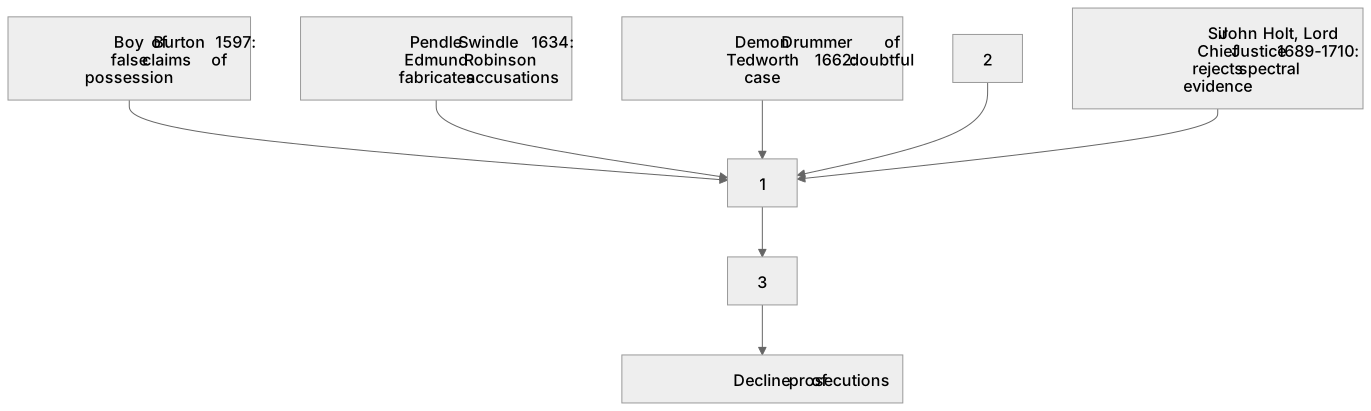
1Box 1
2Box 2
3Box 3
There is more to this lesson
The full lesson goes on to check your understanding and help you earn the marks. Create a free account to carry on, with your progress saved.
A week of Premium from your first lesson · Then the free plan continues · No card, no charge
Test your understanding of Paper 3, Option 33: The witch craze in Britain, Europe and North America, c1580–c1750 - 1 Changing attitudes to witchcraft in Britain: The existence and growth of scepticism, c1580–c1750: the impact of notable frauds and doubtful cases (key developments: the case of the Boy of Burton 1597, the Pendle Swindle 1634, the Demon Drummer of Tedworth 1662, the case of Jane Wenham in 1712); the influence of Lord Chief Justice Sir John Holt, 1689–1710.
Active recall beats re-reading. Take an instant quiz now to test what you’ve learned and lock it into long-term memory.
A week of Premium from your first lesson · Then the free plan continues · No card, no charge