Pearson Edexcel · A-Level · History
Course version: 9HI0 · Version from Sept 2015
The witch craze in Britain, Europe and North America, c1580–c1750 - 2 The…
Full specification wording
Paper 3, Option 33: The witch craze in Britain, Europe and North America, c1580–c1750 - 2 The Lancashire witches of 1604–13: The origins of the case: Alizon Device and John Law; the investigations of Roger Nowell; Old Demdike and Old Chattox and their witchcraft families; the meeting at Malkin Tower.
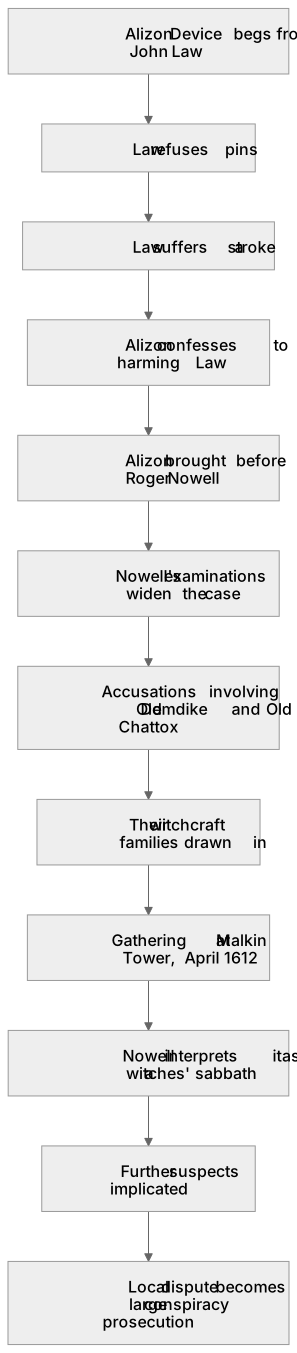
The case began in March 1612 when Alizon Device, begging on the road, was refused pins by the pedlar John Law; shortly afterwards Law suffered a stroke, and Alizon's confession to harming him…
Checked against the Pearson Edexcel 9HI0 specification (opens in a new tab) on .
- Point 2 of 3
- 4 key terms
Study notes
From the checked teaching notes for this specification point.
The idea
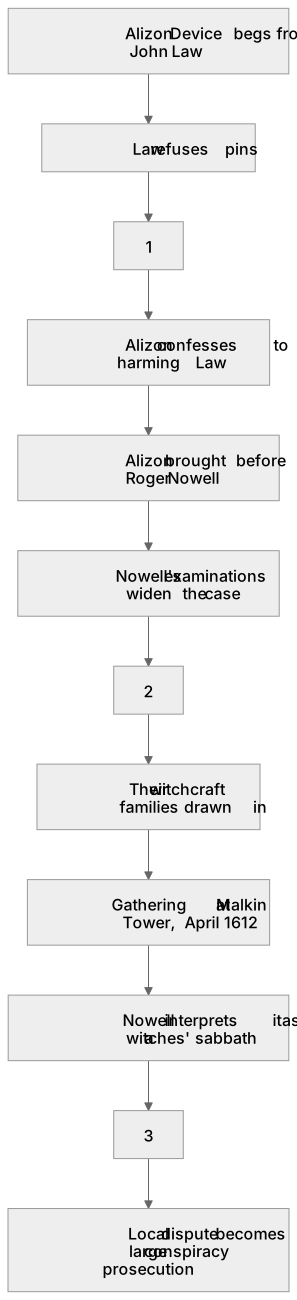
The case began in March 1612 when Alizon Device, begging on the road, was refused pins by the pedlar John Law; shortly afterwards Law suffered a stroke, and Alizon's confession to harming him brought her before the magistrate Roger Nowell. Nowell's examinations widened the case: he recorded accusations involving Old Demdike and Old Chattox, two rival matriarchs whose families were already reputed as witches, and their alleged familiars and maleficium. In April 1612 a gathering at Malkin Tower, probably a meeting to plan resistance or a feast, was interpreted by Nowell as a witches' sabbath and used to implicate further suspects, turning a local dispute into a large conspiracy prosecution.
What earns the marks
- Narrates the trigger incident: Alizon Device's encounter with John Law, the refusal of pins, Law's subsequent illness and Alizon's confession.
- Explains how Roger Nowell's examinations converted a single accusation into a wider investigation, recording confessions and naming further suspects.
- Describes Old Demdike and Old Chattox as rival witchcraft matriarchs whose families, including Elizabeth Device and James Device, were drawn into the case.
- Explains the significance of the Malkin Tower meeting in April 1612 and how Nowell interpreted it as evidence of a organised diabolical conspiracy.
- Shows how the origins of the case combined personal quarrel, local reputation and magisterial investigation, rather than a single cause.
- Uses the sequence of events to assess how far the case was driven by the accused's own words and how far by Nowell's framing of evidence.
Common mistakes and how to put them right
Confusing Alizon Device with her mother Elizabeth Device.
Put it right: Keep the family relationships distinct and attribute actions to the correct person.
Presenting the Malkin Tower meeting as certainly a witches' sabbath.
Put it right: Describe it as a gathering whose purpose is disputed and explain how Nowell interpreted it.
Treating John Law's illness as proven witchcraft.
Put it right: Present it as an illness that contemporaries interpreted through the lens of maleficium after Alizon's confession.
Exam tips
- Build a clear chronology from the John Law encounter through Nowell's examinations to Malkin Tower, since sequence is itself an analytical point about escalation.
- Use the Malkin Tower meeting to discuss how evidence was constructed, contrasting what may have happened with how it was used at trial.
- Link each origin event to the wider question of why Lancashire produced a major prosecution in 1612 rather than an isolated accusation.
Try the lesson
The start of the Paper 3, Option 33: The witch craze in Britain, Europe and North America, c1580–c1750 - 2 The Lancashire witches of 1604–13: The origins of the case: Alizon Device and John Law; the investigations of Roger Nowell; Old Demdike and Old Chattox and their witchcraft families; the meeting at Malkin Tower. lesson, made from checked teaching notes for this specification point.
Have a go first
Who was the pedlar whose encounter with Alizon Device helped to begin the Lancashire witch case of 1612?
Listen
The case began in March 1612 when Alizon Device, begging on the road, was refused pins by the pedlar John Law; shortly afterwards Law suffered a stroke, and Alizon's confession to harming him brought her before the magistrate Roger Nowell. Nowell's examinations widened the case: he recorded accusations involving Old Demdike and Old Chattox, two rival matriarchs whose families were already reputed as witches, and their alleged familiars and maleficium. In April 1612 a gathering at Malkin Tower, probably a meeting to plan resistance or a feast, was interpreted by Nowell as a witches' sabbath and used to implicate further suspects, turning a local dispute into a large conspiracy prosecution. A strong answer earns marks for these points. Narrates the trigger incident: Alizon Device's encounter with John Law, the refusal of pins, Law's subsequent illness and Alizon's confession. Explains how Roger Nowell's examinations converted a single accusation into a wider investigation, recording confessions and naming further suspects. Describes Old Demdike and Old Chattox as rival witchcraft matriarchs whose families, including Elizabeth Device and James Device, were drawn into the case. Explains the significance of the Malkin Tower meeting in April 1612 and how Nowell interpreted it as evidence of a organised diabolical conspiracy. A common slip: Confusing Alizon Device with her mother Elizabeth Device. Instead, keep the family relationships distinct and attribute actions to the correct person. Exam tip: Build a clear chronology from the John Law encounter through Nowell's examinations to Malkin Tower, since sequence is itself an analytical point about escalation.
See it
Key words
Say what each word means before you turn the card.
Personal quarrel and maleficium
Try answering aloud or in your head before turning the card.
Magisterial investigation and confession
Try answering aloud or in your head before turning the card.
Rival witchcraft families and reputation
Try answering aloud or in your head before turning the card.
The construction of conspiracy from a local gathering
Try answering aloud or in your head before turning the card.
See every definition
- Personal quarrel and maleficium
- The case began with Alizon Device's encounter with John Law, the refusal of pins and his subsequent illness, interpreted through the lens of maleficium after her confession.
- Magisterial investigation and confession
- Roger Nowell's examinations converted a single accusation into a wider investigation, recording confessions and naming further suspects.
- Rival witchcraft families and reputation
- Old Demdike and Old Chattox were rival matriarchs whose families were already reputed as witches and were drawn into the case.
- The construction of conspiracy from a local gathering
- A gathering at Malkin Tower in April 1612, probably a meeting to plan resistance or a feast, was interpreted by Nowell as a witches' sabbath and used to implicate further suspects.
Label the diagram
Some boxes have lost their names. Pick the right name for each number.
1Box 1
2Box 2
3Box 3
There is more to this lesson
The full lesson goes on to check your understanding and help you earn the marks. Create a free account to carry on, with your progress saved.
A week of Premium from your first lesson · Then the free plan continues · No card, no charge
Test your understanding of Paper 3, Option 33: The witch craze in Britain, Europe and North America, c1580–c1750 - 2 The Lancashire witches of 1604–13: The origins of the case: Alizon Device and John Law; the investigations of Roger Nowell; Old Demdike and Old Chattox and their witchcraft families; the meeting at Malkin Tower.
Active recall beats re-reading. Take an instant quiz now to test what you’ve learned and lock it into long-term memory.
A week of Premium from your first lesson · Then the free plan continues · No card, no charge