Pearson Edexcel · A-Level · History
Course version: 9HI0 · Version from Sept 2015
The witch craze in Britain, Europe and North America, c1580–c1750 - 5…
Full specification wording
Paper 3, Option 33: The witch craze in Britain, Europe and North America, c1580–c1750 - 5 Cotton Mather and the Salem witch hunt, 1692–93: Reasons for the ending of the witch hunt: the roles of Cotton Mather's father and Governor Phips; the general pardon.
The Salem witch hunt collapsed as elite opinion turned.
Checked against the Pearson Edexcel 9HI0 specification (opens in a new tab) on .
- Point 3 of 3
- 4 key terms
Study notes
From the checked teaching notes for this specification point.
The idea
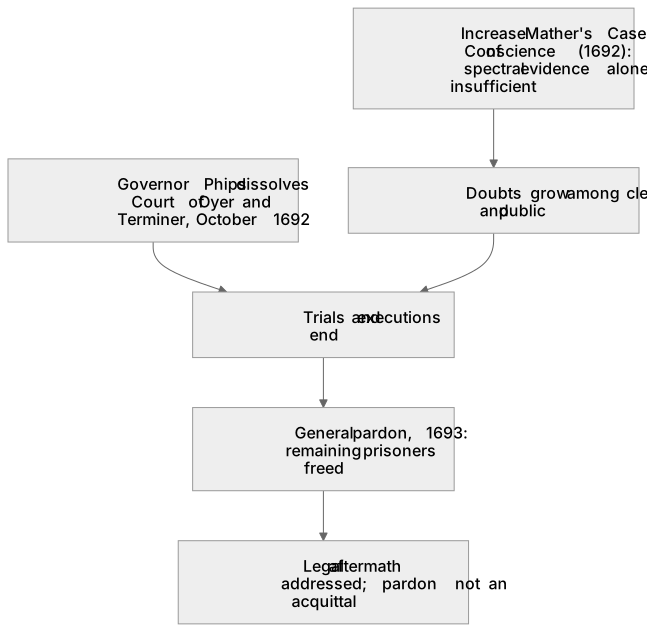
The Salem witch hunt collapsed as elite opinion turned. Increase Mather, Cotton Mather's father and president of Harvard, argued in Cases of Conscience (1692) that spectral evidence alone was insufficient and that the Devil could assume an innocent person's shape. Governor William Phips, whose wife had been accused, dissolved the Court of Oyer and Terminer in October 1692 and later issued a general pardon in 1693, freeing remaining prisoners. These actions, alongside growing doubts among clergy and the public, ended executions and trials. Assess how far each factor contributed to the ending, and how the pardon addressed the legal aftermath.
What earns the marks
- Explains Increase Mather's Cases of Conscience and its challenge to spectral evidence.
- Assesses Governor Phips's decision to dissolve the Court of Oyer and Terminer and its impact on trials.
- Evaluates the general pardon of 1693 as a legal and political measure that ended the prosecutions.
- Considers other reasons for the ending, such as changing public opinion, the accused's social status, and the collapse of accusations.
- Weighs the relative importance of Increase Mather, Phips and the pardon in ending the witch hunt.
Common mistakes and how to put them right
Attributing the end solely to Cotton Mather.
Put it right by distinguishing his father Increase Mather's role and writings.
Assuming the pardon was immediate.
Put it right by noting the sequence from the court's dissolution to the 1693 pardon.
Ignoring the wider context of doubt among clergy and public.
Put it right by integrating contemporary criticisms and the decline in new accusations.
Confusing Increase Mather with Cotton Mather.
Put it right by using full names and specific texts.
Treating the pardon as an acquittal.
Put it right by explaining it was a general release that did not formally reverse convictions.
Exam tips
- Structure answers around the three named factors and then evaluate their relative weight.
- Use precise dates and titles, such as Cases of Conscience (1692) and the general pardon (1693).
- Link the ending to earlier weaknesses in evidence and procedure to show causation.
- Avoid hindsight: explain why contemporaries changed their minds.
Try the lesson
The start of the Paper 3, Option 33: The witch craze in Britain, Europe and North America, c1580–c1750 - 5 Cotton Mather and the Salem witch hunt, 1692–93: Reasons for the ending of the witch hunt: the roles of Cotton Mather's father and Governor Phips; the general pardon. lesson, made from checked teaching notes for this specification point.
Have a go first
Who was Cotton Mather's father, the Boston minister who criticised the use of spectral evidence at Salem?
Listen
The Salem witch hunt collapsed as elite opinion turned. Increase Mather, Cotton Mather's father and president of Harvard, argued in Cases of Conscience (1692) that spectral evidence alone was insufficient and that the Devil could assume an innocent person's shape. Governor William Phips, whose wife had been accused, dissolved the Court of Oyer and Terminer in October 1692 and later issued a general pardon in 1693, freeing remaining prisoners. These actions, alongside growing doubts among clergy and the public, ended executions and trials. Assess how far each factor contributed to the ending, and how the pardon addressed the legal aftermath. A strong answer earns marks for these points. Explains Increase Mather's Cases of Conscience and its challenge to spectral evidence. Assesses Governor Phips's decision to dissolve the Court of Oyer and Terminer and its impact on trials. Evaluates the general pardon of 1693 as a legal and political measure that ended the prosecutions. Considers other reasons for the ending, such as changing public opinion, the accused's social status, and the collapse of accusations. A common slip: Attributing the end solely to Cotton Mather. Instead, distinguishing his father Increase Mather's role and writings. Exam tip: Structure answers around the three named factors and then evaluate their relative weight.
See it
Key words
Say what each word means before you turn the card.
Evidence and proof
Try answering aloud or in your head before turning the card.
Political intervention and pardon
Try answering aloud or in your head before turning the card.
Elite opinion and legal authority
Try answering aloud or in your head before turning the card.
Decline of witch prosecutions
Try answering aloud or in your head before turning the card.
See every definition
- Evidence and proof
- Increase Mather argued in Cases of Conscience that spectral evidence alone was insufficient, since the Devil could assume an innocent person's shape.
- Political intervention and pardon
- Governor William Phips dissolved the Court of Oyer and Terminer in October 1692 and later issued a general pardon in 1693, freeing remaining prisoners.
- Elite opinion and legal authority
- The Salem witch hunt collapsed as elite opinion turned, with growing doubts among clergy and the public ending executions and trials.
- Decline of witch prosecutions
- The general pardon of 1693 was a legal and political measure that ended the prosecutions, though it did not formally reverse convictions.
Label the diagram
Some boxes have lost their names. Pick the right name for each number.
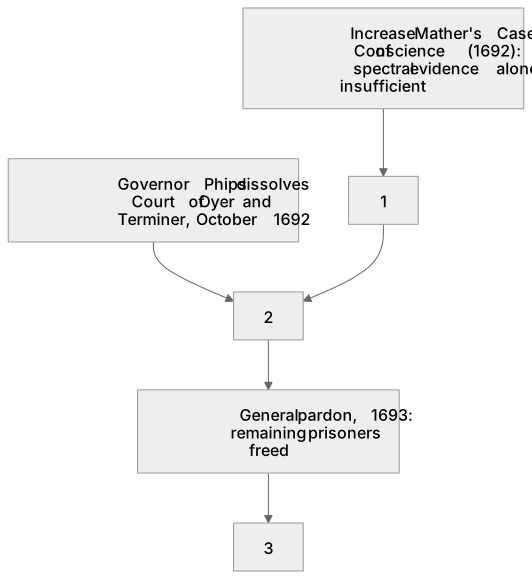
1Box 1
2Box 2
3Box 3
There is more to this lesson
The full lesson goes on to check your understanding and help you earn the marks. Create a free account to carry on, with your progress saved.
A week of Premium from your first lesson · Then the free plan continues · No card, no charge
Test your understanding of Paper 3, Option 33: The witch craze in Britain, Europe and North America, c1580–c1750 - 5 Cotton Mather and the Salem witch hunt, 1692–93: Reasons for the ending of the witch hunt: the roles of Cotton Mather's father and Governor Phips; the general pardon.
Active recall beats re-reading. Take an instant quiz now to test what you’ve learned and lock it into long-term memory.
A week of Premium from your first lesson · Then the free plan continues · No card, no charge