Pearson Edexcel · A-Level · History
Course version: 9HI0 · Version from Sept 2015
The witch craze in Britain, Europe and North America, c1580–c1750 - 5…
Full specification wording
Paper 3, Option 33: The witch craze in Britain, Europe and North America, c1580–c1750 - 5 Cotton Mather and the Salem witch hunt, 1692–93: The social, economic and political context of Salem: weakened authority following the 1688 Revolution; Indian threats and economic crisis; social tensions.
Salem's witch hunt grew from a fragile context.
Checked against the Pearson Edexcel 9HI0 specification (opens in a new tab) on .
- Point 1 of 3
- 4 key terms
Study notes
From the checked teaching notes for this specification point.
The idea
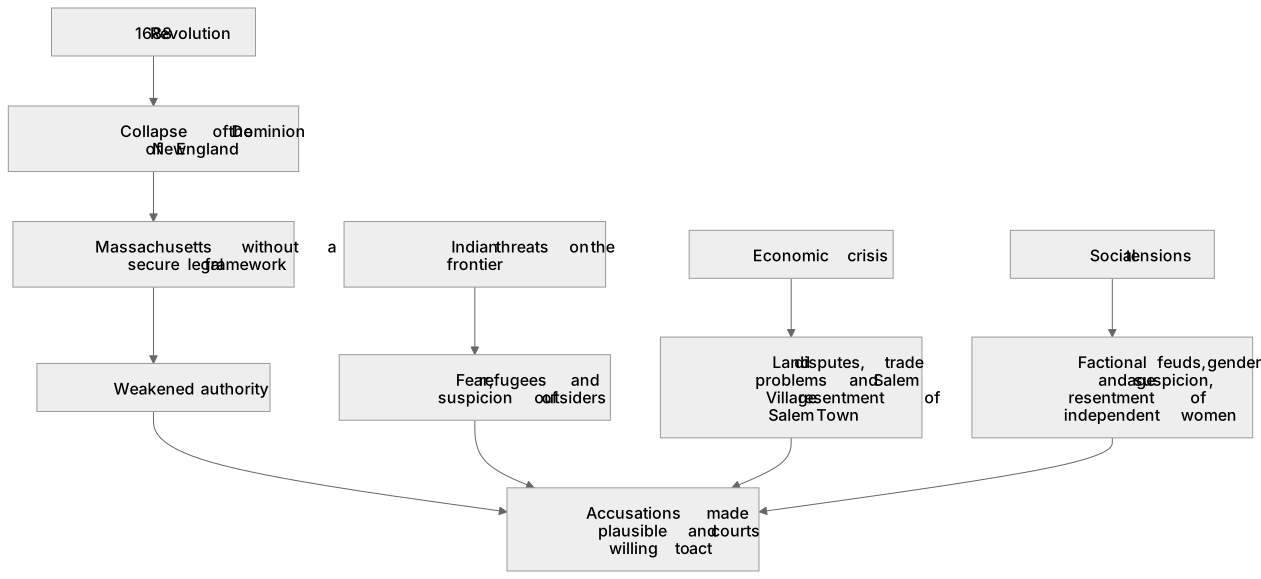
Salem's witch hunt grew from a fragile context. Following the 1688 Revolution, the Dominion of New England collapsed, leaving Massachusetts without a secure legal framework until the 1691 charter arrived, weakening authority. Indian threats on the frontier brought fear, refugees and accusations against outsiders. Economic crisis hit Salem Village: disputes over land, trade and the wealth of Salem Town split families. Social tensions included factional feuds, gender and age suspicion, and resentment of independent women. These pressures made accusations plausible and courts willing to act.
What earns the marks
- Explains weakened authority: the 1688 Revolution caused the collapse of the Dominion of New England, leaving Massachusetts without a secure legal framework.
- Explains Indian threats: frontier warfare brought fear, refugees and suspicion of outsiders into Essex County communities.
- Explains economic crisis: land disputes, trade problems and Salem Village's resentment of Salem Town's wealth divided the community.
- Explains social tensions: factional feuds, gender and age suspicion, and resentment of independent women made accusations credible.
Common mistakes and how to put them right
Stating the 1688 Revolution revoked the Massachusetts charter.
Put it right: The charter was revoked in 1684; the 1688 Revolution overthrew Governor Andros and collapsed the Dominion of New England.
Assuming economic crisis affected everyone equally.
Put it right: Distinguish Salem Village's agricultural grievances from Salem Town's commercial interests.
Ignoring gender and age in social tensions.
Put it right: Show how accusations often targeted older, independent or marginal women.
Exam tips
- Separate political, economic and social factors clearly in your plan.
- Explain how context made accusations believable rather than merely describing events.
Try the lesson
The start of the Paper 3, Option 33: The witch craze in Britain, Europe and North America, c1580–c1750 - 5 Cotton Mather and the Salem witch hunt, 1692–93: The social, economic and political context of Salem: weakened authority following the 1688 Revolution; Indian threats and economic crisis; social tensions. lesson, made from checked teaching notes for this specification point.
Have a go first
How did the 1688 Glorious Revolution contribute to a crisis of political authority in Massachusetts prior to the Salem witch hunt?
Listen
Salem's witch hunt grew from a fragile context. Following the 1688 Revolution, the Dominion of New England collapsed, leaving Massachusetts without a secure legal framework until the 1691 charter arrived, weakening authority. Indian threats on the frontier brought fear, refugees and accusations against outsiders. Economic crisis hit Salem Village: disputes over land, trade and the wealth of Salem Town split families. Social tensions included factional feuds, gender and age suspicion, and resentment of independent women. These pressures made accusations plausible and courts willing to act. A strong answer earns marks for these points. Explains weakened authority: the 1688 Revolution caused the collapse of the Dominion of New England, leaving Massachusetts without a secure legal framework. Explains Indian threats: frontier warfare brought fear, refugees and suspicion of outsiders into Essex County communities. Explains economic crisis: land disputes, trade problems and Salem Village's resentment of Salem Town's wealth divided the community. Explains social tensions: factional feuds, gender and age suspicion, and resentment of independent women made accusations credible. A common slip: Stating the 1688 Revolution revoked the Massachusetts charter. Instead, the charter was revoked in 1684; the 1688 Revolution overthrew Governor Andros and collapsed the Dominion of New England. Exam tip: Separate political, economic and social factors clearly in your plan.
See it
Key words
Say what each word means before you turn the card.
Weakened authority
Try answering aloud or in your head before turning the card.
Frontier warfare
Try answering aloud or in your head before turning the card.
Economic crisis
Try answering aloud or in your head before turning the card.
Social tensions
Try answering aloud or in your head before turning the card.
See every definition
- Weakened authority
- Following the 1688 Revolution, the collapse of the Dominion of New England left Massachusetts without a secure legal framework until the 1691 charter arrived.
- Frontier warfare
- Indian threats on the frontier brought fear, refugees and suspicion of outsiders into Essex County communities.
- Economic crisis
- Land disputes, trade problems and Salem Village's resentment of Salem Town's wealth divided the community.
- Social tensions
- Factional feuds, gender and age suspicion, and resentment of independent women made accusations credible.
Label the diagram
Some boxes have lost their names. Pick the right name for each number.
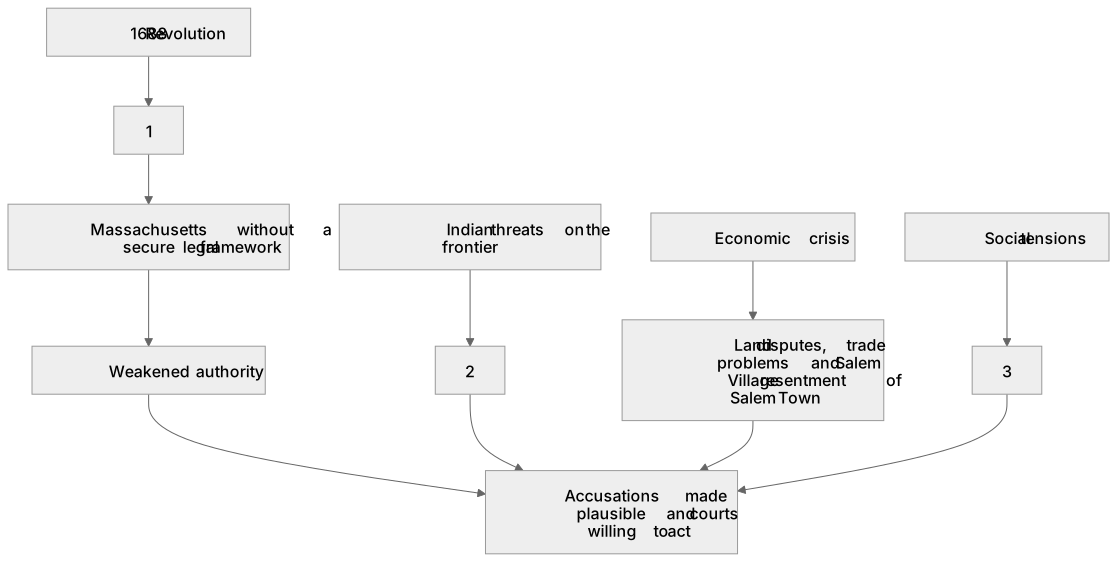
1Box 1
2Box 2
3Box 3
There is more to this lesson
The full lesson goes on to check your understanding and help you earn the marks. Create a free account to carry on, with your progress saved.
A week of Premium from your first lesson · Then the free plan continues · No card, no charge
Test your understanding of Paper 3, Option 33: The witch craze in Britain, Europe and North America, c1580–c1750 - 5 Cotton Mather and the Salem witch hunt, 1692–93: The social, economic and political context of Salem: weakened authority following the 1688 Revolution; Indian threats and economic crisis; social tensions.
Active recall beats re-reading. Take an instant quiz now to test what you’ve learned and lock it into long-term memory.
A week of Premium from your first lesson · Then the free plan continues · No card, no charge