Pearson Edexcel · A-Level · History
Course version: 9HI0 · Version from Sept 2015
Industrialisation and social change in Britain, 1759–1928: forging a new…
Full specification wording
Paper 3, Option 34.1: Industrialisation and social change in Britain, 1759–1928: forging a new society - 1 Changing patterns of adult work and working conditions: The impact of workers’ unions on working conditions, 1759– 1928: the influence and limitations of workers’ associations and unions to 1851; the role of new model trade unions from 1851; the influence of unskilled workers’ unions from 1888 (key developments: the matchgirls’ strike 1888, the Triple Alliance 1919).
Workers' unions from 1759 to 1928 influenced conditions through collective action, but faced legal and economic limits.
Checked against the Pearson Edexcel 9HI0 specification (opens in a new tab) on .
- Point 2 of 2
- 4 key terms
Study notes
From the checked teaching notes for this specification point.
The idea
Workers' unions from 1759 to 1928 influenced conditions through collective action, but faced legal and economic limits. To 1851, associations and unions were often local, illegal under Combination Acts until repeal in 1824, and weakened by repression, though they secured some wage and hours gains. From 1851, new model trade unions, such as the Amalgamated Society of Engineers, focused on skilled workers, used high subscriptions and friendly benefits, and negotiated rather than struck, gaining respectability but excluding the unskilled. From 1888, unskilled unions grew, highlighted by the matchgirls' strike 1888 and the Triple Alliance 1919, which coordinated miners, railwaymen and transport workers. Assessed through source analysis and essays on influence and limitation.
What earns the marks
- Explains the influence and limitations of workers' associations and unions to 1851, including legal repression and localised action.
- Assesses the role of new model trade unions from 1851, such as the Amalgamated Society of Engineers, in securing benefits for skilled workers.
- Evaluates the influence of unskilled workers' unions from 1888, using the matchgirls' strike 1888 as a key development.
- Analyses the Triple Alliance 1919 as an example of coordinated union action and its limitations.
- Compares the effectiveness of different union types across the period in improving working conditions.
Common mistakes and how to put them right
Assuming unions were continuously legal.
Put it right: They were restricted by Combination Acts until 1824 and faced later legal hurdles.
Treating new model unions as inclusive.
Put it right: They mainly represented skilled workers and often excluded the unskilled.
Overstating the success of the Triple Alliance.
Put it right: It collapsed in 1921, showing limits to coordinated action.
Exam tips
- Use specific union names and dates, such as the Amalgamated Society of Engineers and 1888, to support arguments.
- Distinguish between influence on wages, hours and recognition, and limitations such as legal or economic constraints.
- When discussing key developments, explain their short-term and long-term impact on working conditions.
Try the lesson
The start of the Paper 3, Option 34.1: Industrialisation and social change in Britain, 1759–1928: forging a new society - 1 Changing patterns of adult work and working conditions: The impact of workers’ unions on working conditions, 1759– 1928: the influence and limitations of workers’ associations and unions to 1851; the role of new model trade unions from 1851; the influence of unskilled workers’ unions from 1888 (key developments: the matchgirls’ strike 1888, the Triple Alliance 1919). lesson, made from checked teaching notes for this specification point.
Have a go first
Which group of workers took strike action at the Bryant and May factory in 1888?
Listen
Workers' unions from 1759 to 1928 influenced conditions through collective action, but faced legal and economic limits. To 1851, associations and unions were often local, illegal under Combination Acts until repeal in 1824, and weakened by repression, though they secured some wage and hours gains. From 1851, new model trade unions, such as the Amalgamated Society of Engineers, focused on skilled workers, used high subscriptions and friendly benefits, and negotiated rather than struck, gaining respectability but excluding the unskilled. From 1888, unskilled unions grew, highlighted by the matchgirls' strike 1888 and the Triple Alliance 1919, which coordinated miners, railwaymen and transport workers. Assessed through source analysis and essays on influence and limitation. A strong answer earns marks for these points. Explains the influence and limitations of workers' associations and unions to 1851, including legal repression and localised action. Assesses the role of new model trade unions from 1851, such as the Amalgamated Society of Engineers, in securing benefits for skilled workers. Evaluates the influence of unskilled workers' unions from 1888, using the matchgirls' strike 1888 as a key development. Analyses the Triple Alliance 1919 as an example of coordinated union action and its limitations. A common slip: Assuming unions were continuously legal. Instead, they were restricted by Combination Acts until 1824 and faced later legal hurdles. Exam tip: Use specific union names and dates, such as the Amalgamated Society of Engineers and 1888, to support arguments.
See it

Key words
Say what each word means before you turn the card.
Legal status of unions
Try answering aloud or in your head before turning the card.
Skilled versus unskilled organisation
Try answering aloud or in your head before turning the card.
Industrial action and solidarity
Try answering aloud or in your head before turning the card.
Collective bargaining and union recognition
Try answering aloud or in your head before turning the card.
See every definition
- Legal status of unions
- Associations and unions were often local and illegal under the Combination Acts until repeal in 1824, and faced later legal hurdles.
- Skilled versus unskilled organisation
- New model trade unions focused on skilled workers and excluded the unskilled, while unskilled unions grew from 1888.
- Industrial action and solidarity
- New model unions negotiated rather than struck, while the Triple Alliance coordinated miners, railwaymen and transport workers.
- Collective bargaining and union recognition
- New model trade unions negotiated rather than struck, gaining respectability but excluding the unskilled.
Label the diagram
Some boxes have lost their names. Pick the right name for each number.
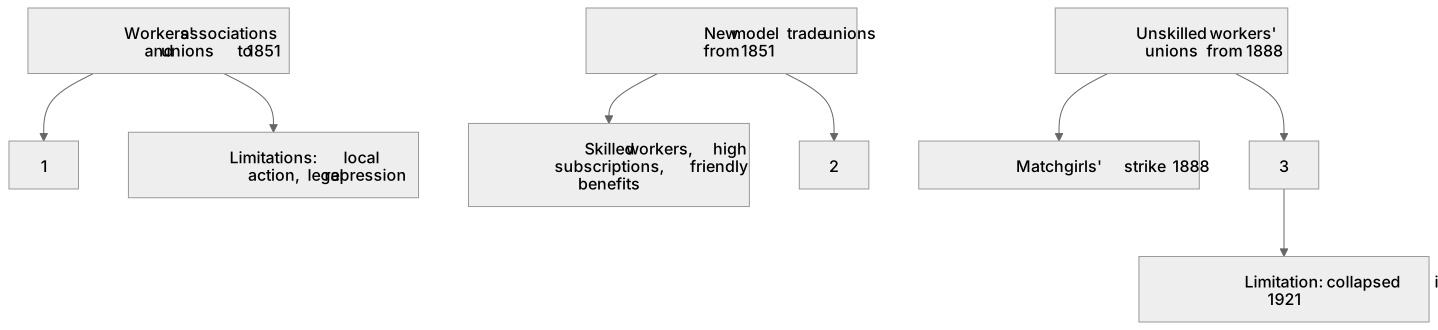
1Box 1
2Box 2
3Box 3
There is more to this lesson
The full lesson goes on to check your understanding and help you earn the marks. Create a free account to carry on, with your progress saved.
A week of Premium from your first lesson · Then the free plan continues · No card, no charge
Test your understanding of Paper 3, Option 34.1: Industrialisation and social change in Britain, 1759–1928: forging a new society - 1 Changing patterns of adult work and working conditions: The impact of workers’ unions on working conditions, 1759– 1928: the influence and limitations of workers’ associations and unions to 1851; the role of new model trade unions from 1851; the influence of unskilled workers’ unions from 1888 (key developments: the matchgirls’ strike 1888, the Triple Alliance 1919).
Active recall beats re-reading. Take an instant quiz now to test what you’ve learned and lock it into long-term memory.
A week of Premium from your first lesson · Then the free plan continues · No card, no charge