Pearson Edexcel · A-Level · History
Course version: 9HI0 · Version from Sept 2015
Industrialisation and social change in Britain, 1759–1928: forging a new…
Full specification wording
Paper 3, Option 34.1: Industrialisation and social change in Britain, 1759–1928: forging a new society - 4 John Kemp Starley: cycles, cycling clubs and emancipation, 1885–1901: The significance of the safety bicycle for women – impacts on mobility, independence and fashion; opposition to the female bicycling craze; the significance of the concept of the ‘New Woman’ in the 1890s.
The safety bicycle gave women unprecedented mobility, allowing them to travel independently without chaperones.
Checked against the Pearson Edexcel 9HI0 specification (opens in a new tab) on .
- Point 3 of 3
- 4 key terms
Study notes
From the checked teaching notes for this specification point.
The idea
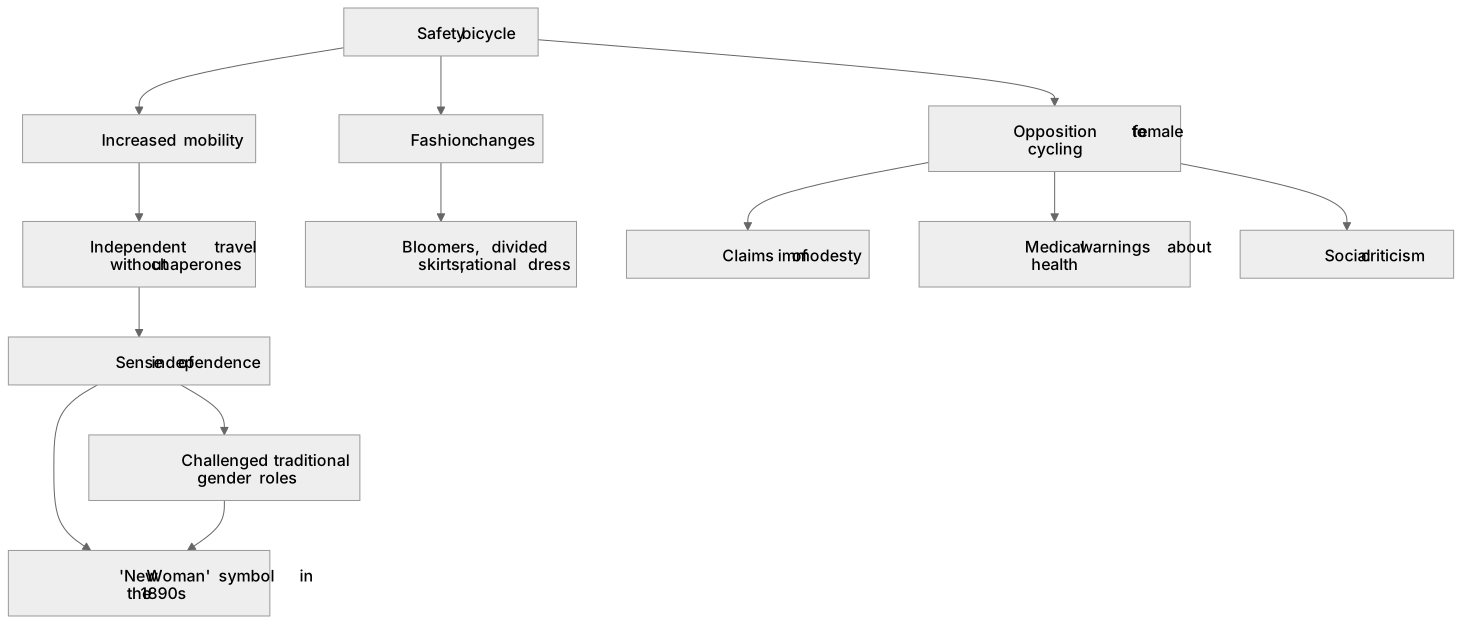
The safety bicycle gave women unprecedented mobility, allowing them to travel independently without chaperones. This fostered a sense of independence and challenged traditional gender roles. In fashion, it prompted practical changes: bloomers, divided skirts, and eventually rational dress, as corsets and long skirts were impractical. However, the female bicycling craze faced opposition: critics claimed it was immodest, medically harmful, or sexually provocative. Despite this, the image of the ‘New Woman’—educated, independent, and mobile—became a powerful cultural symbol in the 1890s. The bicycle was both a practical tool and a symbol of women’s emancipation, contributing to broader debates about women’s rights and suffrage.
What earns the marks
- Explains how the safety bicycle increased women’s mobility, enabling independent travel and reducing reliance on male escorts.
- Describes the impact on fashion: the adoption of bloomers, divided skirts, and other rational dress, and the decline of restrictive corsets for cycling.
- Analyses the opposition to female cycling: moral panics about immodesty, medical warnings about ‘bicycle face’ or damage to health, and social criticism.
- Explains the concept of the ‘New Woman’ in the 1890s and how the bicycle became a symbol of her independence and modernity.
- Evaluates the extent to which the safety bicycle advanced women’s emancipation, considering both its practical benefits and the limits of change.
Common mistakes and how to put them right
Assuming all women immediately adopted cycling.
Put it right: It was mainly middle-class women at first, and opposition was significant; working-class women faced cost barriers.
Treating the ‘New Woman’ as a uniform identity.
Put it right: The term covered various aspirations and was contested; not all women cyclists identified as New Women.
Overstating the decline of corsets.
Put it right: Corsets remained common, but cycling encouraged more practical alternatives for some women.
Exam tips
- Use specific examples of opposition, such as newspaper articles or medical opinions, to show the extent of resistance.
- Connect fashion changes to broader debates about women’s roles and the ‘New Woman’.
- Assess both the advances and the limitations for women’s emancipation, avoiding one-sided conclusions.
Try the lesson
The start of the Paper 3, Option 34.1: Industrialisation and social change in Britain, 1759–1928: forging a new society - 4 John Kemp Starley: cycles, cycling clubs and emancipation, 1885–1901: The significance of the safety bicycle for women – impacts on mobility, independence and fashion; opposition to the female bicycling craze; the significance of the concept of the ‘New Woman’ in the 1890s. lesson, made from checked teaching notes for this specification point.
Have a go first
Which change in women's dress in the 1890s was most closely associated with the spread of the safety bicycle?
Listen
The safety bicycle gave women unprecedented mobility, allowing them to travel independently without chaperones. This fostered a sense of independence and challenged traditional gender roles. In fashion, it prompted practical changes: bloomers, divided skirts, and eventually rational dress, as corsets and long skirts were impractical. However, the female bicycling craze faced opposition: critics claimed it was immodest, medically harmful, or sexually provocative. Despite this, the image of the ‘New Woman’—educated, independent, and mobile—became a powerful cultural symbol in the 1890s. The bicycle was both a practical tool and a symbol of women’s emancipation, contributing to broader debates about women’s rights and suffrage. A strong answer earns marks for these points. Explains how the safety bicycle increased women’s mobility, enabling independent travel and reducing reliance on male escorts. Describes the impact on fashion: the adoption of bloomers, divided skirts, and other rational dress, and the decline of restrictive corsets for cycling. Analyses the opposition to female cycling: moral panics about immodesty, medical warnings about ‘bicycle face’ or damage to health, and social criticism. Explains the concept of the ‘New Woman’ in the 1890s and how the bicycle became a symbol of her independence and modernity. A common slip: Assuming all women immediately adopted cycling. Instead, It was mainly middle-class women at first, and opposition was significant; working-class women faced cost barriers. Exam tip: Use specific examples of opposition, such as newspaper articles or medical opinions, to show the extent of resistance.
See it
Key words
Say what each word means before you turn the card.
Gender and emancipation
Try answering aloud or in your head before turning the card.
Social and cultural change
Try answering aloud or in your head before turning the card.
Fashion and modernity
Try answering aloud or in your head before turning the card.
Opposition and controversy
Try answering aloud or in your head before turning the card.
See every definition
- Gender and emancipation
- The safety bicycle challenged traditional gender roles by giving women mobility and independence, and became a symbol of women's emancipation.
- Social and cultural change
- Practical changes such as bloomers, divided skirts and rational dress, alongside the image of the ‘New Woman’, made the bicycle part of broader debates about women's rights and suffrage.
- Fashion and modernity
- Cycling prompted practical changes in dress, including bloomers, divided skirts and eventually rational dress, as corsets and long skirts were impractical.
- Opposition and controversy
- Critics claimed female cycling was immodest, medically harmful or sexually provocative, and the craze faced moral panics and social criticism.
Label the diagram
Some boxes have lost their names. Pick the right name for each number.

1Box 1
2Box 2
3Box 3
There is more to this lesson
The full lesson goes on to check your understanding and help you earn the marks. Create a free account to carry on, with your progress saved.
A week of Premium from your first lesson · Then the free plan continues · No card, no charge
Test your understanding of Paper 3, Option 34.1: Industrialisation and social change in Britain, 1759–1928: forging a new society - 4 John Kemp Starley: cycles, cycling clubs and emancipation, 1885–1901: The significance of the safety bicycle for women – impacts on mobility, independence and fashion; opposition to the female bicycling craze; the significance of the concept of the ‘New Woman’ in the 1890s.
Active recall beats re-reading. Take an instant quiz now to test what you’ve learned and lock it into long-term memory.
A week of Premium from your first lesson · Then the free plan continues · No card, no charge