Pearson Edexcel · A-Level · History
Course version: 9HI0 · Version from Sept 2015
Poverty, public health and the state in Britain, c1780–1939 - 2 Less…
Full specification wording
Paper 3, Option 34.2: Poverty, public health and the state in Britain, c1780–1939 - 2 Less eligibility: the Poor Law Amendment Act and its impact, 1832–47: The nature of opposition to the operation of new Poor Law, the roles of Oastler and Fielden; the significance of the Anti-Poor Law movement.
The Poor Law Amendment Act's principle of less eligibility provoked varied opposition.
Checked against the Pearson Edexcel 9HI0 specification (opens in a new tab) on .
- Point 3 of 3
- 4 key terms
Study notes
From the checked teaching notes for this specification point.
The idea
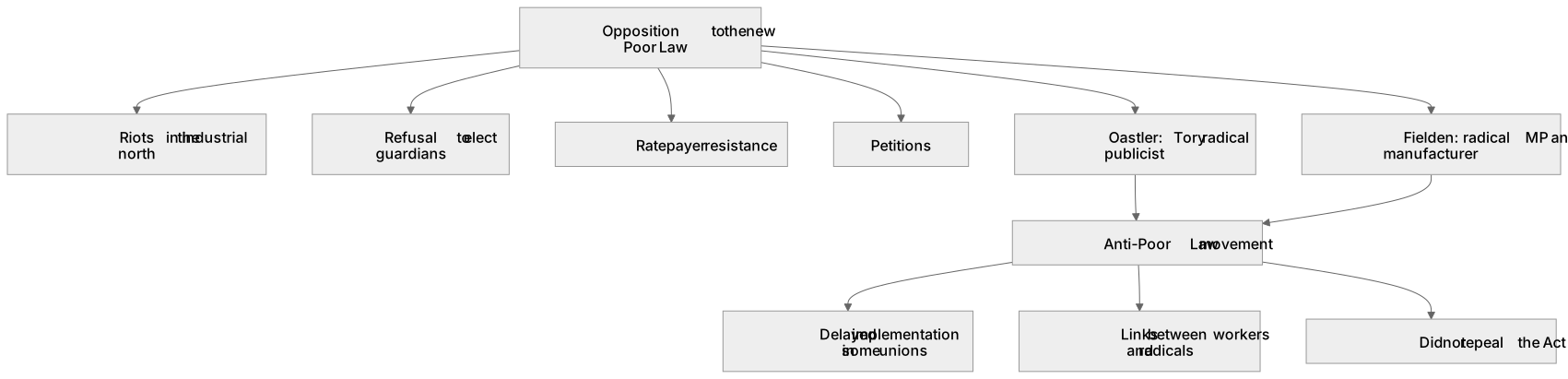
The Poor Law Amendment Act's principle of less eligibility provoked varied opposition. Rioting occurred in the industrial north, where outdoor relief suited cyclical unemployment. Richard Oastler, a Tory radical, attacked the new law as a threat to the poor, while John Fielden, a radical MP, campaigned in Parliament and print. The Anti-Poor Law movement linked ratepayers, workers and radicals, delaying union building in some towns. The nature of opposition to the operation of new Poor Law varied geographically: it was strongest in the industrial north, and weakest in the rural south, despite the south having had a generous allowance system previously.
What earns the marks
- Explains the nature of opposition to the operation of new Poor Law: riots, refusal to elect guardians, ratepayer resistance and petitions.
- Analyses Oastler's role as a Tory radical publicist who linked the new Poor Law to exploitation of the poor and factory children.
- Analyses Fielden's role as a radical MP and manufacturer who attacked the Act in Parliament and supported organised protest.
- Assesses the significance of the Anti-Poor Law movement: it delayed implementation in some unions and forged links between workers and radicals, but did not repeal the Act.
- Locates opposition geographically and socially, contrasting northern manufacturing districts with the rural south.
- Evaluates how far opposition changed policy, distinguishing local obstruction from national failure to overturn the law.
Common mistakes and how to put them right
Treating the Anti-Poor Law movement as a single national organisation.
Put it right: Present it as a loose, locally rooted campaign with varied leadership and aims.
Confusing Oastler and Fielden as holding identical views.
Put it right: Distinguish Oastler's Tory radical moral critique from Fielden's parliamentary and manufacturing radicalism.
Assuming opposition was strongest where the old system was most generous.
Put it right: The rural south had a generous allowance system but weak opposition, whereas the industrial north had the strongest opposition.
Exam tips
- Anchor answers in named places and episodes, such as northern union resistance, to show the nature of opposition concretely.
- Use the wording of the question to balance nature, roles and significance rather than narrating the whole Poor Law story.
- Reach a judgement on significance by weighing local disruption against the survival of the Act.
Try the lesson
The start of the Paper 3, Option 34.2: Poverty, public health and the state in Britain, c1780–1939 - 2 Less eligibility: the Poor Law Amendment Act and its impact, 1832–47: The nature of opposition to the operation of new Poor Law, the roles of Oastler and Fielden; the significance of the Anti-Poor Law movement. lesson, made from checked teaching notes for this specification point.
Have a go first
Which campaigner became the leading voice of the Ten Hours Movement and attacked the new Poor Law for forcing factory workers into the workhouse?
Listen
The Poor Law Amendment Act's principle of less eligibility provoked varied opposition. Rioting occurred in the industrial north, where outdoor relief suited cyclical unemployment. Richard Oastler, a Tory radical, attacked the new law as a threat to the poor, while John Fielden, a radical MP, campaigned in Parliament and print. The Anti-Poor Law movement linked ratepayers, workers and radicals, delaying union building in some towns. The nature of opposition to the operation of new Poor Law varied geographically: it was strongest in the industrial north, and weakest in the rural south, despite the south having had a generous allowance system previously. A strong answer earns marks for these points. Explains the nature of opposition to the operation of new Poor Law: riots, refusal to elect guardians, ratepayer resistance and petitions. Analyses Oastler's role as a Tory radical publicist who linked the new Poor Law to exploitation of the poor and factory children. Analyses Fielden's role as a radical MP and manufacturer who attacked the Act in Parliament and supported organised protest. Assesses the significance of the Anti-Poor Law movement: it delayed implementation in some unions and forged links between workers and radicals, but did not repeal the Act. A common slip: Treating the Anti-Poor Law movement as a single national organisation. Instead, present it as a loose, locally rooted campaign with varied leadership and aims. Exam tip: Anchor answers in named places and episodes, such as northern union resistance, to show the nature of opposition concretely.
See it
Key words
Say what each word means before you turn the card.
Less eligibility
Try answering aloud or in your head before turning the card.
Tory radicalism and factory reform
Try answering aloud or in your head before turning the card.
Radical parliamentary campaigning
Try answering aloud or in your head before turning the card.
Local resistance versus national policy
Try answering aloud or in your head before turning the card.
See every definition
- Less eligibility
- The principle of the Poor Law Amendment Act that provoked varied opposition, including rioting in the industrial north.
- Tory radicalism and factory reform
- Richard Oastler's position, from which he attacked the new law as a threat to the poor and linked it to exploitation of factory children.
- Radical parliamentary campaigning
- John Fielden's role as a radical MP and manufacturer who attacked the Act in Parliament and supported organised protest.
- Local resistance versus national policy
- Opposition that was strongest in the industrial north and weakest in the rural south, delaying union building in some towns but not repealing the Act.
Label the diagram
Some boxes have lost their names. Pick the right name for each number.
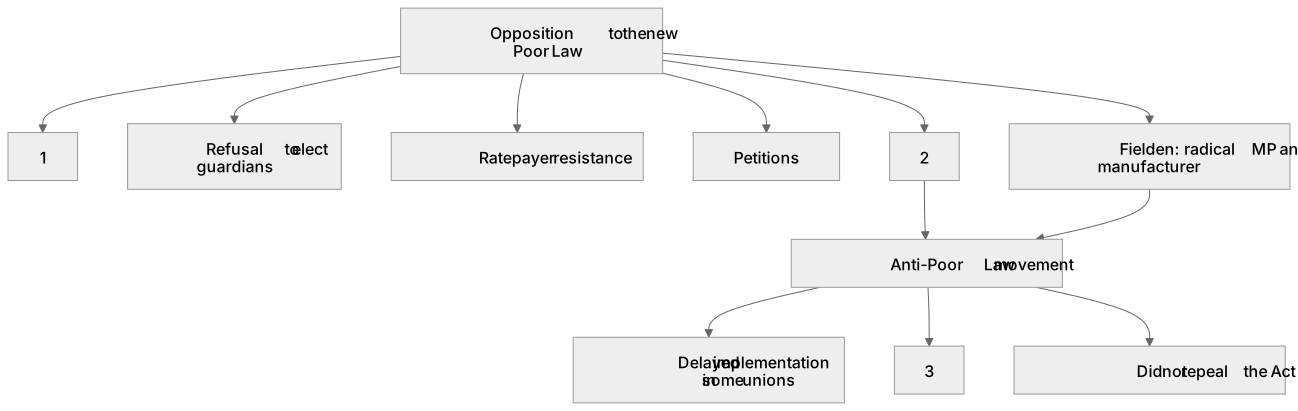
1Box 1
2Box 2
3Box 3
There is more to this lesson
The full lesson goes on to check your understanding and help you earn the marks. Create a free account to carry on, with your progress saved.
A week of Premium from your first lesson · Then the free plan continues · No card, no charge
Test your understanding of Paper 3, Option 34.2: Poverty, public health and the state in Britain, c1780–1939 - 2 Less eligibility: the Poor Law Amendment Act and its impact, 1832–47: The nature of opposition to the operation of new Poor Law, the roles of Oastler and Fielden; the significance of the Anti-Poor Law movement.
Active recall beats re-reading. Take an instant quiz now to test what you’ve learned and lock it into long-term memory.
A week of Premium from your first lesson · Then the free plan continues · No card, no charge