Pearson Edexcel · A-Level · History
Course version: 9HI0 · Version from Sept 2015
Poverty, public health and the state in Britain, c1780–1939 - 5 Depression…
Full specification wording
Paper 3, Option 34.2: Poverty, public health and the state in Britain, c1780–1939 - 5 Depression and the dole: poverty in the inter-war years, 1920–39: The problem of poverty in the 1920s and 30s; the impact of the decline of heavy industry; the impact of the Wall Street Crash and the Depression.
In the 1920s and 1930s, poverty persisted despite inter-war welfare reforms.
Checked against the Pearson Edexcel 9HI0 specification (opens in a new tab) on .
- Point 1 of 3
- 4 key terms
Study notes
From the checked teaching notes for this specification point.
The idea
In the 1920s and 1930s, poverty persisted despite inter-war welfare reforms. The decline of heavy industry—coal, shipbuilding, iron and steel, textiles—led to mass unemployment in regions like South Wales, Clydeside, and the North East. The Wall Street Crash of 1929 triggered a global depression, reducing demand for British exports and worsening unemployment, which peaked at over 3 million in 1932. The means test (1931) and the Unemployment Act 1934 created hardship. Poverty was characterised by low wages, unemployment benefit cuts, and regional disparities. The impact included malnutrition, poor health, and social unrest, but also spurred government responses like the Special Areas Act 1934.
What earns the marks
- Poverty in the 1920s and 30s: mass unemployment, low wages, inadequate benefits, and regional deprivation in industrial areas.
- Decline of heavy industry: coal, shipbuilding, iron and steel, textiles suffered from foreign competition and outdated technology, leading to structural unemployment.
- Wall Street Crash 1929: triggered global depression, reduced international trade, and caused a slump in British exports, worsening unemployment.
- Impact of the Depression: unemployment peaked at over 3 million in 1932; means test caused hardship; regional disparities widened.
- Government responses: Unemployment Act 1934, Special Areas Act 1934, but poverty remained severe.
Common mistakes and how to put them right
Stating that the Wall Street Crash caused the decline of heavy industry.
Put it right: Heavy industry decline began in the early 1920s due to foreign competition and outdated technology; the Crash exacerbated it.
Claiming unemployment was uniform across Britain.
Put it right: It was concentrated in specific regions like South Wales, Scotland, and the North East.
Confusing the means test with the dole.
Put it right: The means test assessed household income to determine benefit eligibility, often reducing payments.
Exam tips
- Use specific examples of declining industries and regions to illustrate impact.
- Link the Wall Street Crash to the wider Depression and its effects on Britain.
- Discuss both economic and social impacts of poverty, such as health and unrest.
Try the lesson
The start of the Paper 3, Option 34.2: Poverty, public health and the state in Britain, c1780–1939 - 5 Depression and the dole: poverty in the inter-war years, 1920–39: The problem of poverty in the 1920s and 30s; the impact of the decline of heavy industry; the impact of the Wall Street Crash and the Depression. lesson, made from checked teaching notes for this specification point.
Have a go first
In which year did the Wall Street Crash occur, marking the start of the Great Depression?
Listen
In the 1920s and 1930s, poverty persisted despite inter-war welfare reforms. The decline of heavy industry—coal, shipbuilding, iron and steel, textiles—led to mass unemployment in regions like South Wales, Clydeside, and the North East. The Wall Street Crash of 1929 triggered a global depression, reducing demand for British exports and worsening unemployment, which peaked at over 3 million in 1932. The means test (1931) and the Unemployment Act 1934 created hardship. Poverty was characterised by low wages, unemployment benefit cuts, and regional disparities. The impact included malnutrition, poor health, and social unrest, but also spurred government responses like the Special Areas Act 1934. A strong answer earns marks for these points. Poverty in the 1920s and 30s: mass unemployment, low wages, inadequate benefits, and regional deprivation in industrial areas. Decline of heavy industry: coal, shipbuilding, iron and steel, textiles suffered from foreign competition and outdated technology, leading to structural unemployment. Wall Street Crash 1929: triggered global depression, reduced international trade, and caused a slump in British exports, worsening unemployment. Impact of the Depression: unemployment peaked at over 3 million in 1932; means test caused hardship; regional disparities widened. A common slip: stating that the Wall Street Crash caused the decline of heavy industry. Instead, heavy industry decline began in the early 1920s due to foreign competition and outdated technology; the Crash exacerbated it. Exam tip: Use specific examples of declining industries and regions to illustrate impact.
See it
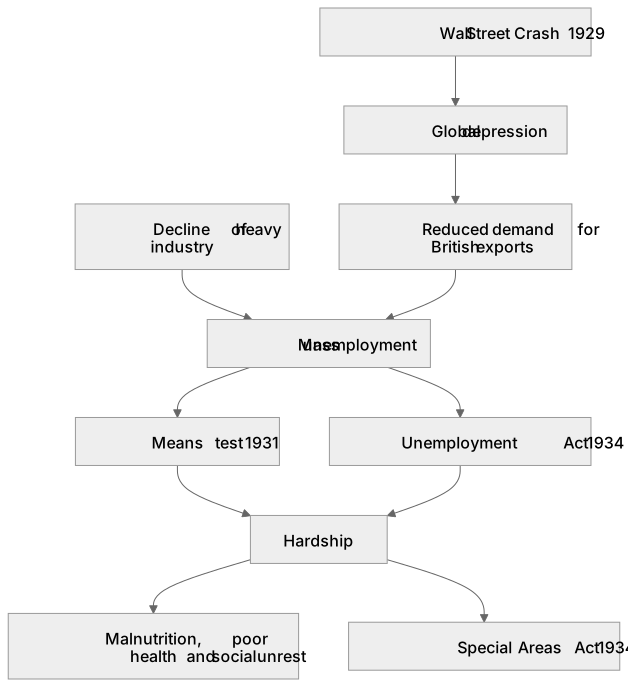
Put the events in order
Put these events in the order they happened, earliest first.
- 1. Unemployment Act and Special Areas Act passed
- 2. Wall Street Crash triggers global depression
- 3. Unemployment peaked at over three million
- 4. Means test created hardship
Key words
Say what each word means before you turn the card.
Unemployment and poverty
Try answering aloud or in your head before turning the card.
Regional economic disparity
Try answering aloud or in your head before turning the card.
Global economic interdependence
Try answering aloud or in your head before turning the card.
Government welfare responses
Try answering aloud or in your head before turning the card.
See every definition
- Unemployment and poverty
- Mass unemployment, low wages, inadequate benefits and regional deprivation in industrial areas characterised poverty in the 1920s and 30s.
- Regional economic disparity
- Unemployment was concentrated in specific regions like South Wales, Scotland and the North East, and regional disparities widened during the Depression.
- Global economic interdependence
- The Wall Street Crash of 1929 triggered a global depression, reduced international trade and caused a slump in British exports, worsening unemployment.
- Government welfare responses
- The Unemployment Act 1934 and the Special Areas Act 1934 were responses, but poverty remained severe.
Label the diagram
Some boxes have lost their names. Pick the right name for each number.
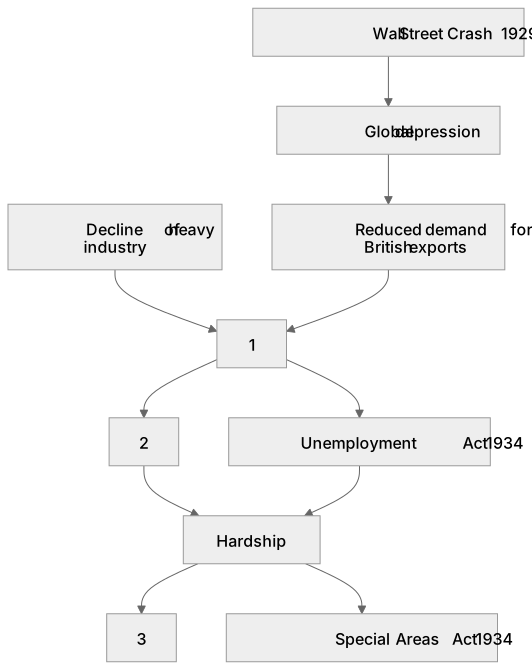
1Box 1
2Box 2
3Box 3
There is more to this lesson
The full lesson goes on to check your understanding and help you earn the marks. Create a free account to carry on, with your progress saved.
A week of Premium from your first lesson · Then the free plan continues · No card, no charge
Test your understanding of Paper 3, Option 34.2: Poverty, public health and the state in Britain, c1780–1939 - 5 Depression and the dole: poverty in the inter-war years, 1920–39: The problem of poverty in the 1920s and 30s; the impact of the decline of heavy industry; the impact of the Wall Street Crash and the Depression.
Active recall beats re-reading. Take an instant quiz now to test what you’ve learned and lock it into long-term memory.
A week of Premium from your first lesson · Then the free plan continues · No card, no charge