Pearson Edexcel · A-Level · History
Course version: 9HI0 · Version from Sept 2015
Britain: losing and gaining an empire, 1763–1914 - 1 The loss of the…
Full specification wording
Paper 3, Option 35.1: Britain: losing and gaining an empire, 1763–1914 - 1 The loss of the American colonies, 1770–83: Britain's defeat, 1777–83: French and Spanish involvement; Britain’s limited military resources; the defeats of Burgoyne 1777, and Cornwallis 1781; the decision to seek peace and accept the Treaty of Paris. Impact of defeat on Britain 1783.
This topic explains how Britain lost the American colonies between 1777 and 1783.
Checked against the Pearson Edexcel 9HI0 specification (opens in a new tab) on .
- Point 3 of 3
- 4 key terms
Study notes
From the checked teaching notes for this specification point.
The idea
This topic explains how Britain lost the American colonies between 1777 and 1783. After Saratoga in 1777, France entered the war in 1778, followed by Spain in 1779; their naval and financial support stretched Britain’s limited army, navy and money across the Atlantic, the Caribbean, the Mediterranean and India. Burgoyne’s surrender at Saratoga encouraged France to ally with the Americans, while Cornwallis’s surrender at Yorktown in 1781, after French naval control of Chesapeake Bay, ended hopes of victory. Lord North’s government fell, and peace talks led to the Treaty of Paris in 1783, recognising American independence. Defeat damaged Britain’s prestige, but trade and empire soon recovered and expanded elsewhere.
What earns the marks
- Explains that French entry in 1778 and Spanish entry in 1779 turned a colonial rebellion into a global war, forcing Britain to divide its forces.
- Analyses how Britain’s limited military resources—manpower, naval strength and finance—made it difficult to hold territory and supply armies across the Atlantic.
- Assesses the significance of Burgoyne’s defeat at Saratoga in 1777 in encouraging France to recognise and support the United States.
- Evaluates Cornwallis’s surrender at Yorktown in 1781, including the role of French naval superiority, as the decisive military blow.
- Explains why Britain sought peace and accepted the Treaty of Paris in 1783, recognising American independence and ceding territory.
- Judges the impact of defeat on Britain in 1783: loss of prestige, political fallout for Lord North, but also resilience and later imperial expansion.
Common mistakes and how to put them right
Treating the war as only Britain versus the American colonists.
Put it right: Include French and Spanish involvement as major factors that globalised the conflict.
Assuming Britain’s defeat was inevitable because of poor generalship alone.
Put it right: Weigh limited resources, distance, supply problems and foreign intervention together.
Confusing the Treaty of Paris 1783 with the 1763 treaty.
Put it right: The 1783 treaty ended the American Revolutionary War and recognised US independence.
Claiming defeat permanently ruined Britain.
Put it right: Assess short-term prestige damage alongside longer-term recovery and expansion.
Exam tips
- Build answers around causation and significance: why did France and Spain intervene, and how did that change the war?
- Use precise dates and names—Saratoga 1777, Yorktown 1781, Treaty of Paris 1783—to anchor analysis.
- When judging impact, separate political, military, economic and imperial consequences rather than listing them.
- Link each factor back to the question: explain how it contributed to defeat or shaped the peace.
Try the lesson
The start of the Paper 3, Option 35.1: Britain: losing and gaining an empire, 1763–1914 - 1 The loss of the American colonies, 1770–83: Britain's defeat, 1777–83: French and Spanish involvement; Britain’s limited military resources; the defeats of Burgoyne 1777, and Cornwallis 1781; the decision to seek peace and accept the Treaty of Paris. Impact of defeat on Britain 1783. lesson, made from checked teaching notes for this specification point.
Have a go first
Which country formally entered the war against Britain in 1778, turning the American rebellion into a wider conflict?
Listen
This topic explains how Britain lost the American colonies between 1777 and 1783. After Saratoga in 1777, France entered the war in 1778, followed by Spain in 1779; their naval and financial support stretched Britain’s limited army, navy and money across the Atlantic, the Caribbean, the Mediterranean and India. Burgoyne’s surrender at Saratoga encouraged France to ally with the Americans, while Cornwallis’s surrender at Yorktown in 1781, after French naval control of Chesapeake Bay, ended hopes of victory. Lord North’s government fell, and peace talks led to the Treaty of Paris in 1783, recognising American independence. Defeat damaged Britain’s prestige, but trade and empire soon recovered and expanded elsewhere. A strong answer earns marks for these points. Explains that French entry in 1778 and Spanish entry in 1779 turned a colonial rebellion into a global war, forcing Britain to divide its forces. Analyses how Britain’s limited military resources—manpower, naval strength and finance—made it difficult to hold territory and supply armies across the Atlantic. Assesses the significance of Burgoyne’s defeat at Saratoga in 1777 in encouraging France to recognise and support the United States. Evaluates Cornwallis’s surrender at Yorktown in 1781, including the role of French naval superiority, as the decisive military blow. A common slip: Treating the war as only Britain versus the American colonists. Instead, include French and Spanish involvement as major factors that globalised the conflict. Exam tip: Build answers around causation and significance: why did France and Spain intervene, and how did that change the war?
See it
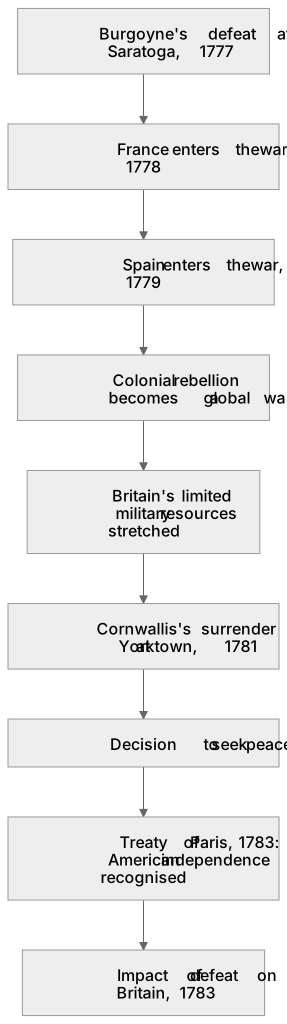
Put the events in order
Put these events in the order they happened, earliest first.
- 1. France entered the war
- 2. Burgoyne's defeat at Saratoga
- 3. Treaty of Paris recognised American independence
- 4. Spain entered the war
- 5. Cornwallis's surrender at Yorktown
Key words
Say what each word means before you turn the card.
Global warfare and foreign intervention
Try answering aloud or in your head before turning the card.
Resource limitations and strategic overstretch
Try answering aloud or in your head before turning the card.
Decisive military defeats and leadership
Try answering aloud or in your head before turning the card.
Peace-making and imperial consequences
Try answering aloud or in your head before turning the card.
See every definition
- Global warfare and foreign intervention
- French entry in 1778 and Spanish entry in 1779 turned a colonial rebellion into a global war, forcing Britain to divide its forces.
- Resource limitations and strategic overstretch
- Limited manpower, naval strength and finance made it difficult to hold territory and supply armies across the Atlantic.
- Decisive military defeats and leadership
- Burgoyne's defeat at Saratoga in 1777 encouraged France to recognise and support the United States, while Cornwallis's surrender at Yorktown in 1781, after French naval superiority, was the decisive military blow.
- Peace-making and imperial consequences
- Britain sought peace and accepted the Treaty of Paris in 1783, recognising American independence and ceding territory, damaging prestige but with trade and empire soon recovering and expanding elsewhere.
Label the diagram
Some boxes have lost their names. Pick the right name for each number.
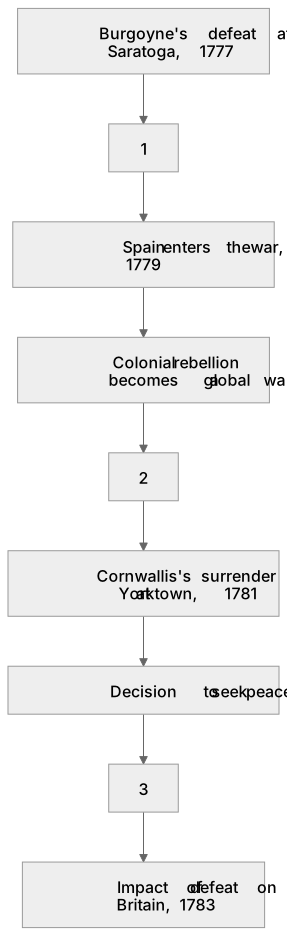
1Box 1
2Box 2
3Box 3
There is more to this lesson
The full lesson goes on to check your understanding and help you earn the marks. Create a free account to carry on, with your progress saved.
A week of Premium from your first lesson · Then the free plan continues · No card, no charge
Test your understanding of Paper 3, Option 35.1: Britain: losing and gaining an empire, 1763–1914 - 1 The loss of the American colonies, 1770–83: Britain's defeat, 1777–83: French and Spanish involvement; Britain’s limited military resources; the defeats of Burgoyne 1777, and Cornwallis 1781; the decision to seek peace and accept the Treaty of Paris. Impact of defeat on Britain 1783.
Active recall beats re-reading. Take an instant quiz now to test what you’ve learned and lock it into long-term memory.
A week of Premium from your first lesson · Then the free plan continues · No card, no charge