Pearson Edexcel · A-Level · History
Course version: 9HI0 · Version from Sept 2015
Britain: losing and gaining an empire, 1763–1914 - 2 The birth of British…
Full specification wording
Paper 3, Option 35.1: Britain: losing and gaining an empire, 1763–1914 - 2 The birth of British Australia, 1788–1829: Australia’s role as a penal colony from 1788; the importance of Lachlan Macquarie: the development of Sydney; land grants to ex-convicts and development up the Hawkesbury River; the growth of Macquarie towns.
This topic examines Australia’s beginnings as a British penal colony from 1788 and the governorship of Lachlan Macquarie from 1810 to 1821.
- 4 key terms
Study notes
From the checked teaching notes for this specification point.
The idea
This topic examines Australia’s beginnings as a British penal colony from 1788 and the governorship of Lachlan Macquarie from 1810 to 1821. After the First Fleet arrived at Botany Bay and settled at Port Jackson, convicts provided labour for survival and building. Macquarie believed ex-convicts could be reformed and integrated, so he granted land to emancipists and encouraged farming along the Hawkesbury River, where fertile soil supported grain and food production. He also planned and developed Sydney with public buildings, roads and wharves, and founded new towns such as Richmond, Windsor, Pitt Town, Castlereagh and Wilberforce—the Macquarie towns—to settle land and manage flooding. These changes helped the colony grow socially and economically, though they caused conflict with settlers and officials.
What earns the marks
- Explains the establishment and purpose of Australia as a penal colony from 1788, including the First Fleet and convict labour.
- Assesses Macquarie’s importance in developing Sydney through public works, planning and administration.
- Analyses the significance of land grants to ex-convicts in changing social and economic opportunities in the colony.
- Explains how settlement and farming developed up the Hawkesbury River, including its agricultural importance and challenges such as flooding.
- Evaluates the growth of the Macquarie towns as planned settlements that extended British control and supported the colony’s expansion.
- Judges the overall impact of Macquarie’s policies on the development of early colonial Australia.
Common mistakes and how to put them right
Assuming all convicts remained powerless.
Put it right: Recognise that emancipists could receive land and become farmers or employers.
Treating Macquarie’s town planning as only about buildings.
Put it right: Link it to settlement, flood management and control of land.
Ignoring the Hawkesbury River’s role.
Put it right: Explain its fertile land, food production and the problems of flooding.
Confusing the Macquarie towns with modern suburbs.
Put it right: Identify them as planned colonial settlements such as Richmond and Windsor.
Exam tips
- Use specific examples—Sydney’s public buildings, Hawkesbury farms, named Macquarie towns—to support analysis.
- When assessing importance, explain what changed because of Macquarie, not just what he did.
- Balance positive development with tensions, such as opposition from wealthy settlers or officials.
- Keep chronology clear: 1788 founding, Macquarie’s governorship 1810–21, and later growth to 1829.
Try the lesson
The start of the Paper 3, Option 35.1: Britain: losing and gaining an empire, 1763–1914 - 2 The birth of British Australia, 1788–1829: Australia’s role as a penal colony from 1788; the importance of Lachlan Macquarie: the development of Sydney; land grants to ex-convicts and development up the Hawkesbury River; the growth of Macquarie towns. lesson, made from checked teaching notes for this specification point.
Have a go first
In which year did the first British convict settlement in Australia begin at Sydney Cove?
Listen
This topic examines Australia’s beginnings as a British penal colony from 1788 and the governorship of Lachlan Macquarie from 1810 to 1821. After the First Fleet arrived at Botany Bay and settled at Port Jackson, convicts provided labour for survival and building. Macquarie believed ex-convicts could be reformed and integrated, so he granted land to emancipists and encouraged farming along the Hawkesbury River, where fertile soil supported grain and food production. He also planned and developed Sydney with public buildings, roads and wharves, and founded new towns such as Richmond, Windsor, Pitt Town, Castlereagh and Wilberforce—the Macquarie towns—to settle land and manage flooding. These changes helped the colony grow socially and economically, though they caused conflict with settlers and officials. A strong answer earns marks for these points. Explains the establishment and purpose of Australia as a penal colony from 1788, including the First Fleet and convict labour. Assesses Macquarie’s importance in developing Sydney through public works, planning and administration. Analyses the significance of land grants to ex-convicts in changing social and economic opportunities in the colony. Explains how settlement and farming developed up the Hawkesbury River, including its agricultural importance and challenges such as flooding. A common slip: Assuming all convicts remained powerless. Instead, recognise that emancipists could receive land and become farmers or employers. Exam tip: Use specific examples—Sydney’s public buildings, Hawkesbury farms, named Macquarie towns—to support analysis.
See it
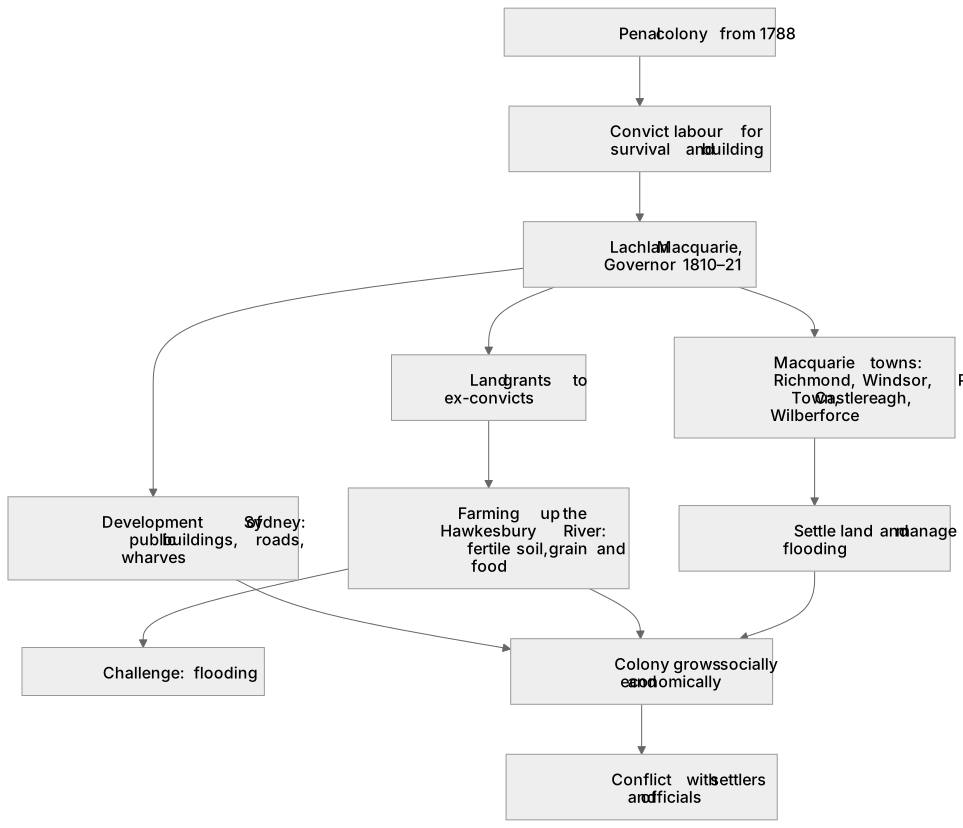
Put the events in order
Put these events in the order they happened, earliest first.
- 1. Australia established as a penal colony
- 2. Lachlan Macquarie's governorship ends
- 3. Lachlan Macquarie begins his governorship
Key words
Say what each word means before you turn the card.
Convict transportation and colonial labour
Try answering aloud or in your head before turning the card.
Governorship and reform
Try answering aloud or in your head before turning the card.
Land settlement and agriculture
Try answering aloud or in your head before turning the card.
Urban planning and colonial expansion
Try answering aloud or in your head before turning the card.
See every definition
- Convict transportation and colonial labour
- Australia served as a penal colony from 1788, and convicts provided labour for survival and building after the First Fleet settled at Port Jackson.
- Governorship and reform
- Lachlan Macquarie governed from 1810 to 1821 and believed ex-convicts could be reformed and integrated, granting land to emancipists.
- Land settlement and agriculture
- Farming along the Hawkesbury River was encouraged, where fertile soil supported grain and food production, though flooding was a challenge.
- Urban planning and colonial expansion
- Sydney was planned and developed with public buildings, roads and wharves, and new towns such as Richmond and Windsor were founded to settle land and manage flooding.
Label the diagram
Some boxes have lost their names. Pick the right name for each number.
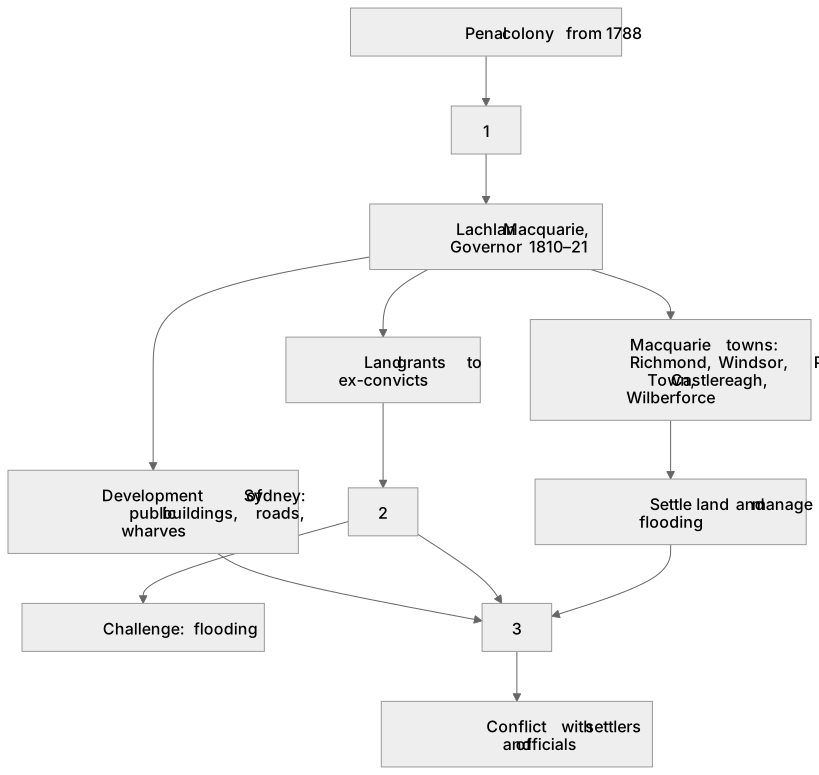
1Box 1
2Box 2
3Box 3
There is more to this lesson
The full lesson goes on to check your understanding and help you earn the marks. Create a free account to carry on, with your progress saved.
A week of Premium from your first lesson · Then the free plan continues · No card, no charge
Test your understanding of Paper 3, Option 35.1: Britain: losing and gaining an empire, 1763–1914 - 2 The birth of British Australia, 1788–1829: Australia’s role as a penal colony from 1788; the importance of Lachlan Macquarie: the development of Sydney; land grants to ex-convicts and development up the Hawkesbury River; the growth of Macquarie towns.
Active recall beats re-reading. Take an instant quiz now to test what you’ve learned and lock it into long-term memory.
A week of Premium from your first lesson · Then the free plan continues · No card, no charge