Pearson Edexcel · A-Level · History
Course version: 9HI0 · Version from Sept 2015
Britain: losing and gaining an empire, 1763–1914 - 2 The birth of British…
Full specification wording
Paper 3, Option 35.1: Britain: losing and gaining an empire, 1763–1914 - 2 The birth of British Australia, 1788–1829: The spreading impact: penal settlement in Van Diemen's land 1803; development of whaling; first crossing of the Blue Mountains 1813; first settlements in Western Australia 1826; extent of colonial control by 1829.
British Australia expanded through linked developments.
Checked against the Pearson Edexcel 9HI0 specification (opens in a new tab) on .
- Point 3 of 3
- 4 key terms
Study notes
From the checked teaching notes for this specification point.
The idea
British Australia expanded through linked developments. A penal settlement was established in Van Diemen's Land in 1803 at Risdon Cove, then Hobart and Launceston, extending convict control south of Bass Strait. Whaling and sealing grew around the Derwent and Sydney, supplying oil and skins and drawing ships into southern waters. In 1813 Blaxland, Lawson and Wentworth crossed the Blue Mountains, opening pastoral land west of Sydney. In 1826 a settlement was founded at King George Sound in Western Australia, later Albany, guarding the western approaches. By 1829 Britain claimed control across the continent, though effective settlement remained coastal and sparse.
What earns the marks
- Explains the 1803 penal settlement in Van Diemen's Land and its role in extending convict transportation and British authority.
- Analyses the development of whaling and sealing as an economic driver that pushed British activity into new coastal waters.
- Describes the 1813 crossing of the Blue Mountains by Blaxland, Lawson and Wentworth and its opening of inland pastoral expansion.
- Explains the 1826 settlement at King George Sound in Western Australia as a strategic extension of British presence.
- Assesses the extent of colonial control by 1829, distinguishing formal claim from limited effective settlement.
Common mistakes and how to put them right
Treating the 1826 Western Australia settlement as a large colony.
Put it right: Describe it as a small strategic outpost.
Confusing the 1813 Blue Mountains crossing with later inland exploration.
Put it right: Place it as the first successful crossing.
Assuming control by 1829 meant settled occupation of the whole continent.
Put it right: Note coastal concentration and sparse interior presence.
Exam tips
- Use dates and names precisely, linking each development to its effect on the spread of settlement.
- Distinguish economic motives such as whaling from strategic and penal motives when explaining expansion.
- Conclude with a clear judgement on how far colonial control had actually extended by 1829.
Try the lesson
The start of the Paper 3, Option 35.1: Britain: losing and gaining an empire, 1763–1914 - 2 The birth of British Australia, 1788–1829: The spreading impact: penal settlement in Van Diemen's land 1803; development of whaling; first crossing of the Blue Mountains 1813; first settlements in Western Australia 1826; extent of colonial control by 1829. lesson, made from checked teaching notes for this specification point.
Have a go first
In which year was the first penal settlement established in Van Diemen's Land?
Listen
British Australia expanded through linked developments. A penal settlement was established in Van Diemen's Land in 1803 at Risdon Cove, then Hobart and Launceston, extending convict control south of Bass Strait. Whaling and sealing grew around the Derwent and Sydney, supplying oil and skins and drawing ships into southern waters. In 1813 Blaxland, Lawson and Wentworth crossed the Blue Mountains, opening pastoral land west of Sydney. In 1826 a settlement was founded at King George Sound in Western Australia, later Albany, guarding the western approaches. By 1829 Britain claimed control across the continent, though effective settlement remained coastal and sparse. A strong answer earns marks for these points. Explains the 1803 penal settlement in Van Diemen's Land and its role in extending convict transportation and British authority. Analyses the development of whaling and sealing as an economic driver that pushed British activity into new coastal waters. Describes the 1813 crossing of the Blue Mountains by Blaxland, Lawson and Wentworth and its opening of inland pastoral expansion. Explains the 1826 settlement at King George Sound in Western Australia as a strategic extension of British presence. A common slip: Treating the 1826 Western Australia settlement as a large colony. Instead, describe it as a small strategic outpost. Exam tip: Use dates and names precisely, linking each development to its effect on the spread of settlement.
See it
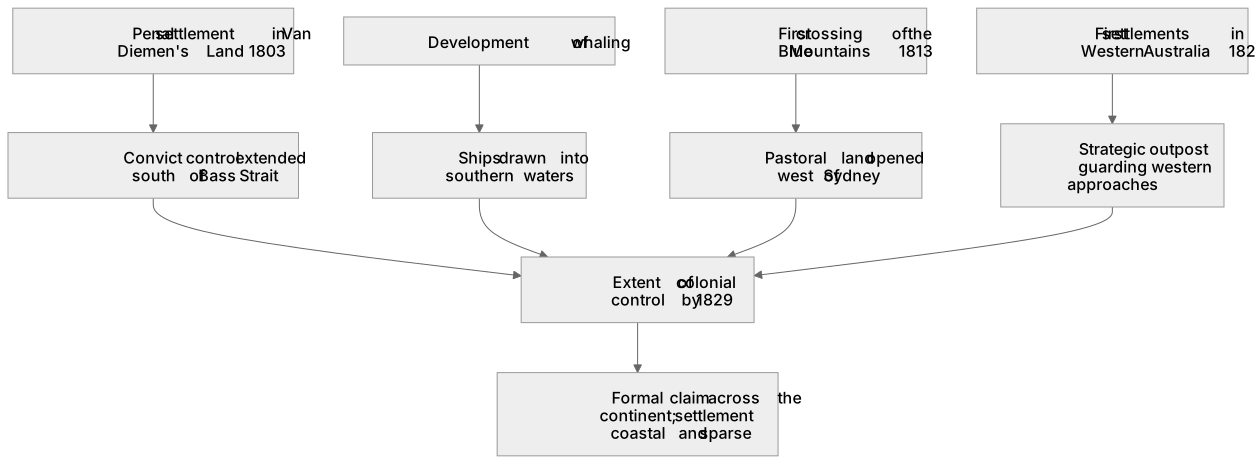
Put the events in order
Put these events in the order they happened, earliest first.
- 1. Britain claimed control across the continent
- 2. Penal settlement established in Van Diemen's Land
- 3. First settlements founded in Western Australia
- 4. First crossing of the Blue Mountains
Key words
Say what each word means before you turn the card.
Convict transportation and penal colonies
Try answering aloud or in your head before turning the card.
Maritime and whaling economies
Try answering aloud or in your head before turning the card.
Inland exploration and pastoral expansion
Try answering aloud or in your head before turning the card.
Strategic settlement and imperial control
Try answering aloud or in your head before turning the card.
See every definition
- Convict transportation and penal colonies
- A penal settlement was established in Van Diemen's Land in 1803, extending convict control south of Bass Strait.
- Maritime and whaling economies
- Whaling and sealing grew around the Derwent and Sydney, supplying oil and skins and drawing ships into southern waters.
- Inland exploration and pastoral expansion
- In 1813 Blaxland, Lawson and Wentworth crossed the Blue Mountains, opening pastoral land west of Sydney.
- Strategic settlement and imperial control
- A settlement was founded at King George Sound in Western Australia in 1826, guarding the western approaches.
Label the diagram
Some boxes have lost their names. Pick the right name for each number.
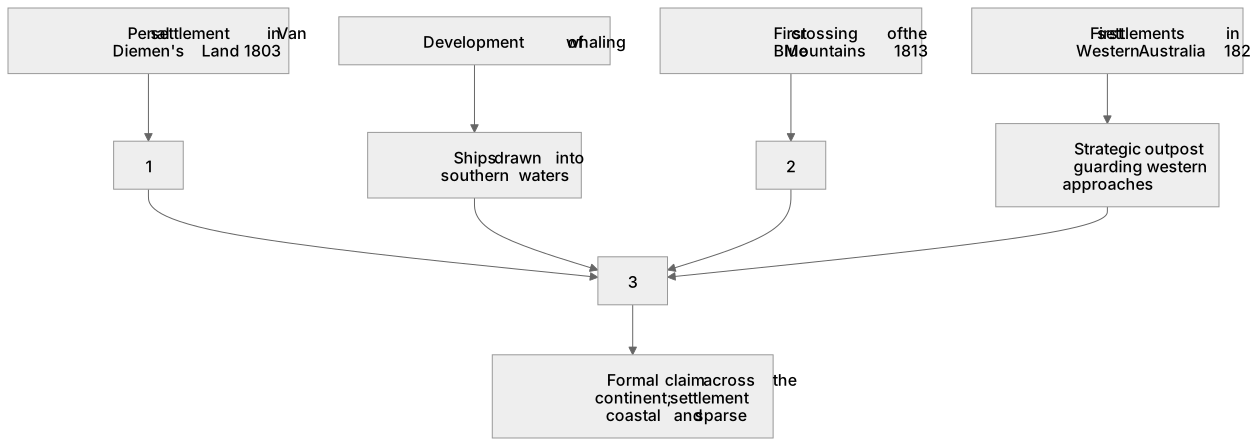
1Box 1
2Box 2
3Box 3
There is more to this lesson
The full lesson goes on to check your understanding and help you earn the marks. Create a free account to carry on, with your progress saved.
A week of Premium from your first lesson · Then the free plan continues · No card, no charge
Test your understanding of Paper 3, Option 35.1: Britain: losing and gaining an empire, 1763–1914 - 2 The birth of British Australia, 1788–1829: The spreading impact: penal settlement in Van Diemen's land 1803; development of whaling; first crossing of the Blue Mountains 1813; first settlements in Western Australia 1826; extent of colonial control by 1829.
Active recall beats re-reading. Take an instant quiz now to test what you’ve learned and lock it into long-term memory.
A week of Premium from your first lesson · Then the free plan continues · No card, no charge