Pearson Edexcel · A-Level · History
Course version: 9HI0 · Version from Sept 2015
Britain: losing and gaining an empire, 1763–1914 - 2 The changing nature…
Full specification wording
Paper 3, Option 35.1: Britain: losing and gaining an empire, 1763–1914 - 2 The changing nature of the Royal Navy: The importance of the acquisition and retention of key strategic bases around the globe, 1763-1914 (key developments: Gibraltar retained 1783, and the acquisition of Malta, Ceylon and Cape Town in 1815, the Falklands in 1833, Aden in 1839 and Cyprus in 1878).
From 1763 to 1914 Britain acquired and retained a global network of strategic bases that underpinned Royal Navy power and imperial trade.
Checked against the Pearson Edexcel 9HI0 specification (opens in a new tab) on .
- Point 2 of 2
- 4 key terms
Study notes
From the checked teaching notes for this specification point.
The idea
From 1763 to 1914 Britain acquired and retained a global network of strategic bases that underpinned Royal Navy power and imperial trade. Gibraltar, retained in 1783 after the Great Siege, guarded the entrance to the Mediterranean. In 1815 Britain acquired Malta, Ceylon and Cape Town, securing routes to India and the East. The Falklands, acquired in 1833, provided a South Atlantic station. Aden, taken in 1839, controlled the approach to the Red Sea and Suez. Cyprus, acquired in 1878, offered a base in the Eastern Mediterranean. These bases enabled coaling, repairs, victualling and communication, projecting naval power and protecting commerce. Their retention often involved diplomatic and military effort, and their importance grew with steam navigation and the need for coaling stations.
What earns the marks
- Identifies and locates the key bases: Gibraltar (retained 1783), Malta, Ceylon and Cape Town (1815), the Falklands (1833), Aden (1839) and Cyprus (1878).
- Explains the strategic function of each base, such as controlling sea lanes, protecting trade routes, or providing coaling and repair facilities.
- Assesses the importance of retention as well as acquisition, for example Gibraltar's retention in 1783 after siege, and the diplomatic efforts to keep bases.
- Links the bases to the changing nature of the Royal Navy, including the shift to steam and the need for global coaling stations.
- Evaluates how the network of bases supported British imperial power and commerce across the period.
Common mistakes and how to put them right
Listing bases without explaining their strategic purpose.
Put it right: Analyse how each base supported naval operations or trade.
Assuming all bases were acquired by conquest.
Put it right by noting that some were acquired through diplomacy, purchase or cession, such as Cyprus in 1878.
Ignoring the date of retention for Gibraltar.
Put it right: Emphasise 1783 as a key moment that secured Mediterranean access.
Treating bases as isolated.
Put it right: Show how they formed an interconnected global network.
Exam tips
- Use precise dates and locations for each base to demonstrate accurate knowledge.
- When discussing importance, refer to specific functions such as coaling, repairs, or controlling chokepoints like Gibraltar or Aden.
- Connect the bases to broader themes of naval change, commerce protection and imperial defence.
- Avoid simple listing; group bases by region or function to structure arguments.
Try the lesson
The start of the Paper 3, Option 35.1: Britain: losing and gaining an empire, 1763–1914 - 2 The changing nature of the Royal Navy: The importance of the acquisition and retention of key strategic bases around the globe, 1763-1914 (key developments: Gibraltar retained 1783, and the acquisition of Malta, Ceylon and Cape Town in 1815, the Falklands in 1833, Aden in 1839 and Cyprus in 1878). lesson, made from checked teaching notes for this specification point.
Have a go first
Which strategic base did Britain retain in 1783 at the end of the war with America and its allies?
Listen
From 1763 to 1914 Britain acquired and retained a global network of strategic bases that underpinned Royal Navy power and imperial trade. Gibraltar, retained in 1783 after the Great Siege, guarded the entrance to the Mediterranean. In 1815 Britain acquired Malta, Ceylon and Cape Town, securing routes to India and the East. The Falklands, acquired in 1833, provided a South Atlantic station. Aden, taken in 1839, controlled the approach to the Red Sea and Suez. Cyprus, acquired in 1878, offered a base in the Eastern Mediterranean. These bases enabled coaling, repairs, victualling and communication, projecting naval power and protecting commerce. Their retention often involved diplomatic and military effort, and their importance grew with steam navigation and the need for coaling stations. A strong answer earns marks for these points. Identifies and locates the key bases: Gibraltar (retained 1783), Malta, Ceylon and Cape Town (1815), the Falklands (1833), Aden (1839) and Cyprus (1878). Explains the strategic function of each base, such as controlling sea lanes, protecting trade routes, or providing coaling and repair facilities. Assesses the importance of retention as well as acquisition, for example Gibraltar's retention in 1783 after siege, and the diplomatic efforts to keep bases. Links the bases to the changing nature of the Royal Navy, including the shift to steam and the need for global coaling stations. A common slip: Listing bases without explaining their strategic purpose. Instead, analyse how each base supported naval operations or trade. Exam tip: Use precise dates and locations for each base to demonstrate accurate knowledge.
See it
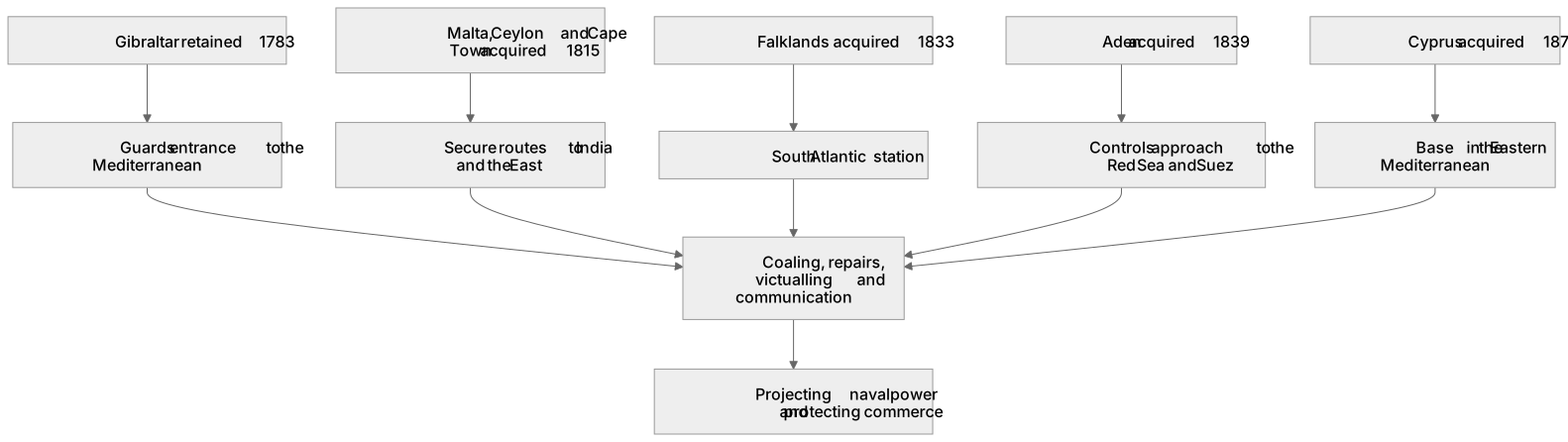
Put the events in order
Put these events in the order they happened, earliest first.
- 1. Britain acquired Malta, Ceylon and Cape Town
- 2. Gibraltar retained after the Great Siege
- 3. Cyprus acquired, offering a base in the Eastern Mediterranean
- 4. The Falklands acquired, providing a South Atlantic station
- 5. Aden taken, controlling the approach to the Red Sea
Key words
Say what each word means before you turn the card.
Global strategic network
Try answering aloud or in your head before turning the card.
Naval logistics and coaling stations
Try answering aloud or in your head before turning the card.
Trade route protection
Try answering aloud or in your head before turning the card.
Imperial defence and diplomacy
Try answering aloud or in your head before turning the card.
See every definition
- Global strategic network
- A worldwide system of bases that underpinned Royal Navy power and imperial trade and that grew in importance with steam navigation.
- Naval logistics and coaling stations
- Facilities at bases that enabled coaling, repairs, victualling and communication, projecting naval power and protecting commerce.
- Trade route protection
- The strategic function of controlling sea lanes and protecting trade routes, as performed by bases such as Gibraltar and Aden.
- Imperial defence and diplomacy
- The diplomatic and military effort often involved in retaining bases, whose importance grew with steam navigation.
Label the diagram
Some boxes have lost their names. Pick the right name for each number.
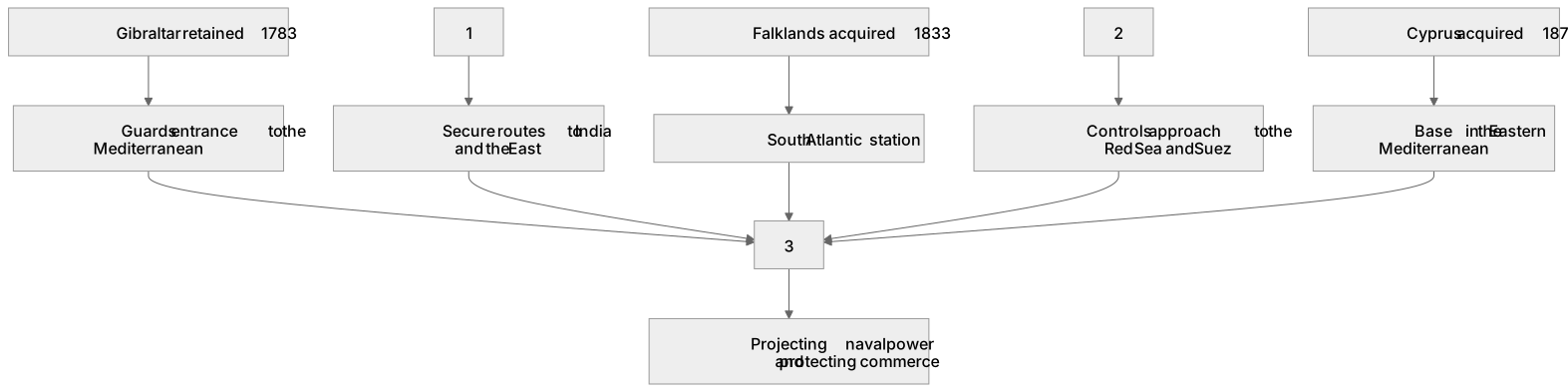
1Box 1
2Box 2
3Box 3
There is more to this lesson
The full lesson goes on to check your understanding and help you earn the marks. Create a free account to carry on, with your progress saved.
A week of Premium from your first lesson · Then the free plan continues · No card, no charge
Test your understanding of Paper 3, Option 35.1: Britain: losing and gaining an empire, 1763–1914 - 2 The changing nature of the Royal Navy: The importance of the acquisition and retention of key strategic bases around the globe, 1763-1914 (key developments: Gibraltar retained 1783, and the acquisition of Malta, Ceylon and Cape Town in 1815, the Falklands in 1833, Aden in 1839 and Cyprus in 1878).
Active recall beats re-reading. Take an instant quiz now to test what you’ve learned and lock it into long-term memory.
A week of Premium from your first lesson · Then the free plan continues · No card, no charge